
Scotland’s historical population censuses for 1841 through 1921 can be searched through ScotlandsPeople, but a free name transcript is not the same thing as the original census page. Scotland’s census evidence survives mainly as enumerators’ copied books: household schedules themselves were destroyed. For a no-cost starting point, some names are available through FreeCEN and ScotlandsPeople’s free 1881 LDS transcription. To establish the page context, relationships and uncertain readings, check whether you can obtain the image from ScotlandsPeople or an approved access location.
Choose the exact Scottish census year and event date
The official census nights were 6 June 1841, 30 March 1851, 7 April 1861, 2 April 1871, 3 April 1881, 5 April 1891, 31 March 1901, 2 April 1911 and 19 June 1921. An address in a directory printed during the same calendar year may not describe the household on census night. Start with the year nearest a verified marriage, birth or relocation and copy the census-night date into your timeline before comparing ages or residences.
The National Records of Scotland states that historical census records are closed for 100 years. The releases through 1921 are available as indexed images, not as a general release of every later census. Scottish 1911 and 1921 surviving enumerator books are not the same sort of original household schedules found for the corresponding England and Wales collections. State what sort of record you viewed and whose handwriting you are reading. If you want the full process, read how to search England census records for free without mistaking an index for an image.

Use free Scottish census transcripts without overstating coverage
The National Library of Scotland notes that some census data is freely searchable on FreeCEN, but not every place or year is represented. ScotlandsPeople provides an additional 1881 LDS index with a free transcript; its own guide distinguishes that transcription from its linked original-image census collection. Make a quick coverage check by county and year before judging a surname’s absence. Try a household associate as well as spelling variants before paying to inspect a page.
Record what the free result actually gives you: transcribed name, age, parish or district and any other people shown. Avoid importing every name in a same-household index as a child or spouse. An index may normalize a place name, omit marginal notes or misread an age. Where a detail matters, view the source image and cite it, especially if there are two candidates of the same name or the purported birthplace changes across censuses.
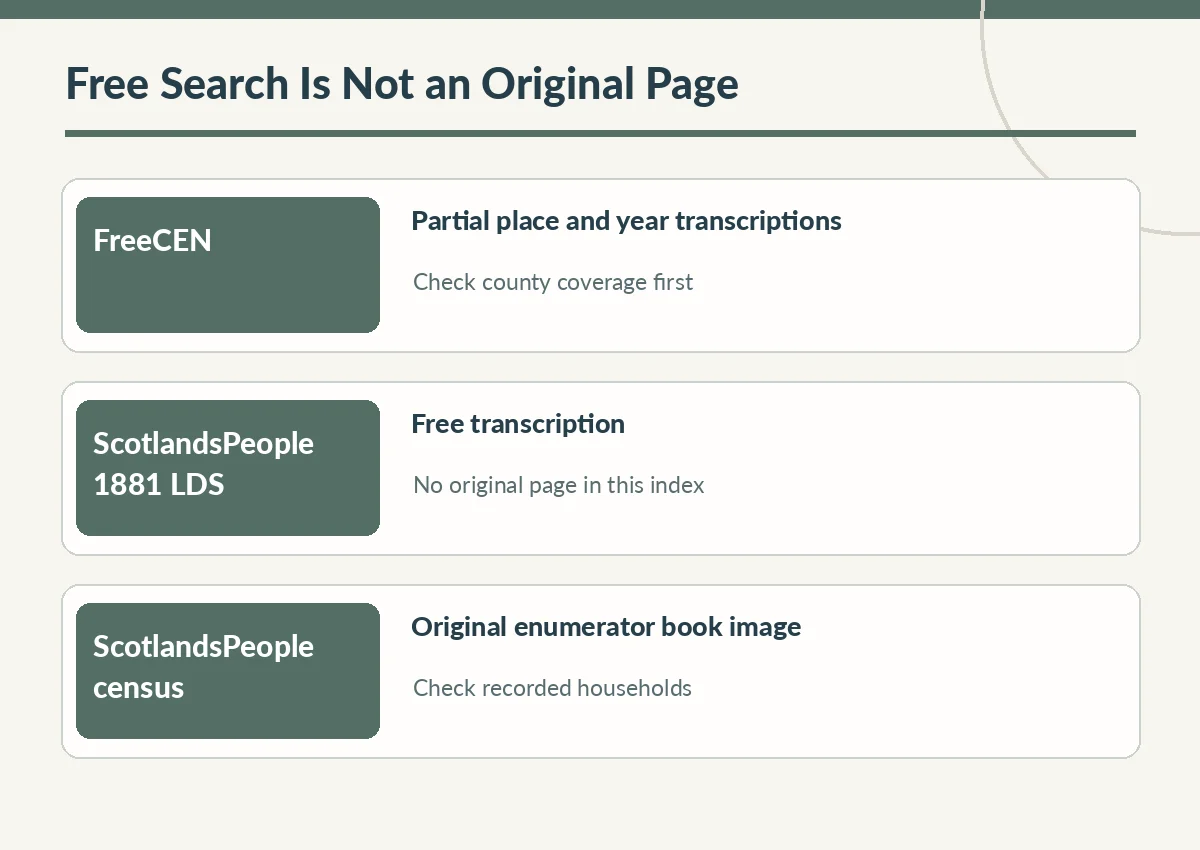
| Access route | What it typically supplies | Limit |
|---|---|---|
| FreeCEN | Some indexed/transcribed entries | Coverage varies by place and year |
| 1881 LDS index | Free transcription on ScotlandsPeople | Not the original image |
| ScotlandsPeople census | Index-linked original-page images | Viewing may require credits |
| NRS access locations | Research access to census books | Check current access terms |
Search household associates and neighboring streets
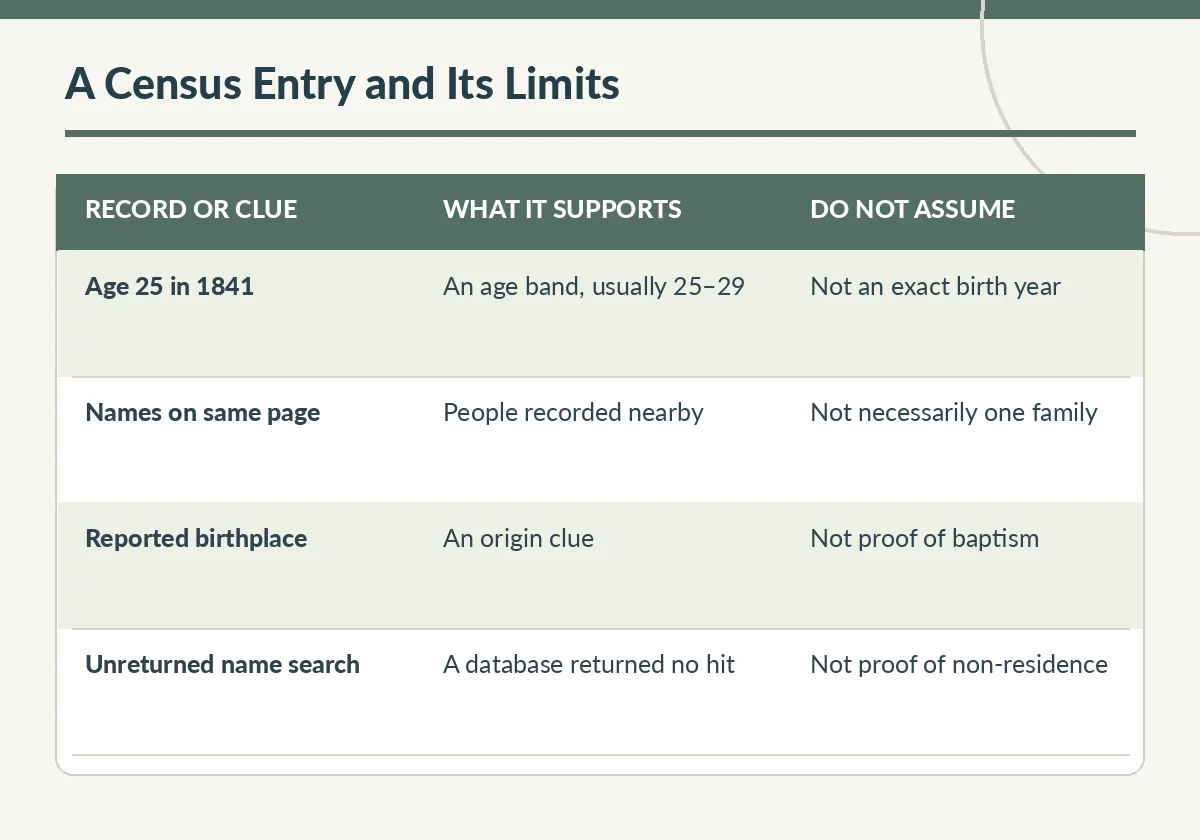
ScotlandsPeople allows searching with another person’s forename on the same census page, making a partial family reconstruction useful for locating a household. If the main person’s surname is very common, try a spouse or child’s given name, then examine the original page. Do not assume every entry on the same page is related: the page can contain separate households and institutions. Track the household boundary and the named relationship to the head rather than simply reading names in a vertical list. To go further, our guide “Edinburgh Census Records, 1841–1921” shows how to find a household by district and address.
For urban residents, historical census street indexes can help recover the correct registration district or enumeration book. For rural residents, parish and district names may shift between decades. Search the historical district used in that census year, then widen to neighboring districts when a query produces nothing. Copy the page number, district and book reference from the original image. A map is useful for understanding a move, but a mapped street does not establish residence without the individual census entry. Our guide “Orkney Census Records, 1841–1921” covers a related question.
Interpret 1841 ages and birthplace columns cautiously
For the 1841 census, enumerators generally rounded down ages of people over 15 to the nearest five years, although some exact ages appear. That makes a recorded age of 25 compatible with a band rather than a precise birth year. Later years normally recorded exact ages, but each age is still a reported value. Do not use an 1841 age to force an exact date of birth in an online tree.
The later Scottish censuses can support a birthplace hypothesis more precisely. Compare successive years, noting whether the original page actually names a parish, district or only a county. A birthplace is reported by a household informant, not a certificate of baptism. Verify it with a statutory civil record after 1855 or an old parish register where appropriate. Mismatches can indicate an enumerator’s abbreviation, a move or a different person.
Explain missing 1841 records and later collection limits
ScotlandsPeople identifies some 1841 enumeration books as missing, including losses for several parishes in Fife. Before treating an unreturned search as a historical absence, inspect the archive’s missing-parish information and check that the district was counted under its correct name. Also remember that early censuses from 1801 to 1831 preserve little person-level information, so a claimed comprehensive name-search for those years is misleading. Our walkthrough on how to find Scottish ancestry records from civil registers to parish books sets out each step.
If a relevant census book or entry cannot be found, turn to ScotlandsPeople valuation rolls, statutory registers, church records, directories or local tax material to build a dated residence picture. Valuation rolls can document a proprietor, tenant or occupier but should not be treated as a full family census. Record the substitute’s narrower evidentiary role and do not invent a missing enumeration page to bridge two known years. Our guide “Aberdeen Census Records, 1841–1921” goes into more detail.
Separate similar households by the strongest clues
Suppose two James Robertsons of compatible age appear in the same county. One census lists a wife with a different given name than an independently verified marriage; the other names a spouse and residence consistent with a child’s birth registration. Write down the full entries for both before choosing. Compare occupation, children’s reported ages, street or parish, and names of unrelated residents when relevant. A shared surname alone is weak evidence in a common-name locality. For the fuller picture, see our guide “Isle of Mull Census Records”.
Flag a candidate as provisional until a second source ties the person to the same place or relationship. If the apparent husband is absent on census night, check whether the page reports work at sea, institutional residence or travel before inventing a death or separation. The result should be a verifiable reason to accept or reject each candidate, not just a copied tree branch.
More Records and Archives Guides
How We Research Scottish Census Access
This guide compares ScotlandsPeople’s up-to-date documentation with the National Records of Scotland and National Library of Scotland access explanations. It distinguishes a free 1881 LDS transcription, partial FreeCEN coverage and an original indexed census image, and notes that only the surviving enumerators’ books can be checked. Our fictional namesake example is a method demonstration, not a real indexed family or verified conclusion.
Before treating a transcript as proof, save its stated place and source then inspect the book page where access allows. We do not recommend a paid genealogy product or assert an affiliate arrangement. The site’s affiliate disclosure describes general policy; check current credits or access terms with the provider.
No. Some transcripts are free, but the National Library of Scotland describes 1841–1921 original images on ScotlandsPeople as fee-based access.
It is a separate free transcription of the 1881 census, not the indexed image of the original enumerator book.
Ages over 15 were generally rounded down to multiples of five, although some entries used exact ages.
No. The surviving Scottish census sources are enumerators’ copied books; the original household schedules were destroyed.
Check ScotlandsPeople’s published missing-1841 coverage and use other dated records; a missing book is not proof the family had left.