
The 1950 U.S. census is the latest federal population census currently open for public genealogy research. Released by the National Archives on April 1, 2022, it offers searchable population images, enumeration-district maps, and descriptions. The best way to use it is not to collect a name match but to connect a person to a particular household, page, and reporting date. This guide provides a 1950-specific field checklist, a sample-line decision test, and a recovery route for names missing from the automated index. It does not treat a census answer as an independently verified birth, marriage, or military record.
Locate the right household before interpreting any fields
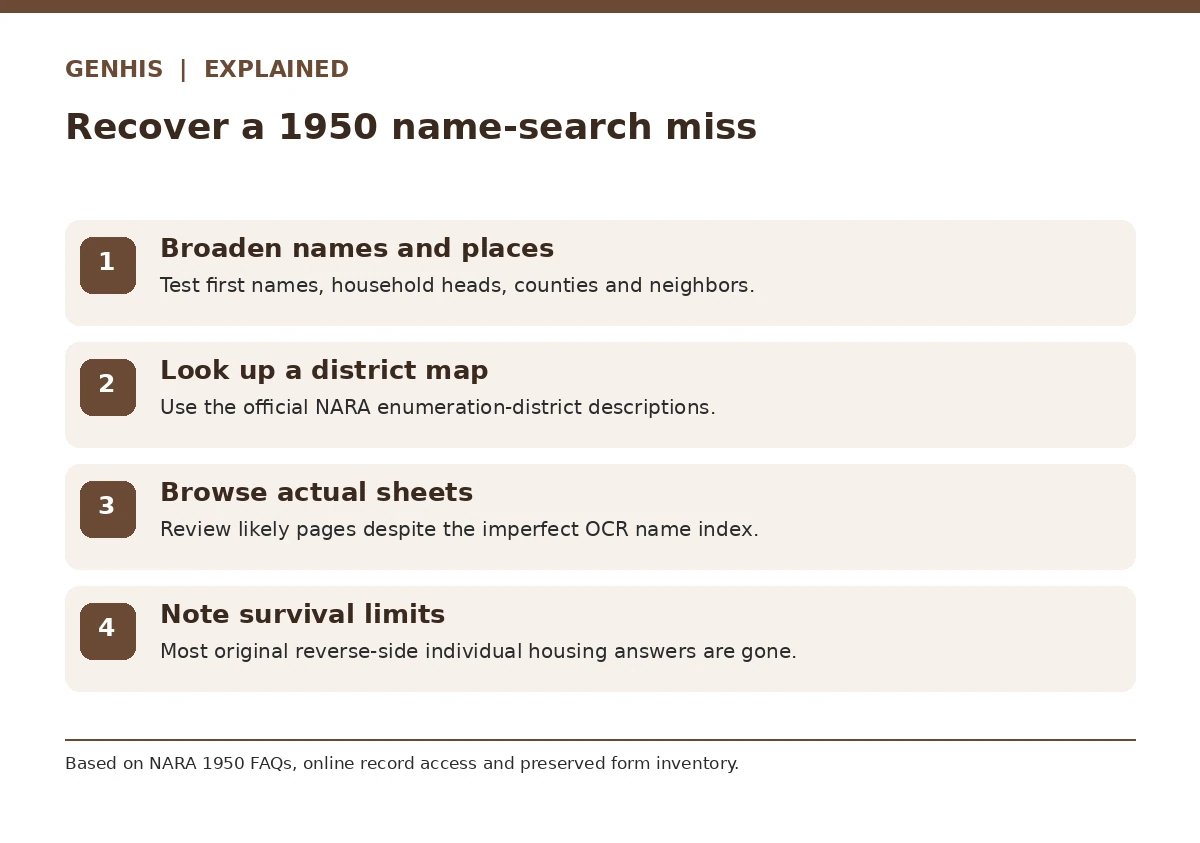
Begin with the official 1950 census website and search a full name together with a likely state or county. NARA warns that its initial name index was produced using handwriting recognition, so spelling may be unreliable. A blank search result is not proof that an individual was never enumerated. Try a surname plus locality, a distinctive first name, a head of household, or a known neighbor. For common surnames, geography usually contributes more evidence than adding extra exact-name restrictions.
When a candidate household appears, open the population schedule image. Record the state, county, enumeration district, sheet and line numbers, as well as the address if entered. Check nearby household members and the relationship column rather than trusting a search snippet. Compare ages and birthplaces to independent evidence: a person described as a son on this document is a reported household relationship, not by itself an established biological link. If you find two plausible families, keep both candidates in the research log until another source separates them. To go further, our guide “1950 Census Enumeration District Maps” shows how to find an address when name search fails.
Understand the ordinary 1950 census questions
On the standard Form P1, the main questions include name, relationship to head, age at last birthday, marital status, place of birth and naturalization status for foreign-born people. For people at least fourteen, the schedule also asks about activity during the previous week and describes occupation, industry and class of worker under defined conditions. These are a snapshot under the census rules, not a full professional or immigration history. In particular, a citizenship response should point toward naturalization or citizenship documentation rather than replace it.
The official census date was April 1, 1950. A person aged twenty on the official date was not necessarily born in calendar year 1930; the possible range spans parts of two years depending on birthday. Do not invent an exact date by subtracting the reported age from 1950. Similarly, an occupation listed for a qualifying respondent is not evidence that the person held the same job throughout the year. Put the census date beside each derived conclusion and label calculations as estimates. Where a later certificate disagrees, preserve the conflict instead of silently changing the census transcription.

Apply the sample-line gate before using extra answers
The 1950 schedule asked twenty questions of all people on the standard form, while six selected sample lines per sheet received additional questions. NARA’s question guide identifies a further group of items for the person on the last sample line, when eligible. Therefore, if a parent’s birthplace, education, prior residence, 1949 earnings or veteran response is absent for a household member, first inspect whether that person’s line was actually selected. Many blanks mean not asked, not missing evidence or refusal.
The 1950 sample includes a one-year residence comparison, unlike the five-year residence reference on the 1940 census. That distinction matters for migration timelines: do not carry the 1940 questionnaire’s 1935-location field into a 1950 interpretation. The sample’s 1949 earnings questions also differ from the questions about activity in the prior week. Connect each supplemental answer to its precise line number. NARA notes that several form versions varied sample positions, so visual inspection beats assumptions about which line must contain an answer.

Recover an unindexed person with enumeration districts
If name variants and relative searches fail, identify where the household probably lived in 1950. City directories, correspondence, dated address books and other available records can narrow a neighborhood. Use NARA’s enumeration-district maps and district descriptions, then browse the relevant population schedules page by page. Addresses may be renumbered, a person may have moved, or an institution may use an unusual schedule. These are hypotheses to test, not excuses to assert the person is definitely somewhere on the images. For a step-by-step method, see how to search U.S. census records by name and confirm a match.
Be alert to forms beyond ordinary P1 schedules. NARA documents special schedules for territories and selected populations, and different household forms used in some test locations. A person staying in a hotel or serving in certain military living arrangements may not appear in the expected home listing. Do not promise that every kind of original form is preserved: the reverse-side housing questionnaires from most 1950 population forms were not microfilmed and are no longer extant. The ordinary population image cannot reconstruct those missing individual housing answers.
Create a reproducible 1950 census evidence note
A compact worksheet should record: searched spelling, locality restrictions, exact result URL or provider, image identifier, state, county, district, sheet, line, household context, verbatim response, and any conflicting claim. Separate three columns headed “What the record says,” “Possible inference,” and “What would verify it.” For example, a reported foreign birthplace is evidence that an informant gave that answer; an immigration passenger record or another firsthand document may support an actual migration. It is not safe to infer nationality, ethnicity, or DNA ancestry from one census column. Our guide “1940 U.S. Census Records” goes into more detail.
A practical test case is an entirely invented family whose 1940 census reports residence in one city and whose 1950 enumeration appears in another. A move occurred at some point only if both households are independently identified as the same people; neither census alone proves when, how, or why they relocated. Record the dates as bounds and use directories or other records where available to narrow the interval. Protect the privacy of anyone who may still be living: public release is not permission to republish a sensitive personal profile. Our guide “1930 U.S. Census Records” adds more detail on this.
How We Research: what official forms can and cannot prove
We checked the National Archives’ 1950 overview, official questions, public FAQs and preserved-form inventory. These explain the release date, indexing limitations, standard and sampled questions, and the loss of the housing reverse sides. We did not fabricate example ancestors, individual records, collection coverage or name-index completeness. Provider search interfaces may change; consult the official landing pages for current access. This is educational genealogy guidance, not a guarantee that a particular relative appears or that a record proves kinship. See our affiliate disclosure; no affiliate partnership or paid record service is recommended here.
More Records and Archives Guides
Official sources and record coverage notes
National Archives — 1950 Census Records — Official release and free population-image access, district maps and indexed-search route.
National Archives — 1950 Census FAQs — OCR name-index limitations, name variants, place browsing and special forms.
Also, National Archives — 1950 Questions Asked — Standard population questions, sample-line questions and their applicable dates.
National Archives — 1950 Census Forms — Population Form P1, alternative forms and non-survival of most housing reverse sides.
Yes. NARA provides free access to the 1950 population images and an official name and location search.
No. Handwriting recognition is imperfect; search relatives or neighbors and browse enumeration districts.
No. Additional questions belonged to sampled lines, with eligibility conditions for some items.
No. The 1950 supplemental questions address residence one year earlier; the 1935 question belongs to 1940.
Generally not. NARA explains that the housing reverse sides were not preserved with most microfilmed population forms.