
The 1940 United States census asks questions that make it unusually effective for tracing people through the Depression years. Alongside household details, it records where eligible residents lived in 1935, school attainment, work and 1939 wage or salary information. It also identifies an informant for the household. Only selected people answered the supplementary questions. This guide distinguishes those different parts of the schedule and shows how to search them without treating an economic figure or migration code as a complete life story.
Use April 1, 1940 as the reference date
The census reference date was April 1, 1940. The enumerator might have completed the household after that day, and some employment questions refer to the week of March 24–30, 1940 rather than the census day itself. Another question concerns wages or salary during the twelve months of 1939. Record those dates beside the particular fields. Interpreting them all as events on April 1 can produce an entirely false timeline for someone who changed jobs or moved during the spring.
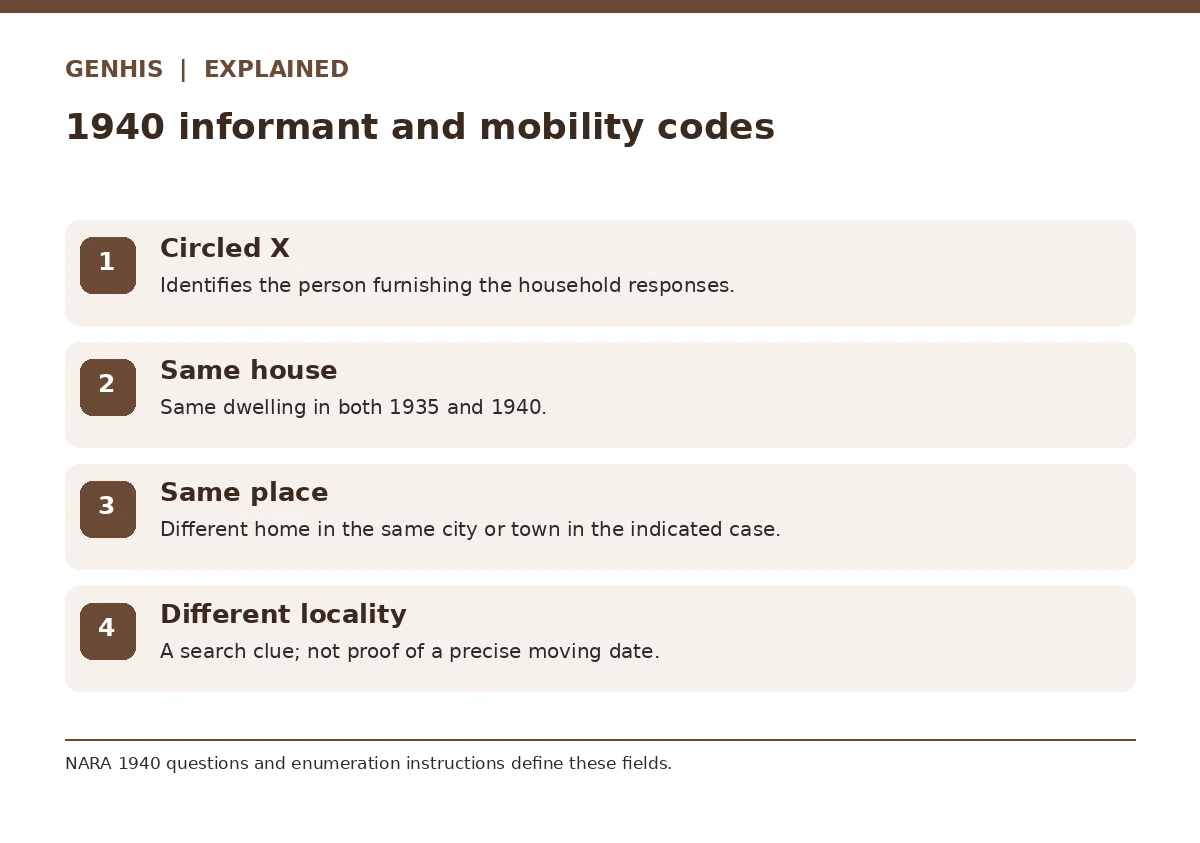
First establish who was living in the household according to the document: names, ages, relationships to the head, historical address, county, town and enumeration district. Look at the actual image, including column headings and adjacent entries. The 1940 questionnaire instructs enumerators to mark the person providing household information with a circled X. That helps assess the likely source of answers but does not establish that the informant personally knew every reported fact. A household description is still evidence to compare with other records. To go further, our guide “1950 Census Enumeration District Maps” shows how to find an address when name search fails.
Read the 1935 residence columns as a five-year clue
For people to whom the question applied, 1940 recorded residence on April 1, 1935. The code “Same house” refers to the same dwelling, while “Same place” means a different house in the same city or town under NARA’s described instructions. These should never be conflated. The form can also show a different locality or state, while small communities are sometimes coded differently from larger cities. Read the associated instructions and columns before plotting a move on a map.
Imagine two entirely fictional records: a family listed in a 1930 Ohio town and a household shown in the 1940 schedule in Pennsylvania, with its 1935 location also reported in Pennsylvania. This does not prove a single move directly from Ohio to Pennsylvania, the reason for the move or residence for every intervening year. It creates a dated question to test with directories, voter rolls, employment files, school records or other sources where those series existed. Keep a distinction between a census statement of residence and a documented moving date.

Decode work, wages and public emergency employment
The 1940 questionnaire asks whether someone worked in the reference week, what work they did, and whether they participated in public emergency work such as WPA, CCC or NYA assignments. It also records weeks worked during 1939 and wages or salary from that year for eligible respondents. A wage figure does not necessarily capture every type of income, and the presence or absence of an emergency-work response does not provide a full work history. The questions refer to specific definitions and periods, not a modern job profile.
NARA explains that questions on this census reflected the experience of the Depression. But the document itself cannot prove why a named person lost work, moved or chose an occupation. Compare employment details to city directories, surviving personnel collections or other contextual records only where available and appropriate. Avoid attaching a supposed WPA project or CCC camp to someone based solely on a tick in a program category. A useful research note asks which agency records were created for that place and whether they survive.
Check school attainment and the circle-X informant
A newly prominent 1940 field asks for the highest grade of school completed. Do not translate a grade entry into a modern credential without researching its meaning in historical context. Other educational information may concern recent school attendance, not an individual’s entire schooling. The same caution applies to birthplace and citizenship answers: they may derive from a household informant who did not directly know another person’s birth or immigration history. Preserve exactly what was entered, then assess it alongside certificates, earlier censuses and other independent records.
The circled-X information marker is especially valuable when a birthplace or age differs from the person’s entry in 1930. A parent answering for several people, for example, might have different firsthand knowledge from an adult answering for themselves, although the mark alone cannot establish which information was reliable. If the informant was someone outside the household, consult the source’s notation and identify what is reported rather than assuming a named household member spoke. Record the reliability question explicitly in your research log.
Identify the selective supplementary questions
The bottom of the 1940 population schedule includes supplementary questions assigned to two preset lines per page, commonly lines 14 and 29, representing a sample of roughly five percent. NARA lists items including the parents’ birthplaces, language spoken at home in earliest childhood, certain veteran details and usual occupation. These answers are not available for every named resident, and the absence of supplemental information beside an ordinary line is not a refusal or lost family record.
Before mining a supplemental answer, match it back to the exact person’s numbered line above. A page can hold multiple members of the same household, and an uncareful reader might attribute a response to a neighboring relative. Supplemental “usual occupation” is also different from work in the particular census reference week. If a parent-birthplace answer is missing for your target, consult other censuses or independent records rather than inferring either parent’s birthplace from someone else’s supplemental row.
Retrieve 1940 schedules and cite the page accurately
NARA’s census-online directory identifies 1940 population schedules as T627 and describes free searching options, including a 1940 census website, the National Archives Catalog and FamilySearch with an account. Search with the person’s name, then broaden to residence, variants, relatives and enumeration district. Images and provider features may change, so recheck links. If a named search fails, use known addresses and historical enumeration-district maps, then browse all likely image pages rather than assuming the family was absent. Our guide “1950 U.S. Census Records” adds more detail on this.
For a reproducible citation, include the year, state and county, town or ward, enumeration district, sheet, line, person and the image provider or archival identifier. Keep a separate note for a 1935 residence claim and its exact column. The 1940 population schedule is not a universal substitute for housing or agriculture schedules: the Census Bureau reports those 1940 schedules were destroyed after tabulation rather than preserved alongside the population images. Never promise an accessible record set merely because a questionnaire once existed.

Protect potentially living people while evaluating findings
A person named on a 1940 census may still be living. Public archival accessibility does not remove ethical considerations around redistributing names linked to sensitive circumstances or creating dossiers about living relatives. Avoid publishing inferred details about wages, health, family situations or identifying data beyond what is necessary, and seek consent where appropriate. The 72-year public-release rule explains why the census is available, not why every modern use of a person’s information would be responsible.
The safest workflow is to write down a documented observation, propose a narrow question and use the next record only when it can test that question. A 1935 residence entry might justify checking the earlier location’s directories. An earnings figure might warrant exploring historical employment context without claiming an exact household income. A sampled mother-tongue response might suggest language-specific records but cannot establish ethnicity or DNA ancestry. Mark what is confirmed, what remains hypothetical and which repositories or jurisdictions still need to be checked.
More Records and Archives Guides
How We Research: the 1940 questionnaire and ethical boundaries
We used the National Archives’ 1940 general-information guide, its 1940 FAQ, its online census directory and the Census Bureau’s public-records explanation. The Ohio/Pennsylvania example is fictional, with no invented records presented as discoveries. We distinguish standard schedule fields from the selective supplemental sample and separate 1939 income, 1935 residence and the 1940 employment reference week. Provider access may change. For the site policy, see our affiliate disclosure; there are no affiliate recommendations here.
National Archives: 1940 Census Questions — NARA documents the 1940 respondent mark, April 1935 residence, work and earnings questions and supplemental sample.
National Archives: 1940 Census FAQ — NARA describes who received the supplemental questions and their relevance to occupation, language and parents.
Also, National Archives: Online Census Resources — NARA lists specific U.S. census-year image and index routes, record group and microfilm publications, and varying provider access.
Census Bureau: Public Census Records — The Census Bureau describes the 72-year release rule, NARA archival responsibility and 1940 schedule survival limits.
No. NARA distinguishes the same dwelling from a different dwelling in the same city or town.
The questionnaire separately asked about earnings in the preceding calendar year; do not treat them as an April 1940 wage.
Only people on selected schedule lines answered the sample questions, not all residents.
It marks the person providing household information according to the instructions, not a general quality guarantee.
No. The Census Bureau reports that those schedules were destroyed following tabulation and were not preserved like the population pages.