
The 1930 United States census can answer questions that the 1920 questionnaire could not: what amount of rent or home value was reported, whether a household had a radio and how old a person said they were at first marriage. Its veteran-service question may also suggest a more focused record search. These fields often attract confident but unsupported conclusions about wealth, marriage history or military service. This guide shows how to retrieve the 1930 schedule and draw only conclusions the original questions justify.
Establish the household on April 1, 1930
The official census date was April 1, 1930, not the date the investigator found the online record. NARA’s 1930 FAQ notes that household entries relate to that reference day; people born afterward were not to be included. A reported age at last birthday can guide a birth-record search but does not itself establish a precise birthday. Use the date and image as a historical snapshot. Identifying a familiar name without comparing its household, locality and neighbors can create a false match that spreads through copied family trees.
Record the state, county, city or township, address, enumeration district, sheet and line. Check the labels for owner, renter, house or farm and for spouse, child, relative, lodger or other household relationships. There may be more than one family at a dwelling, and a street address can house different people between censuses. Preserve the page heading and an image locator so that a second researcher can reconstruct why you linked this schedule to a specific person.
Separate home value, monthly rent and radio ownership
The 1930 questionnaire asks whether the home was owned or rented and then requests home value if owned or monthly rent if rented. It also asks whether the household had a radio set. These are historically revealing observations but are not appraisals, deeds, bank balances or proof that every listed occupant owned a radio. The values should be transcribed in the units and columns actually given. Do not compare rent to a neighboring owner’s reported home value as if the two figures measure the same thing.
For an illustrative, invented example, suppose one household reports being a renter and has a numerical monthly rent entry while a nearby owner lists a home value. Both observations may help identify the residence through directories or property records. But they cannot prove why the households chose those homes or how much money each family had. A radio question reveals reported access to the device at the household level; it does not reveal listening habits or imply a particular political view.

Test the first-marriage-age clue before assigning a spouse
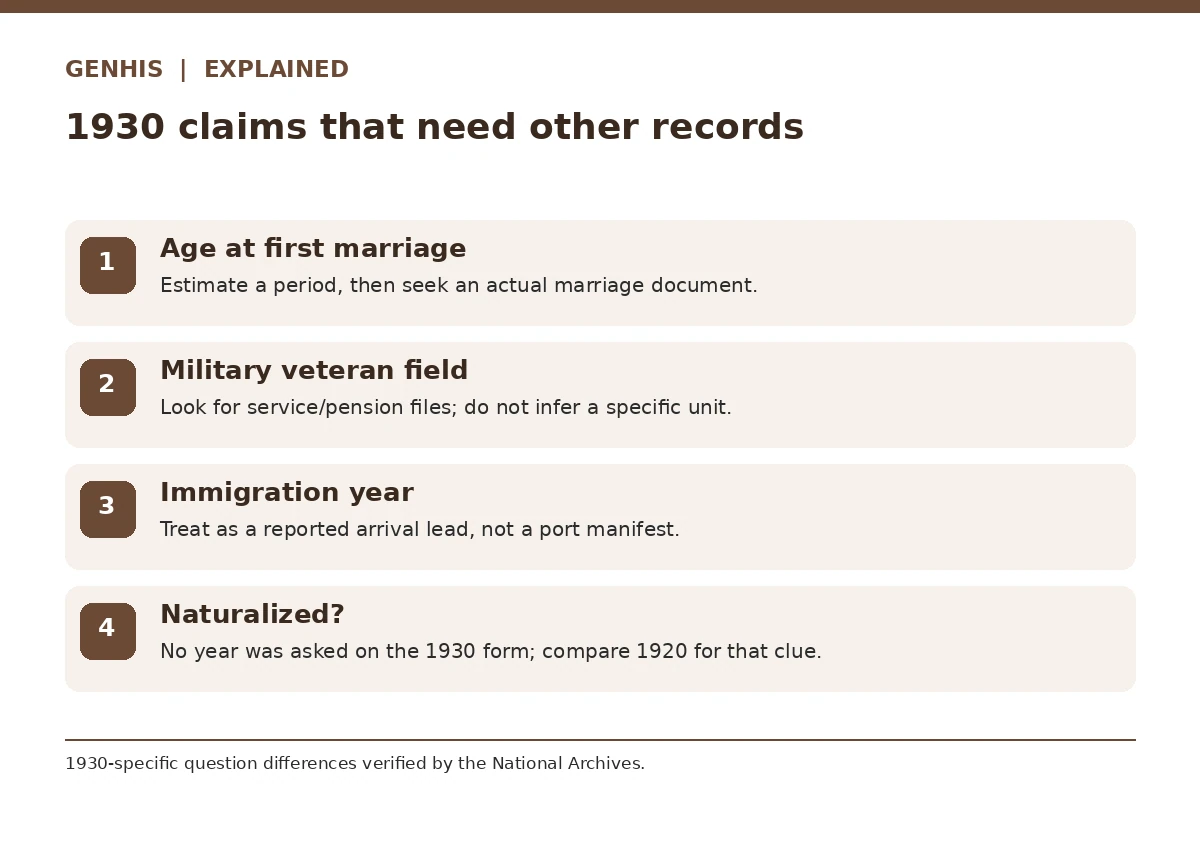
Age at first marriage appears as a dedicated 1930 field. If someone reports age 20 at first marriage and current age 50, simple subtraction yields an approximate calendar period only. Two approximate numbers do not produce an exact wedding date. The first marriage may not be the current one. Compare a dated civil or religious marriage record, earlier censuses and names of children before naming a supposed first spouse. Preserve conflicting entries and do not conflate two people of the same name with different marriage histories. Our guide “1910 U.S. Census Records” adds more detail on this.
NARA contrasts the 1930 fields with earlier schedules: the 1900 and 1910 censuses collected some marriage-duration information, while 1920 did not use the same questions. That means a 1930 first-marriage-age entry should be used to formulate a new search, not to overwrite a 1910 reported present-marriage length. Include age, approximate period, current household details and known locality in a research note, clearly flagging the marriage year as an estimate.
Interpret veterans and naturalization answers precisely
The 1930 census asks if the person was a veteran of U.S. military or naval forces and identifies the particular war or expedition. This can prioritize service or pension record research; it does not replace a service file. Check the exact form and relevant abbreviations before treating a handwritten response as verified military participation. No entry should be converted into a specific unit, battlefield or service date without corroborating documentation. People may report their own circumstances imperfectly or through another informant.
For foreign-born residents, 1930 reports immigration year and whether naturalized, but—unlike the 1920 questionnaire—it does not ask for the year of naturalization. If an unsourced family tree supplies a precise 1930 naturalization year, check whether it actually came from a different document. The distinction matters when narrowing court indexes. A reported status is still a clue. The proper next step depends on the person’s residence, time period and which courts created and preserved the relevant files. Our guide “1920 U.S. Census Records” adds more detail on this.
Find the T626 population page and address gaps
NARA lists the 1930 census as microfilm publication T626, with 2,667 rolls, and identifies FamilySearch as an online access route after free account creation. Its catalog notes that parts of the census can also be reached through NARA’s catalog, while some full online sets are hosted by partners. Search a name first; then try variant spellings, ages, household members and locality. If the index is ambiguous, compare images with family members and the neighbors before claiming a match. Our guide “1950 U.S. Census Records” goes into more detail.
When name searches fail, the enumeration district is a powerful organizing tool. NARA offers maps, district descriptions and street-oriented finding aids for researching a known locality, but district boundaries do not necessarily remain constant from decade to decade. A failed Soundex search needs care: NARA lists historical 1930 Soundex coverage for certain states and portions of Kentucky and West Virginia, not a uniform national card index. Do not confuse limits of an old index with an absence in the underlying schedules.
Do not chase 1930 schedules that are not available
The population schedule may refer to farm or unemployment schedules. But NARA’s 1930 FAQ states those supporting series were not located in the ordinary surviving holdings described there, with specific exceptions for some farm schedules outside the states. A notation on the population page does not guarantee a surviving companion record. Research alternatives—land documents, directories, employment records, local histories—only after checking whether the record type was created and preserved for that place. No negative result proves that a person was unemployed for a decade. For the fuller picture, see our guide “1940 U.S. Census Records”.
Create a short evidence table separating column, what was written, and what can actually be inferred. An age-at-first-marriage value suggests a date range; it does not name a marriage partner. Home rent suggests a reported expenditure; it does not prove ownership or financial condition. Veteran notation suggests a possible service trail; it does not confirm a military unit. This matrix makes the page useful even when relatives share names or identities remain unresolved.

More Records and Archives Guides
How We Research: 1930 questionnaire and record availability
We consulted the National Archives’ 1930 census FAQ and main census page, together with its census-online directory and the official cross-census question comparison. The renter-and-owner scenario is fictional, and all evidentiary inferences are explicitly conditional. Actual record coverage and provider access need checking for the desired state and county. We make no claim that lost schedules or missing pension files are retrievable. See our affiliate disclosure; no commercial partnership is stated or implied.
National Archives: 1930 Census FAQ — NARA lists home value/rent, radio, age at first marriage, veteran service, naturalization question limits and lost schedules.
National Archives: 1930 Census Overview — NARA identifies the 1930 population census and documented routes to images and enumeration-district finding aids.
Also, National Archives: Online Census Resources — NARA lists specific U.S. census-year image and index routes, record group and microfilm publications, and varying provider access.
National Archives: Clues in Census Records — NARA explains age reference dates, limits of reported statements and census clues for family researchers.
Census Bureau: 1930 Questionnaire — Census Bureau documents the 1930 original population questionnaire and historical form instructions, including classification limits.
No. It is a value reported for census purposes, not a verified appraisal or deed price.
No. It suggests a time range and must be connected to an independent marriage record.
No. Use it as a lead for service records and verify any claimed war or expedition.
The 1930 form asks whether a person was naturalized, unlike the 1920 form that also asked the year.
NARA says the ordinary supplementary schedules generally are not available in the holdings described; check any named exceptions and alternatives.