
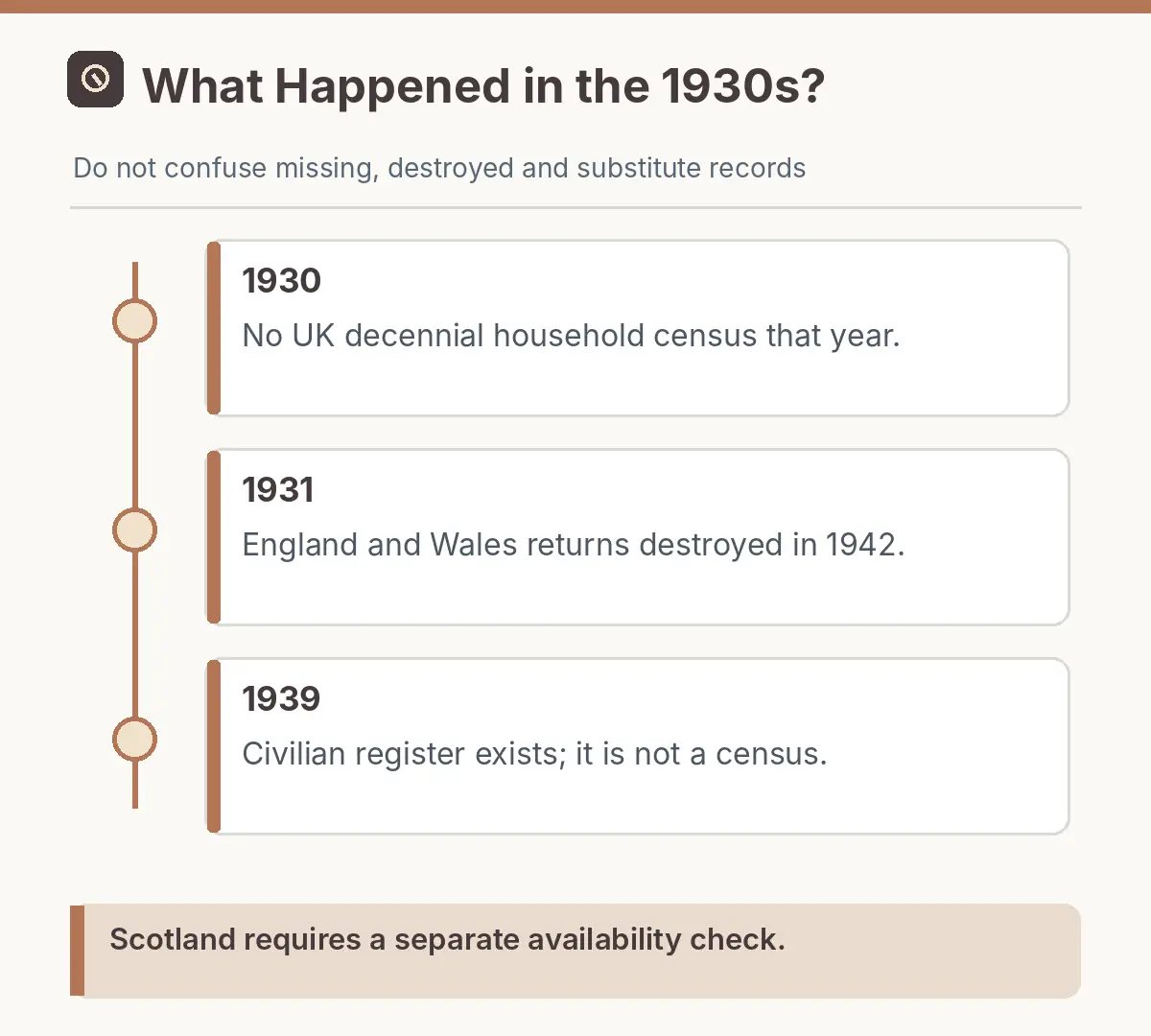
There is no 1930 United Kingdom census to search as a decennial household enumeration. The relevant scheduled census was 1931. Individual 1931 census returns for England and Wales were destroyed in a fire in December 1942, and no census was taken in the wartime year 1941. The 1939 Register is therefore an important alternative for English and Welsh civilian residents. But it is not a census and has different coverage and privacy limits. Scotland had separate census administration and should never be described as if the English and Welsh 1931 loss automatically applied throughout the UK.
Replace the false 1930 date with the correct schedule
Official censuses were generally conducted in years ending in one, not years ending in zero. Searching for an alleged ‘1930 UK census’ on a genealogy site may return neighboring years, imported US results, or other unrelated material. The National Archives census guide explains the relevant British census record series and the absence of a 1931 England-and-Wales household collection. First decide whether the target person lived in England, Wales, Scotland or Northern Ireland in the 1930s, then choose the correct jurisdiction’s official source and access rules. A family letter from ‘around 1930’ should be turned into a documented date range, not a claim that a census exists in that exact year.
Understand exactly what the 1942 fire destroyed
The Office for National Statistics describes the fire of 19 December 1942 that destroyed the individual census returns from 1931 for England and Wales. The published statistical tables survived because they were kept elsewhere. That distinction matters: a county-level 1931 population table can support a historical demographic statement, but it cannot identify a named household at a street address. Do not order an individual 1931 England-and-Wales return on the assumption that a newspaper has merely reported a missing database index. It is a physical record survival problem, not a paywall or an OCR defect. Keep the fire date in the research log as context, not as an event in the family’s own history.
Use the 1939 Register for a different kind of snapshot
The National Archives research guide places the register on 29 September 1939, after the outbreak of the Second World War. It helped administer civilian identity cards and later rationing; it was not the standard population census. Search for a documented English or Welsh civilian by surname, given name, residence and birth-date clues. A blank name result can reflect a changed surname, an entry that is legally closed, an indexing problem, military service, or a residence outside the register’s scope. Many people may still be alive, so comply with the provider’s privacy rules and do not attempt to infer concealed details from adjacent entries.
Keep the 1921 and 1951 endpoints distinct
For England and Wales, the public-access 1921 census is an earlier household snapshot, while the 1951 census is a separate later enumeration subject to the applicable 100-year closure. Never describe a combination of 1921 and 1939 entries as proof of continuous residence throughout the intervening years. A couple appearing at the same address on two dates could have moved away and returned, and an absent child could have lived elsewhere. To examine a shorter time interval, use electoral rolls where eligibility and survival permit, local directories, dated marriage registrations, or municipal rate books. Each source records a different population and must be labeled by its actual date and purpose.

Do not apply England-and-Wales losses blindly to Scotland
The National Records of Scotland maintains separate Scottish census holdings and a 100-year closure rule for individual returns. The archive identifies open historic records through 1921 and acknowledges later Scottish enumeration in its series. That is a different situation from the documented destruction of 1931 England-and-Wales individual returns. Before giving a ‘not available’ conclusion, record the country of the ancestor’s residence in the target year. Northern Ireland also requires jurisdiction-specific research; an England-and-Wales register cannot be assumed to cover Belfast. Geographic precision prevents a true loss statement for one archive from becoming an incorrect UK-wide claim.
Build a 1930s evidence timeline without filling the gap
Create a five-column worksheet: dated source, exact residence, named people, what the source actually states, and what remains unknown. A 1932 electoral register may identify an eligible voter, not every household resident; a 1936 directory may identify a business or listed householder, not biological relationships; a 1939 Register entry is a late-decade civilian snapshot, not a substitute for a 1931 return. An address from a newspaper advertisement may belong to a workplace rather than a home. If two sources disagree, preserve the contradiction and verify whether streets were renumbered or a namesake was involved. Record a properly scoped negative finding: ‘No individual 1931 England-and-Wales return survives,’ not ‘this family was not enumerated.’

Decide whether a statistic or a name is needed
A common research error is to find an official table for the 1931 population and assume a person-level household index must also exist. First write the research question in a complete sentence: ‘How many residents lived in this district?’ or ‘Which relatives lived with this person?’ Aggregate tables can answer the first kind but cannot answer the second. For the individual question, redirect to the closest surviving record made for a comparable purpose and note its inclusion rules. Electoral rolls omit some nonvoters; directories can emphasize householders and businesses; civilian registration has privacy rules. Document that these are substitute observations with different purposes, not restored individual census returns. An unknown household composition must remain unknown. For a step-by-step method, see how to search England census records for free without mistaking an index for an image.
More Records and Archives Guides
How We Research the Missing 1930s Census
We rely on The National Archives census guide and ONS’s account of the 1942 fire for the precise England-and-Wales loss, and use the Register guide to distinguish an alternate record from a census. NRS documentation separates Scottish availability. We do not invent missing names, extrapolate a household from population totals, or claim 1939 coverage of every resident. The affiliate disclosure explains our relationship policy; commercial genealogy listings do not change archival survival.
No. The relevant census cycle was 1931, not 1930.
No. Those individual returns were destroyed by fire in 1942; aggregate statistics survived.
No. It was a civilian administrative register taken 29 September 1939.
Do not assume so. Scotland’s census records have separate custody and access restrictions.
Privacy closures, recording variants, the person’s situation, or jurisdictional scope can all affect results.