
The 1910 United States population census is especially useful when an ancestor’s household may contain remarriage, missing children or conflicting work histories. The schedule records the length of the present marriage, children born and living for mothers, and a more detailed view of occupations and employment. Those fields are often misread as definitive statements of identity or biological parentage. This research guide explains what the columns ask, which dates govern them and how to test their answers against independent evidence.
Anchor each age to April 15, 1910
NARA identifies April 15, 1910 as the official census day. Ages refer to that reference date even when a household appears on a page completed later. An age at last birthday yields an approximate birth interval, not an exact year when the person was born. Write down the original entry and use a cautious range in searches. The 1910 schedule does not offer the routine birth-month-and-year columns familiar to 1900 researchers. So it is unwise to convert its ages into purported precise birthdays.
First identify a person using several anchors: full household, historical county and township, relationships as reported, occupation and parents’ reported birthplaces. A newly married person’s surname might be different from the name in a previous census. A child could be living with grandparents. The head-of-household relationship column describes a household arrangement from the form’s standpoint; it does not prove every proposed parent-child link. Keep same-name candidates separate until additional records make the identification defensible. For the fuller picture, see our guide “1930 U.S. Census Records”.
Read marriage number, present duration and children together
The National Archives catalogs marital status and years in the present marriage, along with children born and children living when a mother is enumerated. Do not automatically interpret the years-married figure as the duration of every marriage a person has experienced. If a household suggests earlier children and a short current marriage, formulate competing explanations—such as a previous marriage, a relative’s child, an enumeration error or an uncertain household relationship—rather than asserting one. Compare any available marriage record with the people listed at the same address.
For a fictional demonstration, consider a woman enumerated in 1910 with a current marriage of four years, three children born and two living, while only one child is in the present household. Those numbers do not reveal the identities or whereabouts of the other children. A sound next step is to check dated marriage records, earlier households, birth or baptismal documents and cemetery or death sources where they exist. Keep the two totals and all household entries in separate worksheet columns so that a hypothetical explanation never becomes a copied fact. Our guide “1920 U.S. Census Records” adds more detail on this.

Investigate work and the weeks unemployed in 1909
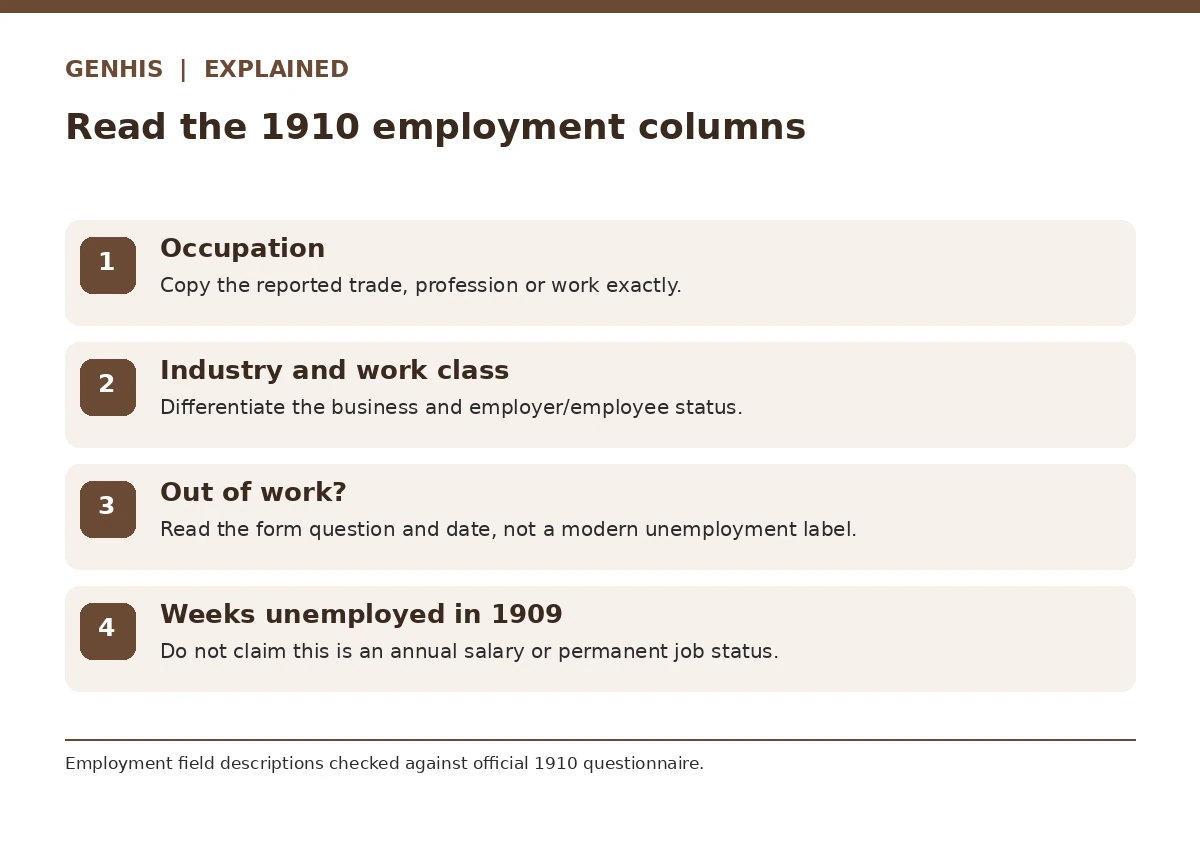
The 1910 census identifies a person’s occupation, industry, and position as employer, wage earner or working on their own account. Its questions also include whether an employee was out of work and the number of weeks unemployed during 1909. This matters because a work-history clue can point to an industry or location without proving that someone held one job continuously. Comparing an enumerated occupation to a city directory, trade record or payroll may help separate two neighbors of the same name.
Never translate the weeks-unemployed number into a diagnosis, an income figure or a full labor history. A record created for enumeration can misstate work status, reflect temporary conditions or use categories that do not resemble modern classifications. If a person’s job description changed between 1900 and 1910, examine the local economy and intermediate records before saying the person retrained or moved. A labor clue is a question to investigate, not a fully documented explanation of motivation.
Find the 1910 image when a name search fails
NARA’s online census directory identifies the 1910 population microfilm as T624, with options for viewing indexes and images. A database search is the quickest first pass, but an image is the evidence you must transcribe. Search household members, given-name variants and communities before declaring no result. Pay attention to the schedule heading, page numbers, enumeration district and county. The historical locality can often be investigated using enumeration-district maps or descriptions.
NARA says historical Soundex/Miracode indexes made for the 1910 census cover only 21 states; the original nationwide population schedules and those specific historical indexes are different things. Lack of a historical Soundex card for a state outside that list does not mean its 1910 census was never taken or that modern searchable transcriptions cannot cover it. Conversely, damaged microfilm and unreadable handwriting can obstruct a named search even in covered areas. Record which image range you actually browsed and what you could read.
Handle military and other additional questions carefully
The 1910 schedule also includes a question about surviving Union or Confederate Army or Navy service. It may direct attention to military and pension collections, but an affirmative-looking mark needs comparison with the legend and other documented facts. Do not convert the field into a verified military biography or assume a service record survives. Researchers examining Native American households should consult the relevant form and catalog because NARA describes separate survey details, including tribe and band, rather than treating modern identity labels as self-explanatory.
Immigration year, birthplace of each parent and spoken language can form a useful cluster when a surname changes spelling between decades. Yet birthplace labels and foreign-language categories are reported information; they are not conclusive proof of ethnic origin or genetic ancestry. Check an arrival document, naturalization or church record against a person already established through residence and family connections. Record whether the source was a copy, index or original schedule and avoid claiming a marriage or birth without supporting records. For the fuller picture, see our guide “1900 U.S. Census Records”.
Build a reproducible 1910 family comparison
A practical worksheet can have two columns for competing households, with rows for name forms, reported age, children, marriage information, parents’ birthplaces, neighbors, industry and citation. Give every observation an image locator. Then ask which observations are genuinely identifying: a common surname is weak, but a named spouse, an unusual occupation and a consistent locality may together make a stronger case. Document contradictions rather than silently choosing whichever row supports a favored tree.
When moving from 1910 to 1920, remember that the questionnaires changed. NARA states the 1920 form omitted the children-born and duration-of-marriage questions, while adding year of naturalization and mother-tongue detail. Absence of a 1910-specific field in 1920 is a form-design difference, not evidence that a family refused to answer. Use the source comparison to decide which other collections can address a remaining question, and check dates and archival coverage for each jurisdiction before reporting a negative search.

More Records and Archives Guides
How We Research: census questions versus family conclusions
The National Archives’ 1910 microfilm catalog and the Census Bureau’s questionnaire history supplied the field inventory; NARA’s general census-clues and online-resource pages informed the age and retrieval method. The fictional remarriage worksheet is an illustrative hypothesis, not an actual household or a claim about a historical person. All conclusions require comparison to the photographed schedule and, when possible, independent sources. Access details can change. Read the site’s affiliate disclosure; this article makes no affiliate endorsement.
National Archives: 1910 Census Catalog — NARA describes 1910 marriage, child, employment and veteran questions, image limitations and the 21-state historical index.
Census Bureau: 1910 Questionnaire — The Census Bureau details the 1910 census form including children born/living, length of current marriage and 1909 work questions.
National Archives: Online Census Resources — NARA lists specific U.S. census-year image and index routes, record group and microfilm publications, and varying provider access.
National Archives: Clues in Census Records — NARA explains age reference dates, limits of reported statements and census clues for family researchers.
It refers to the present marriage as asked on the schedule, and is not proof of an exact wedding date.
No. Different residences, enumeration limits, deaths or reporting errors all require investigation.
The ordinary 1910 population schedule reports age at last birthday rather than the separate birth month and year fields of 1900.
NARA says its historic Soundex/Miracode indexes covered only 21 states; that does not mean the population schedule is absent.
No. It indicates a particular employment measure, not a comprehensive income or work history.