
Oregon Census Records: Find Federal, Territorial, and State Returns. Searching “U.S. census Oregon” often returns federal census databases, yet Oregon’s State Archives also preserves provisional, territorial and later local returns that can answer different genealogical questions. The state’s official census records guide lists materials from 1842 forward and describes many returns as county-specific or statistical abstracts. A year on that list does not guarantee a statewide name-by-name list. Start by deciding whether you need a federal household schedule, an early local enumeration, or a limited county return. This guide maps an efficient repository-first route through those distinct sources and helps you document what survives.
Choose federal or Oregon-specific census material
For a household question in a standard decennial year, begin with the appropriate federal population schedule, using the actual census year and historical place. Oregon’s early federal entries belong to the territorial and then state periods; county names and political boundaries can change between enumerations. The Oregon State Archives guide also inventories provisional and territorial material including an 1842 enumeration by Elijah White, 1845 county returns and later enumerations. These local records were not necessarily taken on federal census dates or designed with the same family relationships and columns as a decennial population census.
Define your target result first. Are you looking to name every person at a known household in 1860? A federal schedule may be the best starting point. Are you seeking evidence of an adult in the Oregon Country before the first federal Oregon census? A provisional list or early territorial return might be relevant, but the exact record format must be checked. Are you trying to bridge an 1880 and 1900 residence gap? A surviving 1895 county enumeration may help. The source question determines the archival series, not the other way around.
Use the Oregon State Archives county-year inventory
The Oregon Secretary of State maintains a detailed census guide listing provisional, territorial, state and federal materials by year and frequently by county, sometimes with manuscript document numbers. For example, it identifies 1845 returns for counties including Clackamas and Yamhill, while many 1853–1858 holdings are county-level abstracts rather than uniformly named household schedules. The 1895 listings include Linn, Marion, Morrow and Multnomah, among others. Those inventories are a starting point for holdings, not a statement that every county’s original images are indexed for public online searching.
Make a year-versus-county grid with the ancestor’s historically documented locality in one column and the archive’s exact item wording in another. Distinguish “enumeration of inhabitants,” “abstract,” “apportionment,” “school census” and “industrial products.” These types answer different questions. If the source describes only an aggregate county total, it may help explain settlement patterns but cannot name a particular ancestor. A county return with people listed requires examination of the original page and headings to determine whether individuals or only selected adults were included.

Check territorial county and modern boundary changes
The Oregon archives inventory includes historical county labels such as Champoeg (later Marion), Tuality (later Washington) and Umpqua (later Douglas). It also names districts such as Lewis and Vancouver that later belonged to Washington. Those differences matter when a family appears on opposite sides of a present-day state line. Start from a dated settlement record or early map, then identify the administrative unit at the date of the desired enumeration. Search the historical county named in the archive, not only the county printed on a modern genealogy website.
As a teaching example, imagine a land transaction describing property in Tuality County followed by an Oregon territorial enumeration indexed under Washington County. That is a jurisdictional clue worth investigating; it is not evidence that the family migrated between those counties. Confirm the date of a rename and the exact parcel or settlement. In early Oregon Country records, political boundaries could encompass places now outside Oregon. Record each place label exactly as used by its historical document and add modern geography separately, clearly marked as later interpretation. For the fuller picture, see our guide “Washington Territorial Census Records”.

Browse actual schedules rather than relying on abstract titles
The State Archives inventory describes many early records with a document number, microfilm location or a note that a printed transcription exists. Use that information to request or inspect the right item. An abstract is often a summary produced from more detailed returns or recorded for administrative reporting. Determine whether the underlying named pages survive before treating it as a family census. For 1849, the archive specifically describes an apportionment census involving males over 21; that definition does not cover entire households and cannot be turned into a list of all Oregon residents.
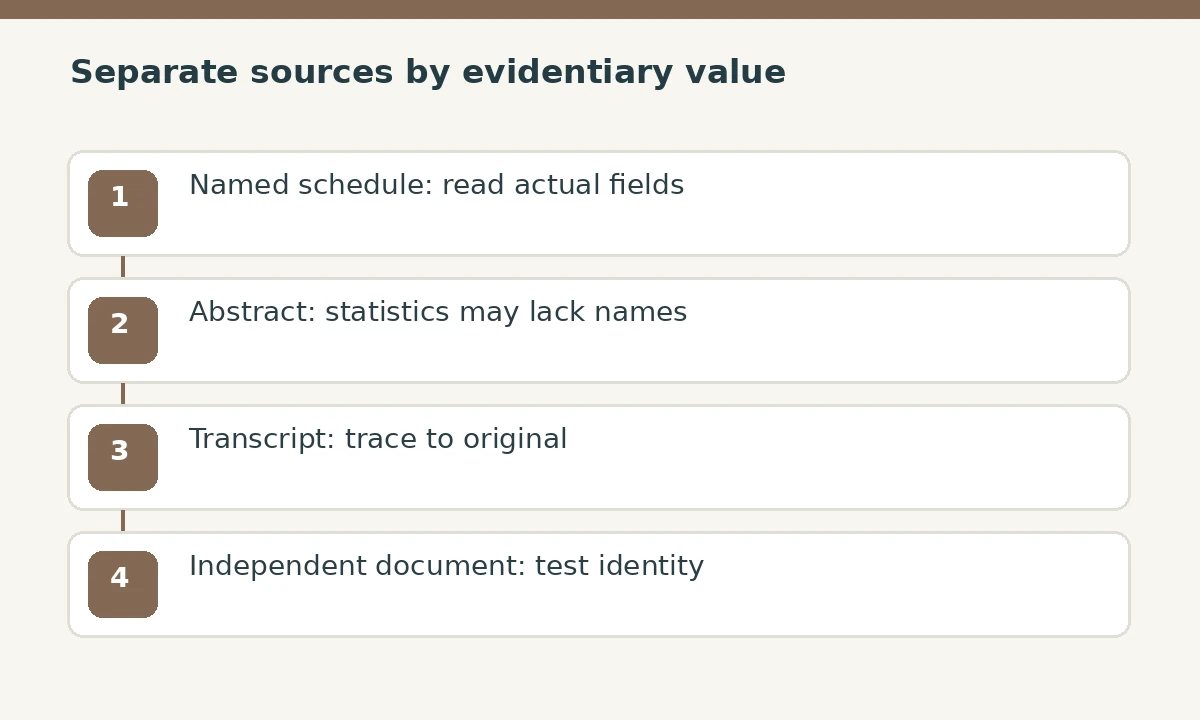
If you find a plausible name on a transcription, look for the manuscript or microfilm that supplied the entry. Copy the column headings, exact handwriting, county, year and page or document number. Even where an individual is named, a column may describe voting or military eligibility rather than household relationship. Do not turn a nearby line into a proven child or spouse. An administrative total on its own supports only a statement about that administrative unit, not a connection between particular ancestors. Preserve the difference between an index, transcript, original and historical statistic.
| Source state | What is supported | Next necessary test |
|---|---|---|
| Original name-bearing entry | Wording on this exact census page | Compare another independent dated source |
| Index hit or transcript | A candidate locator, not proof of a relationship | Obtain and transcribe original source |
| Coverage limitation or abstract | What holdings or totals are documented | Choose a different record series |
Find alternatives for gaps in the Oregon census sequence
Oregon local returns do not provide one continuous, complete series between federal decades. The State Archives describes selected 1865 and 1870 county returns and local material for 1885, 1895 and 1905. Their county and format coverage varies widely, which is why a broad search for “Oregon state census 1895” can produce misleading impressions of completeness. When a known county is not listed, do not conclude that the ancestor left Oregon. Switch to dated local sources that were created for another purpose.
Deeds, territorial court records, probate, taxation books, newspapers, church records and city directories can each test a specific residential or family hypothesis. The state’s county records guides and historical records index are useful for locating those materials, but they do not replace the underlying documents. A land grant can identify a recipient, not every occupant; a tax entry may reflect ownership rather than residence. Add these limitations to a timeline and compare each new discovery with the nearest accessible federal census. The result is an evidence chain rather than an assumed missing statewide enumeration. For a related choice, see our guide “Hawaiʻi Historical Census Records”.
Preserve a county-specific citation and a testable result
Complete the research log with date, original Oregon county name, current county if different, source creator, census type, document number or roll, person or aggregate result and whether an original page was read. An online index match is only a possible locator until the underlying record is examined. If the archive lists an early census abstract but no name-bearing schedule, cite the abstract for its stated contents without inventing an individual entry. When the search yields nothing, specify which files and alternate spellings were checked and whether the correct county-year material survives. For a related choice, see our guide “Tennessee Census Substitute”.
A final conclusion might say a person is named in a particular 1856 territorial enumeration and independently linked to a local deed, with the relationship to a nearby same-surname resident still unresolved. Another might say an 1895 county list is not documented for the ancestor’s county in the current state inventory, so tax or directory records are the next appropriate evidence. Both are useful progress. A reproducible answer clearly separates manuscript evidence from historical geography, later indexes and family traditions before making a genealogical claim. Our guide “Arizona Territorial Census Records” covers a related question.
How We Research This Census Collection
We used the Oregon Secretary of State’s specific county-year census inventory as the primary record guide, crosschecked the Census Bureau’s broader year list, and separated federal household schedules from original county returns and abstracts. The hypothetical Tuality-to-Washington county example does not assert a real family history.
More Records and Archives Guides
Official archives and source documentation
Oregon Secretary of State lists provisional, territorial, state, county and federal census holdings, dates and document numbers. The specific Oregon inventory provides county, year, original document numbers and descriptions of abstracts.
U.S. Census Bureau provides the Oregon provisional and state census year list as a discovery aid. The federal summary offers discovery years, which need checking against named Oregon county records.
National Archives explains federal population schedules, access and census research methodology. The National Archives framework applies to federal schedules and must not be confused with Oregon local returns.
The unlettered cover is an original visual metaphor for Oregon geography and archives, not an authentic territorial map or census manuscript. County names and dates should always be sourced. No commercial relationship is represented by the Oregon holdings chart or repository links. See the GenHis affiliate disclosure.
The Oregon State Archives guide lists provisional and territorial censuses beginning in 1842, with differing county and record-type coverage.
No. The inventory includes county-specific returns and statistical abstracts; check the exact item rather than assuming statewide coverage.
It may be an administrative summary rather than a nominal list. Check its description and original headings before using it for genealogy.
Those are historical county names relevant to early records; later county labels differ.
Record the original county, year, source series, archive document or film, and exact page or image read, then distinguish any index.