
Washington Territorial Census Records: Search by County and Year. Washington territorial censuses do not form a complete, continuous, statewide name database. Also, Washington State Archives describes intermittent county enumerations from 1857 to 1892 and notes that not every county took a census each year. Individual digitized county titles may be searchable, but the larger body of records is not uniformly indexed. A successful search therefore begins with a map and inventory, not with the assumption that a statewide name search covers everyone. This guide shows how to move from an address clue to the right custodian and original page.
Build the county-year search matrix first
Establish the person’s likely location using a deed, tax roll, city directory, school record or a federal census before selecting a territorial enumeration. Washington became a state in 1889, but the Archives describes a territorial census series that stretches from 1857 to 1892 in its surviving holdings. The collection title or date therefore matters more than a simple territory-versus-state label. Use the county name as it appeared at the event date, then check whether a county was created or divided after the family lived there. Our guide “California Census of 1852” covers a related question.
Make a worksheet with one row for each plausible county and columns for the years shown in the Archives inventory. Mark each combination as held, not found in catalog, not digitized, or not yet checked. Do not mark every absence in an online search as destroyed; digitization and existence are separate questions. Regional archive branches hold different county materials, and the Archives advises contacting the region responsible for the place. This matrix makes a scattered record set navigable and gives a future researcher a precise explanation of where you looked.
Find digitized titles and older microfilm rolls
The Washington Digital Archives provides collection-level titles for individual counties and years, sometimes with image scans and name indexes. For example, the official 1857 King County title has a searchable index and images, with the creator named as the county auditor. Browse a specific title and verify its record creator and county before relying on the search results. A general keyword search across all Washington collections is not proof that the exact county census was searched, especially where indexing is incomplete.
The Washington State Library also describes territorial census rolls on microfilm from 1859 to 1892, with holdings that vary by county and year. A record may exist on film or with a regional branch without appearing in the online Digital Archives interface. If the date and district fit but no image is available, request the archive’s call number or title details. Tell the archivist your county and the approximate enumeration year, not just an ancestor’s surname. This saves time and avoids an unsupported claim that a collection is unavailable.

Read historic enumeration rules without modern assumptions
Washington’s earliest territorial census laws used categories based on race, sex, citizenship and taxable status that reflect discriminatory rules of the period. Individual county descriptions, such as the official 1857 Pierce County title, summarize which groups were entered and how. These headings should be treated as features of a historically biased form, not as reliable statements of a modern person’s ethnicity, legal citizenship or complete household membership. Some communities were counted under separate headings or omitted from certain columns.
Transcribe fields with their actual labels when they affect a conclusion, and explain harmful historical language without casually repeating it. County titles may include age, occupation, birthplace or origin, and marriage or citizenship categories, but do not assume every year used the same form. A person missing from a particular name sequence could have been recorded under a different category or excluded by the enumerator’s rules. Absence must always be discussed alongside the scope of the original form and the completeness of the surviving pages.
| What you found | What it supports | What needs independent testing |
|---|---|---|
| Catalog or index match | A possible source location | Person identity and original text |
| Original record entry | Information actually written on the form | Accuracy, family links and exceptions |
| Second dated source | An independent comparison | Any unresolved conflict or missing coverage |
Compare neighboring entries with independent evidence
Use the 1857 King County census title as an illustration of the workflow, not as evidence about a named family. The Archives states that this series contains a name index and page images for each member of a household. Compare a plausible name against age, occupation, birthplace, marital status and the order of nearby entries where the actual page supports doing so. A household may not follow today’s expected family arrangement, and adjacency alone cannot prove a biological relationship.
A fictional researcher may encounter two people called Thomas Reed in separate territorial districts, each aged about thirty. That is a demonstration of a common research problem, not an assertion that such entries exist. Compare residence records dated before and after the census, county taxes and deeds, and then record differences as well as agreements. Neighboring landholders can help reconstruct a move; however, similar neighbors do not create identity certainty without a document connecting the person. Record both candidates rather than merging them prematurely.

Document gaps and choose the next local record
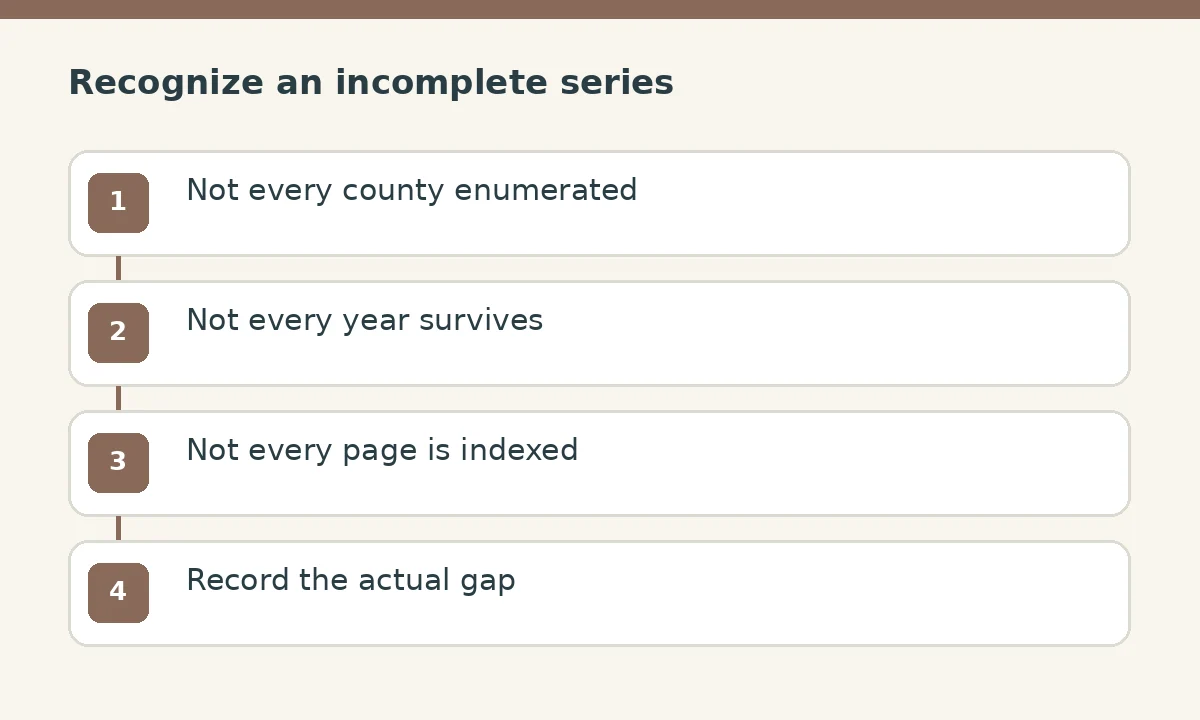
When a territorial search fails, distinguish three possibilities: no census took place for the county and year; a census existed but the relevant pages are missing or not indexed; or the surviving form contains no matching entry. The Washington State Archives inventory does not imply a complete set of annual censuses. Ask for a holdings confirmation if the record would materially affect a family-history claim. Preserve notes of database searches, microfilm references and archivist responses, including exact collection titles and dates. For a related choice, see our guide “Nevada Territorial and State Censuses”.
Use available county assessment rolls, school censuses, naturalization petitions and territorial court files as targeted alternatives. Washington State Archives describes separate property assessment rolls for selected territorial years, while school censuses focus on children and can be uneven by district. The school list cannot represent all adults in a community, just as an assessment may identify property owners rather than all residents. Close with a citation identifying the original census title, county auditor or other creator, year, page or image and repository. State any unresolved coverage issue explicitly. Our guide “Connecticut Military Census of 1917” covers a related question.
How We Research Wa State Census
We compared a statewide Washington archival guide with specific county-auditor records and separately tracked county-year survival, microfilm, digitization and indexing. Claims about historic classification categories are described as properties of the documents, not modern judgments about people.
More Records and Archives Guides
Official archives and record coverage sources
Washington State Archives documents intermittent territorial census coverage, inconsistent indexing and regional custody. The regional-archive guide confirms that the surviving records are intermittent and only partially indexed.
Digital Archives describes the 1857 King County census and its original fields, images and name index. The named 1857 King County title describes a specific searchable county series with images, not a statewide name database.
Digital Archives details Pierce County 1857 form categories and the historical enumeration rules. The Pierce County title identifies historically exclusionary categories that cannot be generalized to other years.
h Any outside link is supplied as an evidence source, not a paid recommendation. See the GenHis affiliate disclosure.
No. Washington State Archives describes intermittent coverage, not a complete annual statewide series.
No. Some county series have indexes or scans; other holdings are on microfilm or held in regional archives.
The Archives groups territorial census holdings by record series, including surviving years through 1892; inspect the specific creator and title.
Check the form’s enumeration rules, county-year coverage and unindexed pages before inferring absence.
Compare the original entry with dated property, school, local court, church or other records for the same locality.