
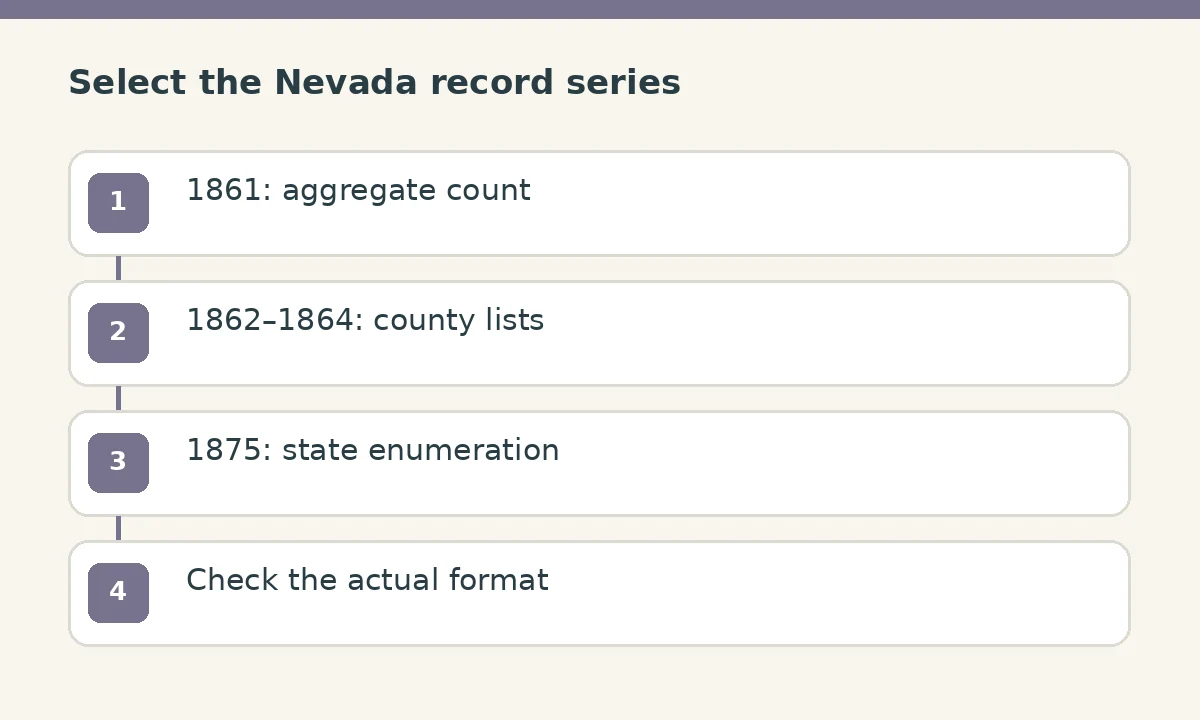
Nevada Territorial and State Censuses: Trace the Surviving Lists. Nevada’s early census record sets require a chronological decision before a name search. The Nevada State Library and Archives describes an aggregate count in 1861, surviving territorial name lists from the early 1860s, and a state enumeration in 1875. These are different kinds of evidence. Not every early county is represented by a surviving manuscript, and a printed 1875 report is not identical to the richer handwritten Washoe County schedule. A family historian should first identify the year, record form and historic county before claiming that a person was or was not enumerated.
Separate the 1861 count from later individual records
A guide prepared for the Nevada State Library and Archives notes that Governor Nye commissioned an aggregate territorial count in 1861. Because an aggregate report summarizes people rather than listing each one by name, it cannot establish an individual ancestor’s presence on its own. A name-based search should focus instead on surviving manuscript county censuses from the 1862–1864 period or on appropriate federal and local sources. Record the exact type of source being offered by a database before adding a supposed census resident to a family tree. For a related choice, see our guide “1856 Utah Territorial Census”.
The Nevada Library Cooperative preserves a description of the 1862 Storey County census and explains that the territorial legislature required county assessors to create lists of certain inhabitants. The official description reflects exclusionary nineteenth-century definitions; a listing may fail to represent communities omitted by law or practice. A count cannot be equated with the region’s whole population, and an absence under a restrictive form cannot prove that a person did not live there. Always retain the original heading and explain which group was subject to enumeration.
Use the historic county and the correct year
County boundaries changed rapidly in the Nevada mining period. An early territorial manuscript can apply to a district that later moved into another county, and the Nevada archival guide identifies missing returns for particular counties. Check the county named on the original schedule and the date at which that jurisdiction existed. A locality presently found in a modern county should not be used as a substitute for the historic county without comparing boundary history. The year 1863 also does not mean every existing county generated a surviving name list.
The archival guide says some materials are missing, including the Esmeralda County manuscript, and identifies parts of Churchill and Lyon coverage as absent for certain early years. Use a three-column holdings matrix: year, county, and surviving original format. Then add a fourth column showing whether a name index is available. A later index might contain useful leads but be incomplete or incorrectly transcribed. This matrix is the unique value of approaching Nevada as separate territorial and state record series, rather than treating a database search as exhaustive. Our guide “Washington Territorial Census Records” covers a related question.
Locate manuscript images and published 1875 returns
The Nevada State Library and Archives guide explains that a statewide census was taken in 1875. But the Washoe County manuscript is the only handwritten county schedule described there as located in that form. It reports that the whole enumeration was published in volumes appended to Nevada legislative journals, and that indexes and microfilm were produced. A printed entry or summarized presentation therefore needs a citation identifying the published or manuscript version actually examined, without assuming their details are interchangeable.
The University of Nevada, Las Vegas library catalog separately lists microfilm titled Nevada Territory manuscript census, 1861–1864 and Nevada state manuscript census for Washoe County, 1875. If a commercial database displays a search result, verify its underlying film, county, page and record type rather than copying the index’s title into your citation. If the old electronic Nevada Historical Census interface is mentioned on another website, check its status first. The University of Nevada, Reno Libraries reports that the interface was retired. Do not promise an active portal that a researcher cannot use. Our guide “Louisiana State Censuses of 1853 and 1858” covers a related question.

| What you found | What it supports | What needs independent testing |
|---|---|---|
| Catalog or index match | A possible source location | Person identity and original text |
| Original record entry | Information actually written on the form | Accuracy, family links and exceptions |
| Second dated source | An independent comparison | Any unresolved conflict or missing coverage |
Interpret a census name alongside mining and land records
A hypothetical researcher searching for a miner called James Nolan might find a plausible Storey County surname entry in an early list and an unrelated Nolan in later Washoe County materials. That imagined case illustrates an identity question, not a transcription of real Nevada people. Compare age when available, address, work, nearby names and independently dated land or mining notices. A county name alone cannot connect the two men. Mining camps could be mobile, and jurisdiction changes can make the same physical community appear under different administrative labels.
Use a dated local deed, property assessment, newspaper or probate document to test a candidate identification. Be especially cautious with workplace descriptions because a mining district’s dominant industry does not prove a particular resident was a miner. A person might have worked in transport, trade, farming or another occupation. Preserve all alternative candidates until a source distinguishes them. This record-centered approach is more defensible than merging names because they appear within the same decade or share a broad mining-region label.

Cite exact holdings and record a negative search honestly
Build your final citation with the historical jurisdiction, year, name if present, page or film reference, manuscript or printed format, holding institution and access date. Separate the title of the original census from the title of a modern index. Where the archive’s own guide says an index was created by volunteers, treat its accuracy as something to verify against the original, not as established. For a no-result search, state which county volumes and indexes were examined, rather than writing that the ancestor never lived in Nevada. Our guide “Connecticut Military Census of 1917” covers a related question.
If the relevant county has missing manuscript coverage, turn to tax records, territorial courts, newspapers, church registers, land patents or the surrounding federal population schedules. Note which were accessible and which still require a repository inquiry. A strong conclusion may simply be that a named ancestor was in a Nevada county by a certain date. But no surviving early territorial census has yet established the household. That precise limit is more informative than a false negative produced by a single modern search field. Our guide “California Census of 1852” covers a related question.
How We Research Nevada State Census
We contrasted official Nevada territorial collection descriptions, a university microfilm catalog and the Census Bureau year list, and checked that a retired online Nevada interface is not advertised as active. The guide distinguishes aggregate totals, individual manuscripts and printed state census returns.
More Records and Archives Guides
Official archives and record coverage sources
Nevada Library Cooperative hosts an original territorial census description explaining the 1862 authority and early jurisdiction changes. This historical collection description explains the 1862 legislation and the difference between early aggregate and individually named enumerations.
UNLV confirms microfilm holdings for Nevada territorial manuscripts and Washoe County 1875 census. UNLV documents microfilm for the surviving territorial manuscripts and a separate Washoe County 1875 manuscript.
Census Bureau lists Nevada state and territorial census years 1862, 1863 and 1875. The Census Bureau confirms Nevada census years; check the original county series before reporting a family match.
University of Nevada Reno reports its former Nevada historical census interface has been retired. The university confirms retirement of its former web interface; do not direct readers to it as an active index.
Nevada State Library and Archives census microfilm guide describes the published 1875 enumeration and the surviving manuscript exceptions; consult original headings before quoting index data.
No sponsored archive service or referral arrangement is asserted. Our GenHis affiliate disclosure details link practices.
Frequently Asked Questions
The Nevada archival guide describes an aggregate census in 1861, not a complete household name list.
No. Surviving territorial manuscripts are partial; check the precise county and year.
The enumeration was published; the archival guide identifies Washoe County as retaining a manuscript with additional individual detail.
No. Check county creation and boundary changes at the census date.
State the specific series, years, counties and formats checked, plus any known original-record gaps.