
The U.S. Census Bureau’s historical state-census inventory lists Utah in 1856, but that short listing does not establish that a complete modern name-search database or original page images survive for every community. The Utah State Archives explains that records from the territorial era, 1850–1896, are scattered among institutions. A published 1856 name list can therefore be useful while still requiring independent verification. Secondary guidance warns that some names in the 1856 index may represent people not then living in the territory, including people reported deceased. Search for your target as a candidate, record the published source and its limitations, and resist the tempting but unwarranted statement that one index hit proves an ancestor lived at a Utah address in 1856.
Identify which 1856 list or transcription you actually found
Start with a catalog entry rather than a search-engine excerpt. Record the exact title of the list, compiler, edition, repository and any introduction discussing its purpose. A named index to an 1856 territorial count, a later family compilation and an 1856 county probate record are three different source types. If a website simply says “Utah Census, 1856,” inspect the description to learn whether it displays original manuscript images, a printed index or a derivative database. Do not describe a derivative index as a photographed enumeration. If source provenance cannot be established, mark that result low confidence and continue to an independent archival holding.
Map the reported settlement to the correct territorial period
Utah Territory was created in 1850 and became a state in 1896. Political boundaries, counties, settlements and jurisdictions changed during those decades. A modern municipality or county cannot always be placed uncritically on an 1856 record. Build a place worksheet using contemporary deeds, court proceedings, maps or dated church records to fix the individual’s locality. Distinguish a recorded ward, township or settlement name from a later catalog location. The Utah State Archives Territory Project is useful for finding historical governance context, but it is not automatically a full searchable census index. Keep place names exactly as the original or catalog gives them.

Search namesakes without assuming the same religious community
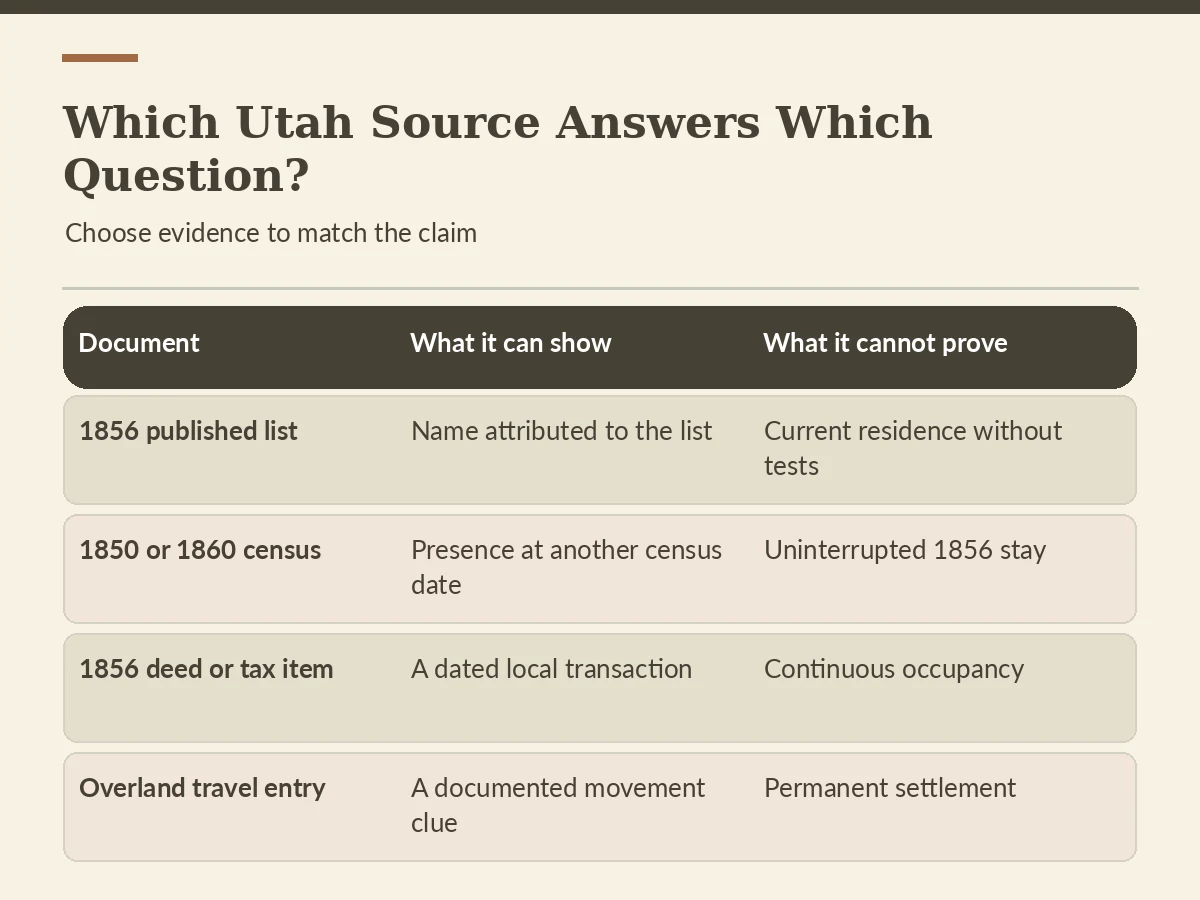
If several indexed people share a common surname and given name, build separate entries for each possible candidate. Note spellings, age approximations, spouse names and associated places from independently dated records. Utah’s territorial history includes many forms of migration and multiple communities. Do not assume an indexed name proves membership in a particular church, or that a shared religious affiliation proves identity. An overland travel entry might place someone on a route; it does not by itself show that the person remained in Utah during the entire census year. Ask what the individual record actually attests: journey, arrival, land transaction, membership entry or dwelling.
Use 1850 and 1860 federal enumerations as dated cross-checks
A federal population census near 1856 may help establish that a likely person was in a Utah locality before or after the reported count. The 1850 Utah federal enumeration was taken in the early territorial period, and 1860 provides a subsequent checkpoint. Neither proves continuous residence across all intervening years. Put all entries on a timeline, recording each census reference date rather than treating all observations as events on January 1. If an individual appears elsewhere in 1860, investigate a move; if someone died before 1856, that conflict is a warning about the 1856 index or a namesake. Never harmonize contradictory dates without a stated reason.
Select county records that could test physical presence
An 1855–1857 deed, property assessment, probate proceeding or court entry can provide independent evidence of a transaction or recognized legal association with an area. It still may not prove that someone lived there full-time: landowners could be absent, and a witness could travel. Select the record according to the claim. For residence, a contemporary local tax entry, named household, municipal roster or employment record may be more relevant than an inheritance mentioned decades later. Use the Utah State Archives catalog and the relevant county custodian to determine whether originals survive and how they are arranged. Do not promise that all county books are digitized.
Separate a published index from a signed original record
Evidence quality depends on provenance. A printed index extracts names selected by an editor; an image of an original roster may show the heading, corrections, context and other people on the same page. A deed bears a specific transaction date and named roles. In your notes, create distinct citation blocks for each object. Transcribe a name exactly as given and then add a standardized search name separately. Record whether you personally viewed the underlying manuscript. A missing original should be treated as an explicit limitation, not silently replaced with a more authoritative-sounding citation to an unrelated 1856 volume.
Explain anomalous and deceased names without choosing a story
Secondary census research has raised concerns that the 1856 index can include people who were absent or already deceased. That warning should trigger a verification test, not a blanket judgment that the whole source is useless. If a death certificate, burial record or contemporary newspaper places someone’s death before 1856, examine whether the 1856 entry reflects a copied earlier roster, editorial conflation, mistaken identity or another person with the same name. Until the source chain is clear, classify the index as unverified for residence. The original evidence of death also needs scrutiny: a later memorial inscription is different from a contemporary registration.
Build a citation and a three-level conclusion
Record the published 1856 list title and page, the stated locality if any, the compiler and publisher, and the access path. Then add separate citations for the independent 1850 or 1860 census and territorial documents. Assign one of three statuses to the specific question of Utah residence in 1856: name appears only in a derivative list; contemporary documentation supports presence; or evidence conflicts or remains insufficient. This is a research-status label, not a numerical proof score. It makes uncertainty understandable to another reader and prevents a later family-tree import from converting a bibliographic clue into a demonstrated migration date.

Plan the next search around the missing link
If the only finding is a published index name, seek the compiler’s sources and a dated local record. If you have a travel roster but not a residence, investigate land, taxes, church or court holdings for the settlement. Also, if two namesakes remain plausible, find a document naming a spouse, occupation or close associate. If the relevant records have not survived, say precisely what is missing. The strongest defensible statement may simply be that a name appears in a particular published 1856 list and the person’s actual residence has not been established. That is preferable to an unsupported family relocation or death conclusion.
More Records and Archives Guides
How We Research 1856 Utah Census
We checked the stated time periods, location boundaries, holdings scope and likely error modes in repository guide; archive research guidance; original collection notes. Editorial illustrations are conceptual, not photographs of particular historical documents. No affiliate relationship is claimed for these official resources. See the affiliate disclosure for site policy.
The Census Bureau lists Utah 1856 among territorial or state counts; consult holdings notes before assuming comprehensive surviving returns.
No. Verify the index provenance and seek a contemporaneous record tying that person to a specific place.
Do not assume so. Confirm surviving manuscripts, printed indexes and access restrictions through the relevant repository.
Treat this as a possible name or source conflict. Compare the underlying index, death evidence and any same-name candidates.
Try nearby federal censuses plus dated deeds, court files, taxes, travel records and local or church entries, matched by place.