
The 1840 United States census was the first federal population census taken in Iowa, while Iowa was still a territory. The surviving schedules do not provide every resident’s name. They identify the householder and use columns of numbers to summarize other people. That distinction makes a standard name search unusually easy to misread: finding one man with the right surname does not mean the unnamed children or spouse have been identified. Work from a known 1840 county or settlement, search plausible household heads, and treat the tally as a set of clues. The State Historical Society of Iowa identifies 1840 as the first federal Iowa enumeration; the National Archives identifies the original two-page form and the microfilm series M704.
Locate an 1840 county using its historical boundaries
Begin with the place where your ancestor was recorded in an earlier land purchase, marriage, tax roll, or later census. Iowa’s territorial jurisdictions were changing rapidly in the 1830s and 1840s. A modern county name may not describe which court or enumeration district served the same farm in 1840. Write down the historical county supported by a dated document. Search the 1840 census under that county, then inspect adjacent districts if borders or spelling are uncertain. Copy the jurisdiction as the census actually states it; do not substitute a present-day map label. If you lack a town, neighboring householders can supply a narrower lead when those names recur in deeds or tax lists.
Read both sides of the original 1840 schedule
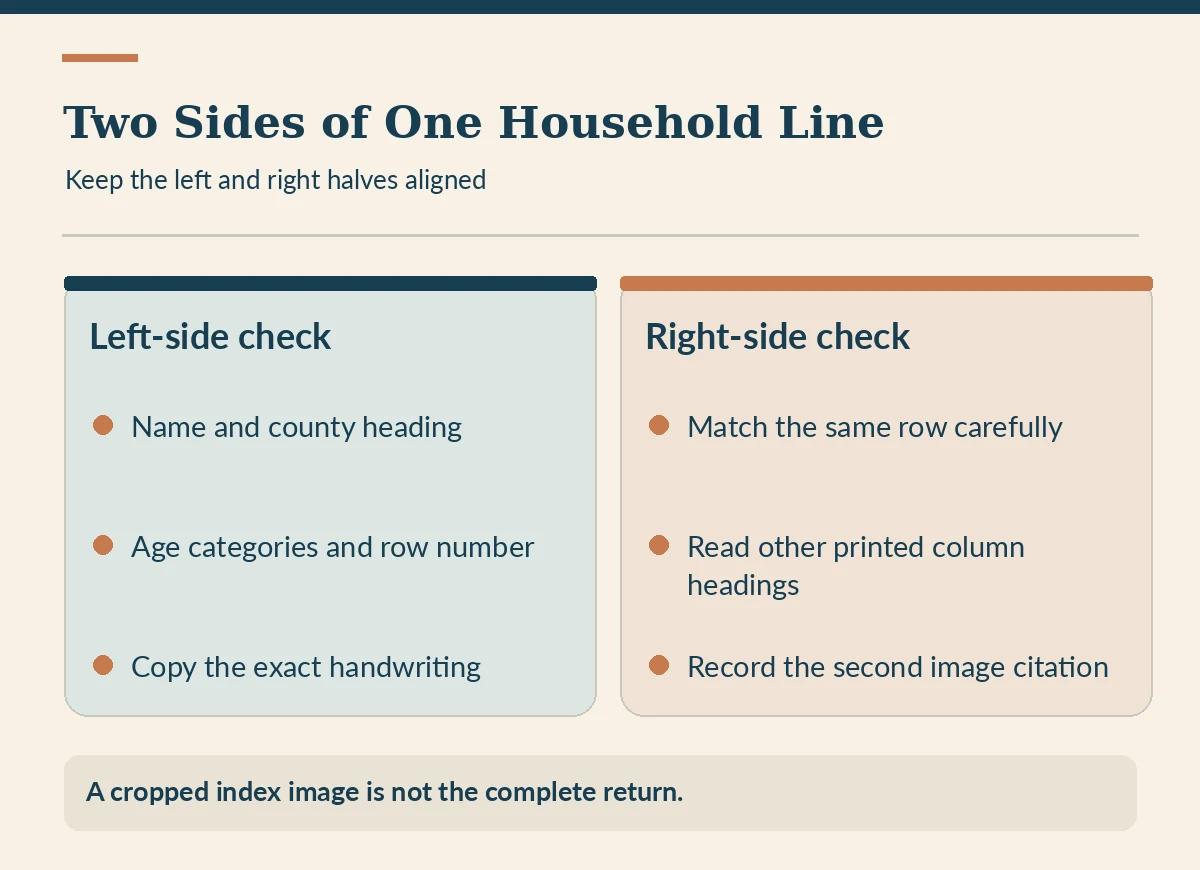
The federal government provided a printed schedule that extends across two pages. NARA reproduces the left and right forms. A cropped database image may highlight the line with a household head while hiding columns on the opposite side. Open the original images in sequence and record the full page pairing before interpreting totals. Align the same row across the two sides and note any overwritten figures, marginal remarks or totals. Include the film or image reference, page numbers, locality and named head in your notes. If the two sides cannot be reliably aligned, label that information unverified rather than attaching the wrong population columns to a family.

Convert age brackets into ranges, not exact identities
Age and sex categories indicate counts, not an individual birth certificate. For example, one person reported in an age bracket could be any of several similarly aged relatives, an unrelated boarder or another resident. Build a proposed household table with a column for the number of people counted and a separate column for people independently documented. Work backward from known 1850 named inhabitants cautiously: someone living with a household in 1850 was not necessarily there ten years earlier. Deaths, migration, marriage and moves can change the composition. Do not assign a particular child to a census tick mark unless another record ties that child to the place and period.
Use neighboring heads without assuming family relationships
Household sequences can indicate a practical neighborhood search area, but page adjacency does not prove contiguous property or kinship. Copy three or four names above and below the target and compare them to nearby land entries, township tax assessments, court files or probate notices. If one neighbor witnesses a deed involving the proposed ancestor, document the witness role exactly. Repeated neighbors across independent records increase confidence in a locality, not automatically in a parent-child link. Be especially cautious with common names such as John Smith: a tally and one neighboring surname are weak evidence without ages, land descriptions or dated transactions to differentiate the candidates.
Interpret status and occupation columns with historical context
The 1840 schedule also collected information beyond free-person age counts. Its historical categories reflect the legal and social assumptions of the period; they should be transcribed accurately without adopting those classifications as a present-day description of anyone’s identity. Household counts do not reveal the names of enslaved people where those categories appear, nor establish that every person counted was related to the named head. Other questions, including certain occupations and pensioner information, may help direct further research but are not proof of a particular person’s job or military service. Read the printed heading before taking an isolated number as a biographical fact.
Compare the 1840 household with Iowa’s 1850 named census
The 1850 federal census generally names individual free residents and offers a useful later checkpoint. Build an 1840-to-1850 table showing name, locality, age range, household composition and competing explanations. A person aged ten in 1850 may fit a zero-to-four category in 1840, but only after checking reference dates and possible enumeration errors. A family found elsewhere in 1850 could reflect migration; a matching name in the same county may be another household. The strongest links also use land deeds, marriage registers and tax assessments from the intervening decade. Record uncertainty rather than force the 1840 anonymous counts into a finished pedigree.
Log missing names and unsuccessful township searches honestly
NARA lists Iowa among the surviving jurisdictions for the 1840 federal census, but surviving schedules do not guarantee that every expected person was counted or correctly indexed. Search spelling variants and browse the locality even after a name query fails. Record the counties, image ranges, variants and dates inspected. A negative index result says only that the particular search failed; it cannot establish that someone never lived in the territory. A township-level land or court record may supply the better entry point. If several same-name heads remain possible, keep separate candidate profiles rather than merging their families.
Make a citation that preserves the two-page context
Cite the 1840 U.S. federal census, Iowa Territory, the relevant county, recorded householder, district or page identifiers, and the image repository or NARA M704 reference where available. Preserve image numbers for both sides when the provider uses separate files. Attach your transcript of only those columns you can align confidently. Keep three conclusion fields: observed text, candidate interpretation and independent corroboration. This allows another researcher to reexamine whether a proposed daughter, trade or location is a documented person or merely an attractive explanation for one numerical census cell.

Choose the next record according to the unresolved claim
If your uncertainty is residence, search land and territorial tax records. If it is the identity of an unnamed family member, prioritize an 1850 named census entry and a contemporary marriage or probate record. Also, if it is an older person’s military-service claim, seek original pension documentation rather than converting a census notation into proof of service. Return to the original image when databases disagree about the spelling of the householder. A good 1840 conclusion can be modest: one named household appears in a documented county with particular enumerated groups. Family membership remains a testable hypothesis until other documents identify those people. For a related choice, see our guide “1856 Utah Territorial Census”.
More Records and Archives Guides
How We Research 1840 Iowa Territorial Census
We checked the stated time periods, location boundaries, holdings scope and likely error modes in repository guide; archive research guidance; original collection notes. Editorial illustrations are conceptual, not photographs of particular historical documents. No affiliate relationship is claimed for these official resources. See the affiliate disclosure for site policy.
No. Iowa was still a United States territory; its first federal enumeration was conducted in 1840.
No. The population schedule primarily names household heads and counts other residents in categories.
The printed federal 1840 schedule extends over two pages; align the same household line across both sides.
Not by itself. Use ages, dates and additional records to test a proposed match, including migrations and deaths.
Browse the relevant historical county and its neighbors, test variants and record what coverage you actually searched.