
Use Iowa’s 1915 state census as an independent time-point between the 1910 and 1920 federal counts, not as a substitute for either household schedule. The State Historical Society of Iowa lists a 1915 state enumeration with original holdings in state archival record groups. FamilySearch provides an index and images. Begin with a named person and a known county, open the actual entry, and compare each reported fact with records created for a different purpose.
Choose 1915 Rather Than the 1905 or 1925 Formats
Iowa took multiple state censuses, and the surviving formats are not interchangeable. The State Historical Society specifically distinguishes 1905 individual cards, 1915 material, and the longer multi-page individual forms associated with 1925. This guide focuses on the 1915 image and its index, not the more elaborate parental information found on the later pages of the 1925 census. Confirm the year on the image before copying any field into a worksheet, because search platforms often present several Iowa collections together.
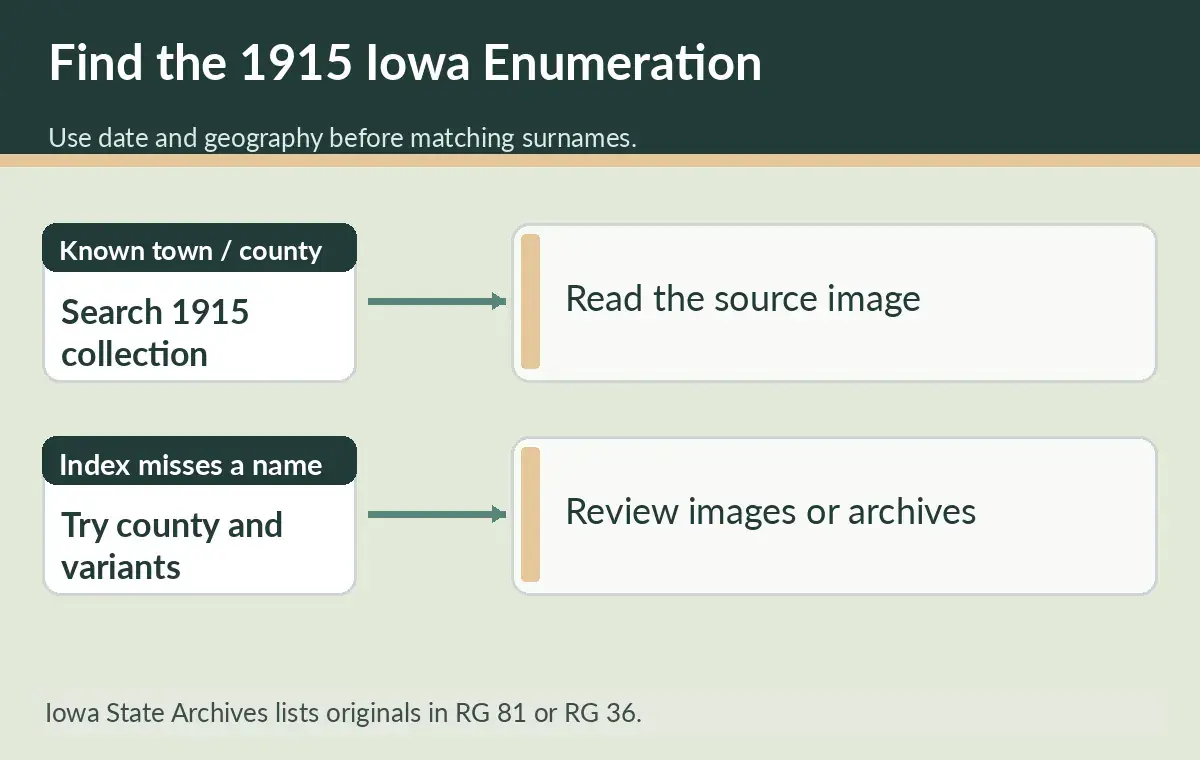
Write down the county, city or township and approximately where the person lived in 1915. A farmer who appears in a 1910 federal return may have moved to a nearby municipality before the state count. A missing 1915 result is not evidence of death or departure until name variants, geography and coverage have been tested. The state archive’s census overview links to online access partners and identifies the original custodial groups RG 81 and RG 36.
Read the Original Entry Instead of the Search Snippet
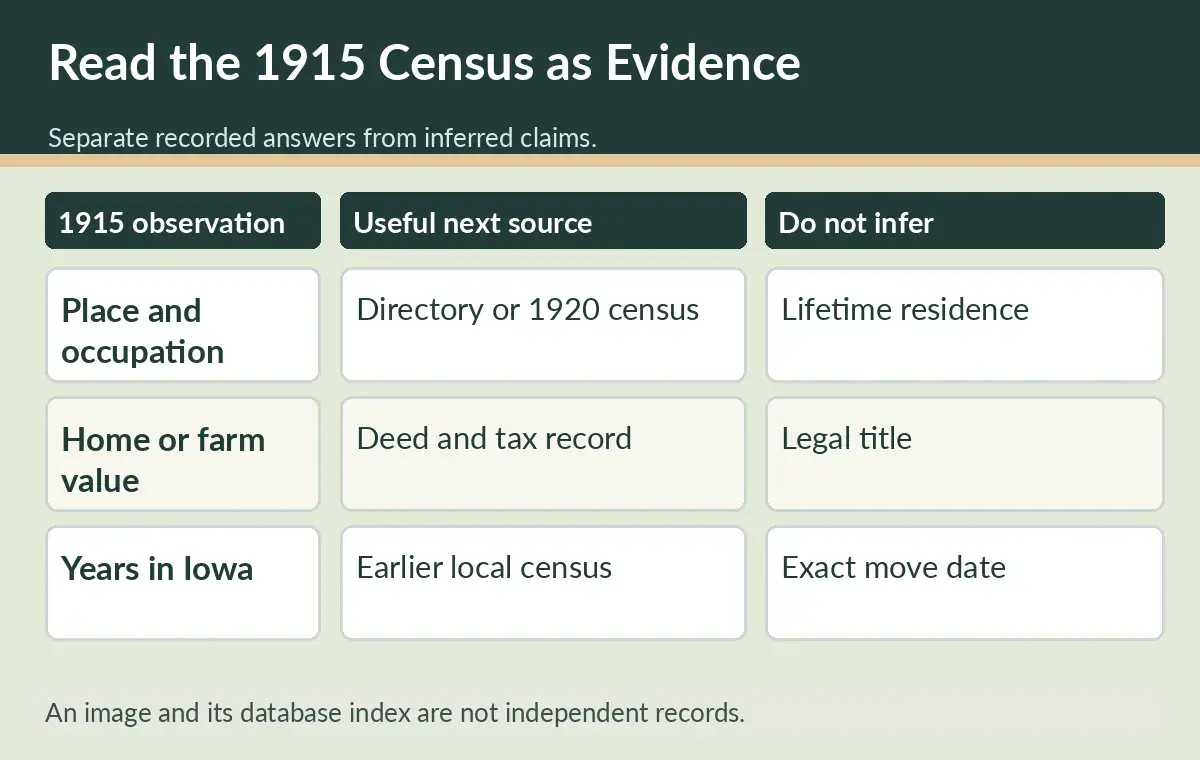
FamilySearch lists county and township, name, sex, age, place of birth and parental birthplaces among fields that may occur. The collection may also include occupation, naturalization details, time in Iowa, literacy, school attendance, unemployment and property information. These are reported statements tied to a specific census date; they are not independent confirmations of births, citizenship or ownership. Before transcribing, open the original image and read the handwritten form headings. Not every entry or online extract displays every element in exactly the same way.
If an indexed field is truncated, do not guess at the intended value. A reported parent’s birthplace may mean a state or foreign country depending on the form, and the response might be an abbreviation. Preserve the literal spelling and add your interpretation separately. If the card or record uses a reporting category you would not use today, quote it only where relevant to the evidence and explain its historical context. Avoid turning a numerical age into an exact birthday without independent evidence.
Rebuild Families From Independent Evidence
A single person’s 1915 record can suggest a locality and family links, but adjacent search hits and similar last names do not prove a household. Compare the same person in the 1910 federal schedule, the 1920 federal schedule, marriage or birth registrations and contemporary directories where available. Group candidates by address, age, birthplace and clearly identified spouse or parent rather than surname alone. Keep a separate line for discrepancies such as a five-year shift in reported age or an apparent change of occupation.
Consider two fictional men named Charles Miller born within three years of one another. One might be a railroad laborer in Polk County and the other a shop clerk in Linn County. Their occupation and residence differences are material even if both name a German-born father. Search a contemporaneous city directory, newspaper or marriage register before selecting one identity. When the evidence remains incomplete, keep two candidate profiles with separate citations instead of attaching records to one online family tree prematurely.
Check Work, School and Property Columns Carefully
An occupation reported in a 1915 census is not an uninterrupted employment history. Months unemployed, schooling and property entries reflect the form’s questions and the person’s reported circumstances. They can suggest new archives: school attendance may lead to local school reports, occupation to directories or labor records, and home tenure to property-tax or deed files. But a tenant’s address does not establish ownership; nor do property figures on a census prove legal title to a parcel. Use the exact field label and the year before comparing financial values across decades.
The state enumeration may include indicators for military service or naturalization. Such entries are research leads, not discharge papers or court naturalization petitions. A person might have answered a question inaccurately or incompletely, and separate eligibility rules could affect what was asked. When testing military or migration claims, identify which original record class would provide primary evidence. Record the census assertion first and then explain the independent source you expect to confirm or contradict it.
Recover Searches That Fail Under One Name
Start with a surname and place; then remove restrictive birth-year assumptions and try a middle initial, phonetic variant or spouse clue. FamilySearch presents search fields for name, location and relatives, but the original collection is not necessarily indexed perfectly. A hard-to-read name may be searchable only under a mistaken transcription. Use any available browse paths to inspect geographic groups, and take note of counties or towns that were fully examined. A website returning zero hits for one spelling does not amount to a complete search of the surviving Iowa census.
If two platforms show different residence fields, consult the same original image rather than treating their transcriptions as two independent witnesses. Image count and indexed-person count may differ because a card can have multiple faces or an image can contain other printed material. If an individual card is restricted or not displayed, the State Archives may still identify a copy or reference path. The distinction between access arrangements and missing historical records should appear in the final research log.

Cite the Archival Origin and a Targeted Next Search
A reproducible citation should include ‘Iowa State Census, 1915,’ the county and township or city, person, image identifier or folio/card reference, source provider and the archival custodian. Where available, save the digital link and exact date you viewed it. The Society of Iowa lists original records under Secretary of State RG 81 or Executive Council RG 36; do not invent a more precise file unit without reading the catalog entry. Keep the image URL separate from the description of the historical record.
Finish with a bounded question, such as whether the fictional Edith Wilson recorded in Cedar Rapids in 1915 is the same individual enumerated with a known spouse in 1920. Specify which name, age, birthplace and address observations must agree and what would disprove the match. Record a negative search only when its place, year, source and variants are clear. See the site’s affiliate disclosure; these source recommendations are based on archives and not an assumed commission.
More Records and Archives Guides
How We Research This Collection
We compared the Iowa State Historical Society enumeration list and RG 81/RG 36 references with FamilySearch’s 1915 collection description and the Census Bureau definition of state censuses. The article distinguishes person-level entries, database extracts and corroborating federal households. All illustrative names and scenarios are fictional.
No. Iowa conducted its own state enumeration between federal census years.
FamilySearch lists an index and images; available browsing or sign-in conditions may vary.
No. Do not transfer fields or layout assumptions from a different state census year.
No. Compare tax and deed records to establish legal title.
Iowa’s State Archives identifies original state-census holdings in RG 81 and RG 36.