
The New York State Archives identifies the original 1915 population schedules as series A0275. Start with a county and a probable household rather than assuming a free name index contains the entire document. Find a candidate in a searchable collection or use the New York State Library county microfilm guide, then read the original lines with the address, household members, and page reference. The 1915 return can bridge the gap between the 1910 and 1920 federal censuses, but a household entry is evidence of enumeration, not proof of every family relationship.
Identify the 1915 state schedules before following a search hit
New York took multiple state censuses, and a record labeled merely “New York census” can belong to 1905, 1915, or 1925. The Archives describes A0275 as the 1915 original population schedule series and A0276 as the separate 1925 series. Keep the date and repository collection title alongside every candidate. A relative born after the enumeration would not yet appear; an older resident may have moved by the federal census five years later. Build a short dated timeline before interpreting any missing person as dead or permanently absent. Our guide “1895 Minnesota State Census” covers a related question.
Search by county, surname variant, and known household companions
Begin with surname variations, an age range, and a confirmed county from a marriage license, directory, or the 1910 census. New York State Library lists surviving microfilm by county rather than promising that every online name index is complete. Include a spouse, child, boarder, or expected street address as a second identifier. Retain plausible same-name entries until you have checked their original context. If one name search fails, try a phonetic spelling or use an address-based approach; an indexing failure does not establish that no schedule survives. For the next step, our guide “New York State Census Records” explains how to choose the right year and surviving county.
Distinguish 1915 questions from the richer 1925 naturalization detail
The State Library question guide lists an address, relationship to the family head, age, birthplace, years in the United States, citizenship status, and occupation among the 1915/1925 questions. It separately marks “if naturalized, when and where” as a 1925 feature. A 1915 “citizen” or “alien” answer is not a court citation or a date of naturalization. To pursue that claim, find a petition, declaration, or certificate in the correct jurisdiction rather than inventing a naturalization date.
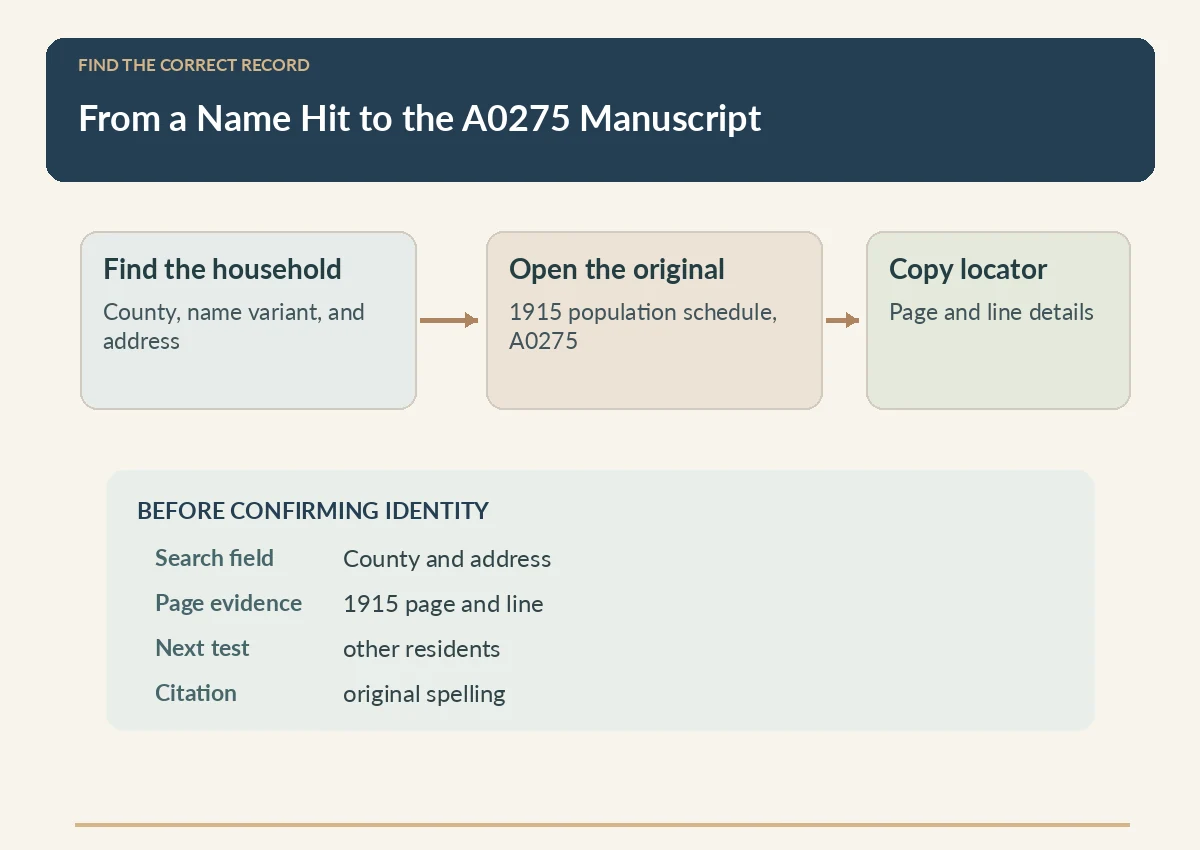
Open an original page and transcribe the household in line order
A name result is easiest to misinterpret when extracted from its neighbors. View the page and transcribe the full household, address, age, birthplace, occupation, citizenship column, and any marginal marks without silently correcting spelling. Notice whether the next line belongs to the same family, a lodger, or another unit at the address. Some line breaks and household groupings are evident only on the manuscript. Copy the county, election or enumeration district information, page and line, image locator, and the date you viewed it so someone else can reproduce the observation.
Use city key maps and district references for a failed search
The Archives notes that key maps for large cities accompany 1915 and 1925 microfilm. If a person is missing from a name index but an address is confirmed independently, locate the relevant city district and browse likely pages. Check whether street renumbering, boundary changes, or an institution affected enumeration. The county microfilm table gives a useful coverage screen. Do not assume the original manuscript is available for unrestricted handling: the Archives states that the fragile schedules have restricted use and that staff ordinarily do not perform family-name searches.
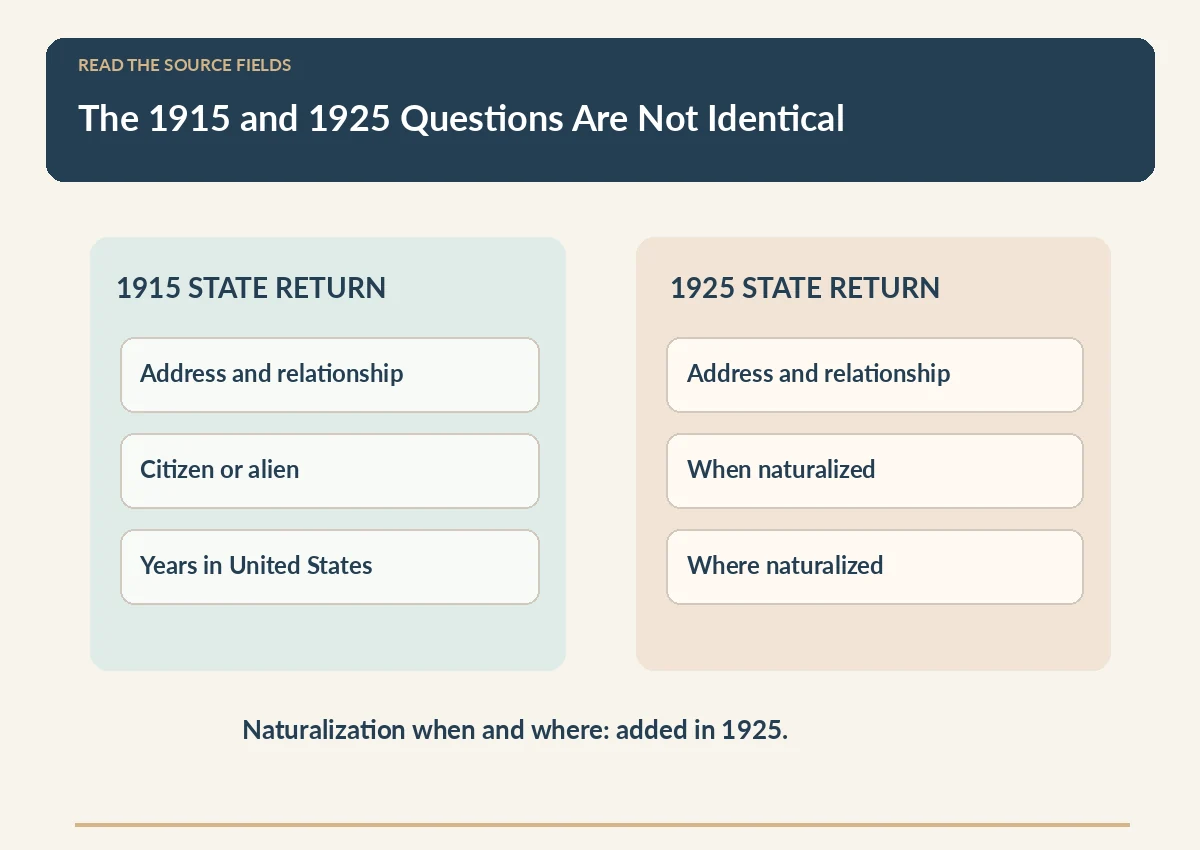
Separate a printed citizenship answer from a legal immigration event
A household line may record years in the United States and a categorical citizenship response. Those values reflect census reporting, not the underlying immigration document. Compare the reported arrival interval with the 1910 and 1920 federal returns and, where appropriate, contemporary passenger lists. If the numbers disagree, retain all three statements in a comparison sheet instead of averaging them into a precise date. The census can prioritize a naturalization search; it cannot by itself supply a court, certificate number, or completed federal proceeding.
| 1915 source field | What to record | What it cannot establish |
|---|---|---|
| Citizen or alien | The reported category | A naturalization court or date |
| Years in the United States | Reported duration | A verified arrival year |
| Relationship and address | Reported household context | Biological parentage |
Compare the correct year-specific fields before merging households
Use this small field comparison to avoid an attractive but false match. The 1915 and 1925 censuses both identify households at addresses, yet their naturalization detail differs. A person of the same name with a similar age in a later census must also agree with a spouse, birthplace, or documented address. An apparent child in the census might be an unrelated resident unless the written relationship supports the claim. Keep unresolved matches as candidates until an independent vital record or directory supplies another link.
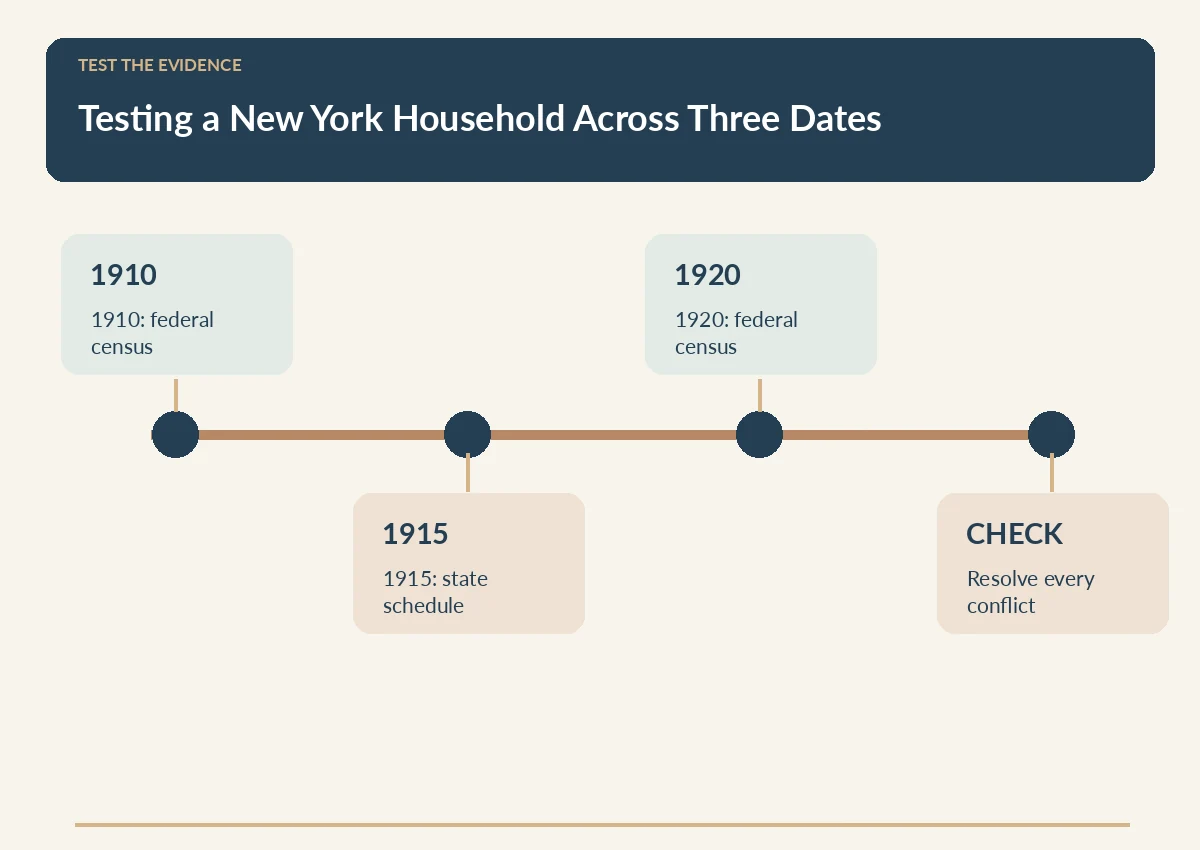
Build a three-record residence test around 1915
Place a 1910 federal census, the 1915 New York state return, and a 1920 federal census in dated columns. For each record note street and house number, each resident’s age, occupation, birth location, and citizenship answer. A changed address is a reported move, not necessarily a change of family. A household member disappearing from one census is a research question: search for work elsewhere, military service, marriage, death, or a transcription variation. This three-point method tests continuity better than two isolated database-name matches. For the fuller picture, see our guide “1865 New York State Census”.
Cite the New York State Archives series and image locator
A usable census citation specifies “1915 New York State Census,” the county and local enumeration district or address, the named household, original page and line, and the digital provider or microfilm reference used. Include the original custodian, New York State Archives series A0275, when applicable. If the online database rewrites a surname, quote the manuscript spelling first and record the index spelling separately. Preserve uncertainty about ambiguous handwritten letters. A citation should let another researcher retrieve the same evidence, not merely repeat the person’s name.
More Records and Archives Guides
How We Research the 1915 New York state returns
We checked the New York State Archives custody guide, the State Library microfilm holdings, and the year-by-year census questions. Our central check prevents the 1925 naturalization-when-and-where question from being projected backward onto 1915. We distinguish an index candidate, a visible manuscript entry, and an independently documented identity conclusion. This article contains no paid census referrals; the general policy appears in our affiliate disclosure.
The New York State Archives identifies the originals as population schedules series A0275; the State Library has county microfilm holdings.
No. The New York State Library identifies that when-and-where detail as a 1925 census feature, not a 1915 field.
The Archives says the fragile originals are restricted and staff do not ordinarily search them except for legal proof-of-age requests.
Check the county microfilm listing and relevant city key maps, then browse district pages and compare address variants.
No. A listed relationship is census testimony, and parentage should be checked against independent birth, baptism, or other records.