
The 1925 New York state census, dated June 1, 1925, was New York’s last statewide population census. Its household schedules do more than identify residents between the federal 1920 and 1930 enumerations: they report addresses, relation to head, birthplace, years in the United States, citizenship status, and—if someone was naturalized—when and where. The original manuscripts are New York State Archives series A0276; images or microfilm may be accessible through separate providers. Begin with the actual census page and its district header, because a database hit alone cannot establish a court of naturalization or a family relationship.
Locate the June 1 household inside series A0276
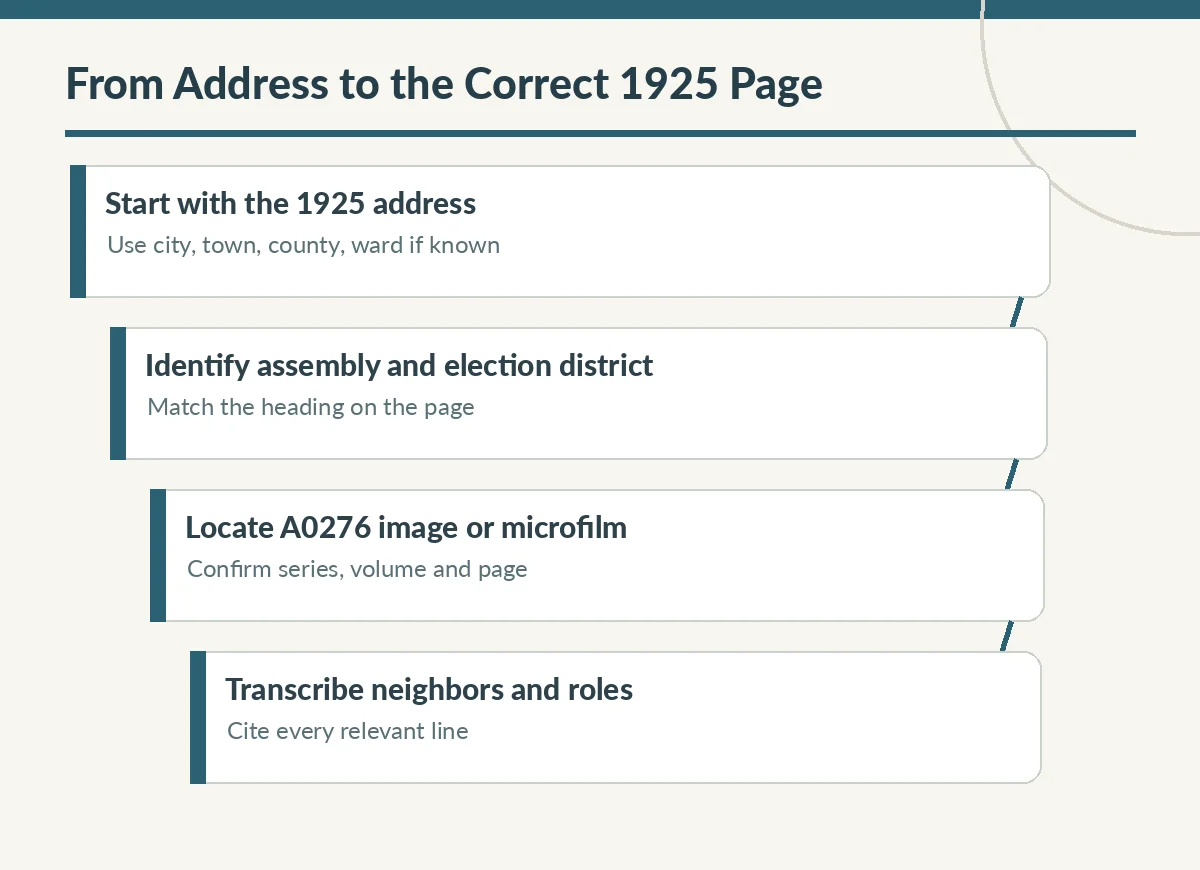
Search the 1925 collection using name variants plus a known borough, town or county; expand beyond the spelling in a family tree. On the actual image, copy county, assembly district, election district, municipality, ward if present, enumeration page and address. The Archives’ A0276 finding aid explains that volumes are arranged by county, then assembly district, then election district, which makes the header part of the record’s identity. A similarly named adult in another election district is not a match based on spelling alone.
Transcribe everyone assigned to the same home, but distinguish ‘relationship to head’ from verified biological descent. Lodgers, servants and extended relatives may share an address. Examine adjoining pages when a large household crosses a page boundary, and note whether an apparent missing child is away at school, living elsewhere, omitted or actually unidentified. The return is a single date’s administrative observation, not a complete history of residence or kinship.
Read the 1925 naturalization columns as leads, not certificates
The state schedules ask whether a foreign-born resident was a citizen or alien and, if naturalized, when and where. Write the wording and apparent jurisdiction exactly as recorded; ‘New York’ may refer to a place rather than a uniquely identified court. The New York State Library’s question comparison shows the when and where detail as a special 1925 feature, not a universal field on every state census. A reported year could be approximate or supplied by someone else in the household.
To test the answer, determine the person’s residence and probable court at the reported date. Search relevant federal, state or county naturalization indexes and original petition papers. Compare name, address, spouse, birth location and petition date. Record separately the census response, index entry and actual court document. Never turn a census ‘citizen’ notation into proof of a surviving certificate, and do not confuse an application, declaration or final order.

| Recorded in 1925 | Working interpretation | Needed verification |
|---|---|---|
| Alien | Census status report | Historical immigration file |
| Citizen | Enumerated as citizen | Independent citizenship evidence |
| Naturalized: date/place | Search clue for court records | Petition or final order |
| Years in the U.S. | Reported duration | Arrival or prior census |
Use address and employment-class codes to separate namesakes
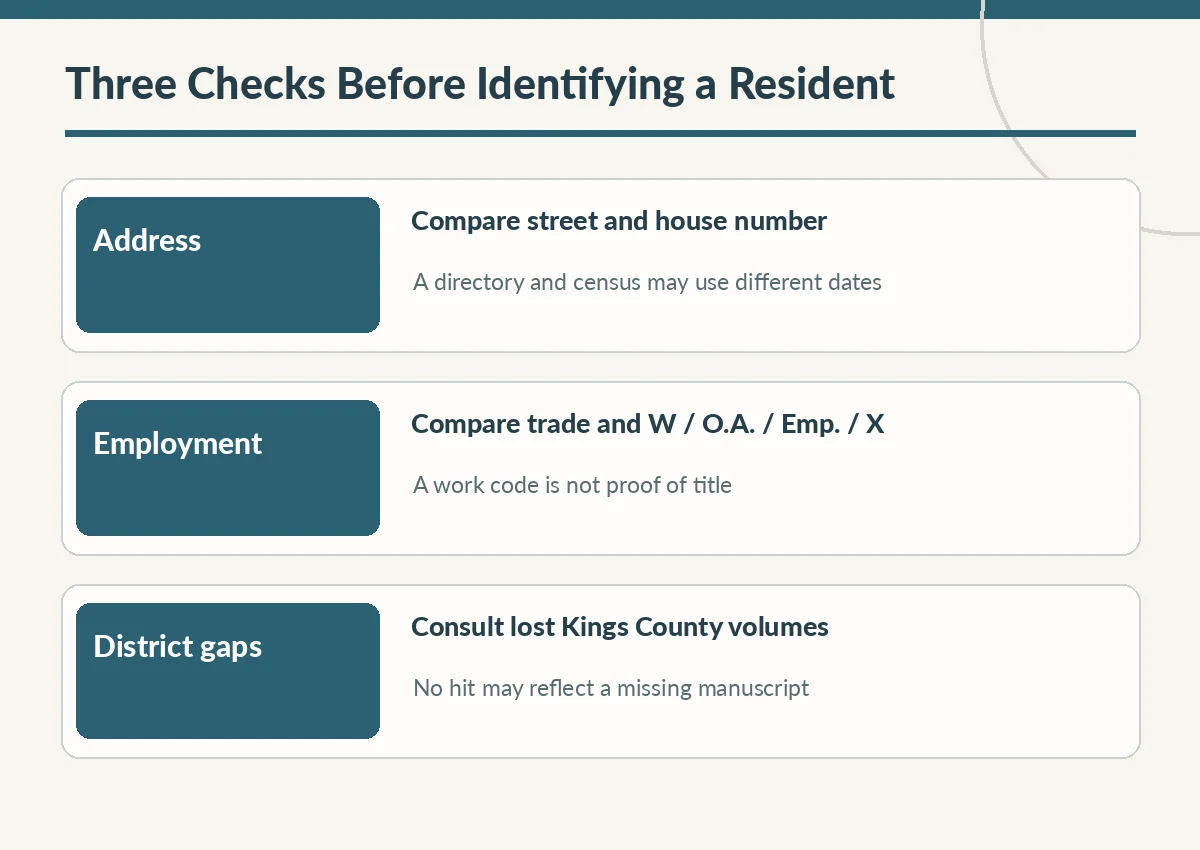
The schedule includes street or road, house number, occupation and an employment class. The Archives defines W as wage or salary worker, O.A. as working on one’s own account, Emp. as employer, and X as not in gainful occupation. Those are census classifications; X does not prove a person never worked, and an employer code says nothing by itself about a business’s legal ownership. Compare a reported trade with the 1920 and 1930 federal censuses and period city directories. For the next step, our guide “NYC Marriage Records” explains how to compare health certificates with clerk license files.
If two candidates named Anna Kowalski appear, build an address-and-associates matrix. Candidate A matches a city-directory address but conflicts with a verified husband’s occupation; Candidate B has a plausible age and child but lies in another district. Keep both provisional until a marriage certificate, school admission or another dated record resolves the conflict. Do not force consistency by overwriting the spelling on the original page. An unusual employer class can signal a transcription or column-alignment mistake, so check the printed heading first.
Check the known Kings County gaps before calling a result absent
The State Archives’ series inventory specifically identifies missing Kings County volumes 130 and 131, Assembly District 2, Election Districts 36–45, and volume 157 for Assembly District 9. Consult the finding aid for the precise location and uncertainty described for the latter volume. If the target’s address maps into an affected district, an unreturned name query cannot establish non-residence in Brooklyn. Note the district-level loss in your research log rather than claiming a complete search of New York City.
Try city directories, voter lists, 1920 and 1930 federal census pages, tax lists and municipal records as dated substitutes. A directory is not equivalent to a census: the year printed on the volume may differ from when information was collected, and it generally lists fewer residents. A useful negative-search entry says which name variants, image runs and election districts you checked, and which manuscript volumes were unavailable.
Distinguish census access from archival custody and name indexes
The New York State Archives retains the original 1915 and 1925 manuscripts but restricts handling because of their condition. The State Library describes microfilm access by county; other services may offer searchable transcriptions and scanned pages with their own sign-in or regional arrangements. Check the current portal terms before promising free images. A person found in an online transcription should be cited to the precise image and series, not simply to the search provider’s headline.
For a repeatable citation, capture ‘New York, state population census, 1925,’ county, assembly/election district, page, line, named household, A0276 if supported by the image metadata, and the repository or image provider. Where a digital image identifier is provided, copy it. Avoid claiming that a search index is the authoritative original manuscript. Keep a screenshot or careful transcription of difficult handwriting, subject to the site’s permitted uses. If that is your next decision, our guide “New York State Census Records” explains how to choose the right year and surviving county.
Build a defensible 1920–1925–1930 family timeline
Treat June 1, 1925 as the fixed middle point between the two federal population censuses. Record each person’s age, address, reported birthplace and household role in three separate dated rows. A family may change addresses without changing counties, and an adult may be temporarily absent from a household. If a spouse appears in 1920 but not 1925, test marriage and death evidence before inferring widowhood; the census does not automatically state why an individual is missing.
For naturalization, plot reported immigration, 1925 status and the petition or final order date separately. If the supposed final court event follows 1925, revisit whether ‘citizen’ was entered in the proper row, whether naturalization occurred through a spouse under historical law, or whether you have conflated two people. Your end product should be a three-date table, independent citations and one clear unresolved question, not a retrofitted single story.
More Records and Archives Guides
How We Research the 1925 New York State Census
We checked the State Archives’ A0276 finding aid against its general census custody guidance and the New York State Library’s actual list of 1925 questions. That crosscheck matters because later family-history summaries sometimes borrow details from 1915 or the federal 1930 schedule. The missing Kings County volumes and employment codes above come from the state-series description, not from an assumed complete index. Examples of competing namesakes are explicitly hypothetical.
We treat a census entry as an attributed report, not proof of a naturalization event. For any original document found, preserve the exact reference and recheck access and pricing on the archive’s site. No affiliate research platform or paid archive service is endorsed here; the site’s affiliate disclosure describes its general policy.
The enumeration describes residents as of June 1, 1925; it was the final New York state population census.
No. Its citizenship and naturalization-place fields are reported leads; confirm the court event in original records.
New York State Archives holds series A0276. Microfilm and digitized access can be available through other repositories or services.
New York State Archives identifies missing Kings County volumes for specified assembly and election districts.
The Archives defines O.A. as own account, meaning a person working for themselves rather than on wages; it does not establish business title.