
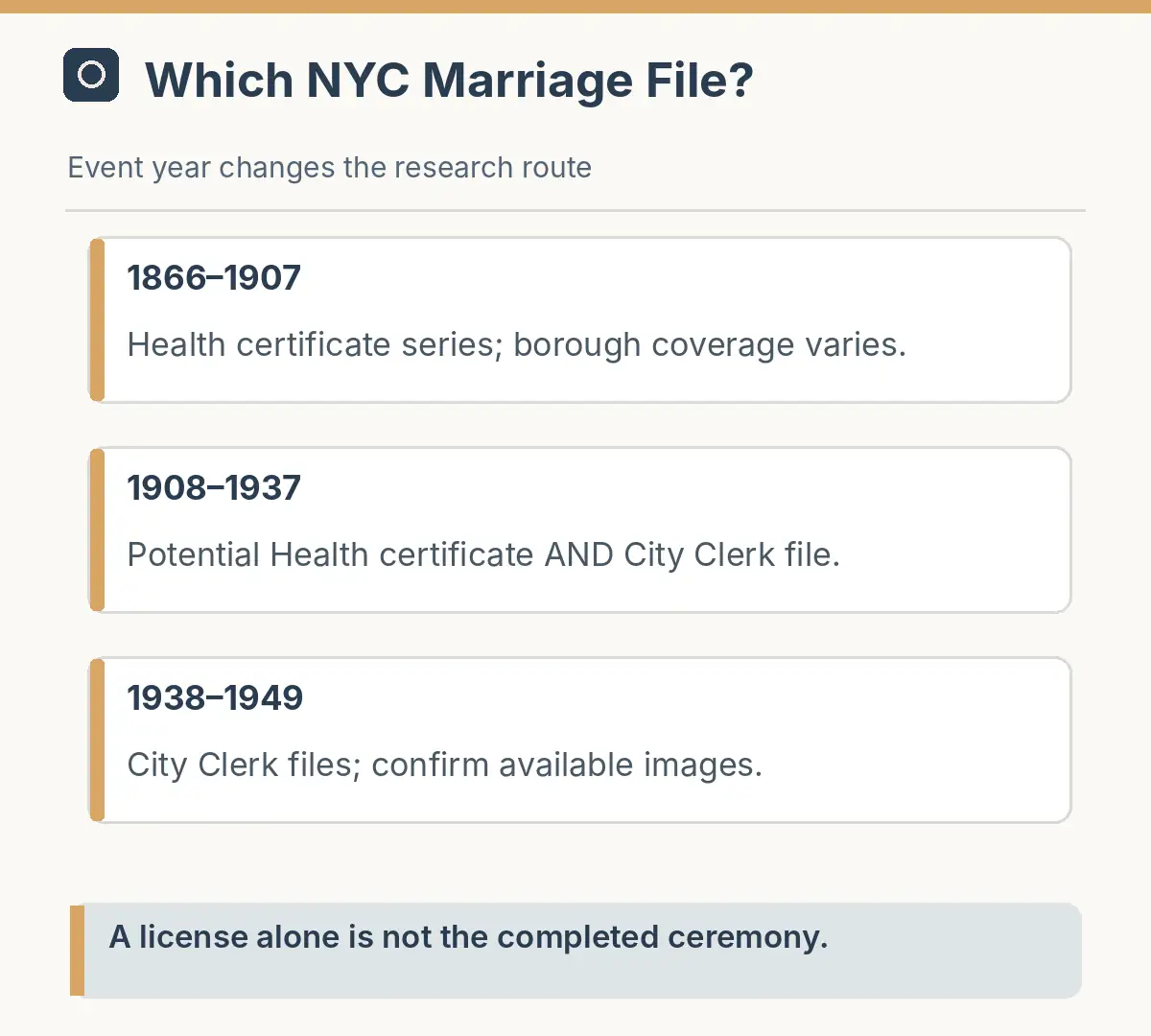
A New York City wedding between 1908 and 1937 may have produced two separate archival records: a Department of Health marriage certificate and a City Clerk file involving an affidavit, license and marriage certificate. The NYC Municipal Archives FAQ explains why. Use the official Historical Vital Records portal to search, then decide which series you have actually found. An application or issued license is not, alone, proof that the ceremony occurred. Borough and year determine whether a full scanned certificate is available.
Choose the right borough and the historical city boundary
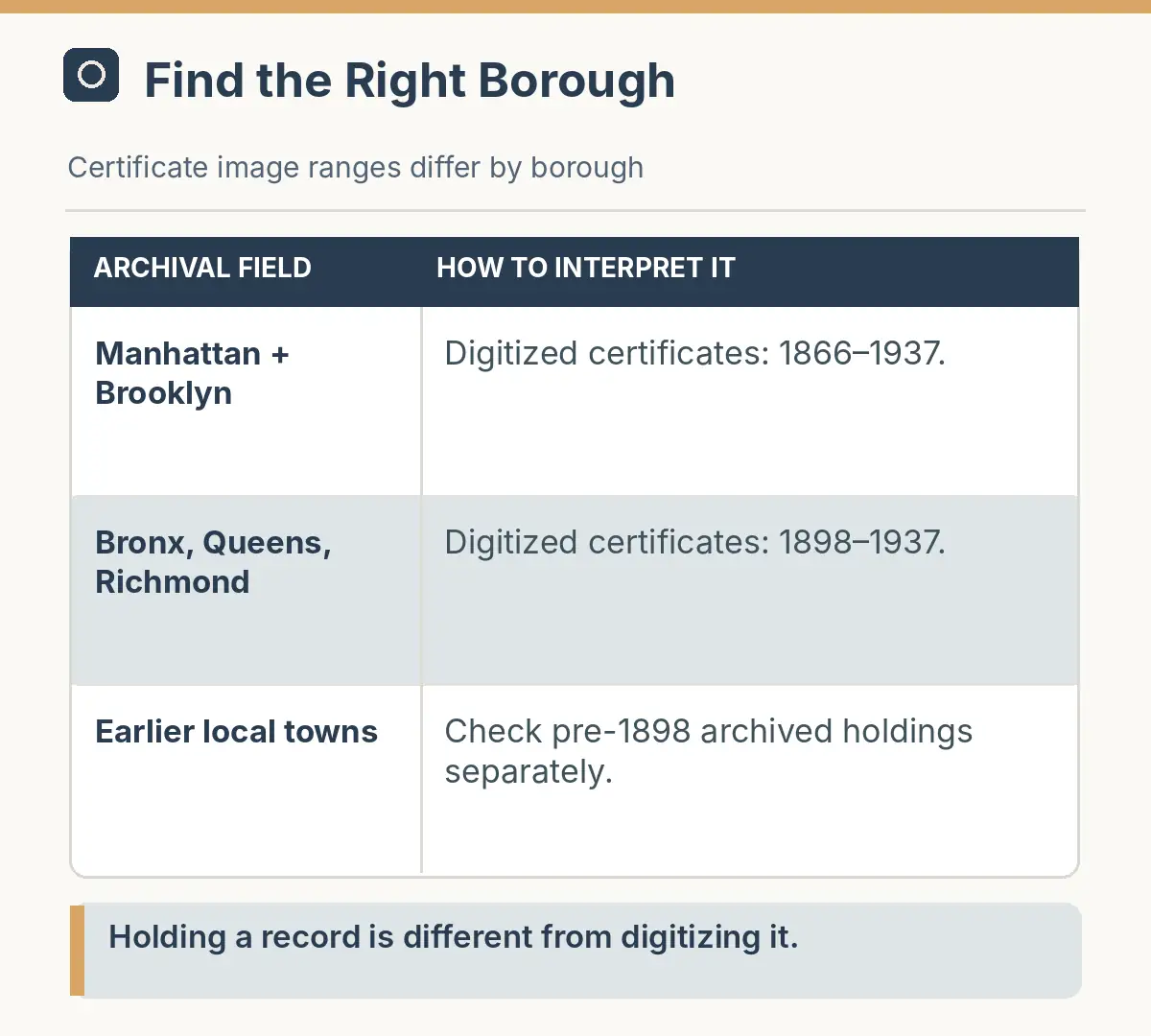
New York City did not consist of its modern five boroughs in every nineteenth-century year. The 1898 consolidation changed administrative geography. Before then, the City of Brooklyn, old New York City, and towns in Queens or Kings counties may have kept their own registers. The Municipal Archives holdings list separates Manhattan and Brooklyn early records from Bronx, Queens and Richmond series beginning in 1898, with additional earlier local holdings. Search by the borough of the ceremony, not automatically the borough where a later census placed the spouses. Preserve both the historic locality and its current borough name. A person living in Brooklyn may have married in Manhattan, and a church wedding could be entered in the civil borough where the event happened. When the certificate year predates consolidation, verify whether the locality had its own recordkeeping authority and archive series before switching your search to modern Queens or the Bronx. A failed modern five-borough filter does not show that the couple never married.
Look first for the Health Department marriage certificate
NYC Municipal Archives lists digitized Health Department marriage certificates for Manhattan and Brooklyn, 1866–1937, and for the Bronx, Queens and Staten Island, 1898–1937, on its digital-status chart. These are image availability ranges, not promises that every event in every year was registered correctly. Use one spouse’s name and approximate ceremony year to identify a possible index result. Note any certificate number, borough, date and named officiant, then open the image. Check the actual spellings, occupations and reported parents or witnesses when those fields appear. If a match is not digitized, the archive explains that microfilm or a copy order may still be the appropriate route. A transcribed index entry should remain labeled as such until the page has been inspected.
Search the distinct City Clerk license-file series
New York State’s 1908 marriage licensing requirement created another documentary series in New York City. The archive’s marriage FAQ says the City Clerk file typically includes the couple’s affidavit, the license issued in advance and a certificate completed by the ceremony’s officiant. Additional details may appear in the affidavit, including parents’ places of birth and the bride’s occupation. These extra statements do not make the forms independent witnesses if the same applicant supplied them. The City Clerk series extends to 1949 in the Municipal Archives holdings, but the digitization coverage is uneven by borough and year. Do not equate the archive’s full holding span with the portion currently viewable online. Keep the two series’ indexes and document numbers separate.
Distinguish an issued license from a performed marriage
When you find a license, ask whether a certificate completed by an officiant is attached or independently filed. The affidavit contains information the couple reported before the event. Issuance of the license allowed a ceremony but did not alone establish that a wedding was celebrated. A Health Department certificate or the completed City Clerk ceremony record can directly support the registered marriage, though identity details may still be secondhand. In a report, quote exactly which document provides the ceremony date rather than silently borrowing the affidavit filing date. If the same couple appears in both series, compare the witnesses and parent details and note conflicts. The two series can illuminate different information, but they need not be independent corroboration of every fact; both may ultimately repeat the couple’s own statements. Reconcile not only the date and names but also who supplied parental data on each form, if an informant is indicated. Our walkthrough on how to find historical U.S. marriage records and prove the event sets out each step.
Use the Municipal Archives website rather than guessing digitization
The city’s status chart is periodically updated. The Digital Vital Records page specifically distinguishes digitized marriage certificates from digitized license records. For a desired borough and year, check both chart entries before promising a viewable image. The official genealogy page explains that researchers can search, browse, download or order historical vital records and identifies the City Clerk as the custodian for marriage records after 1949. If an archival item is available only on microfilm, record that limitation rather than sending a reader to an imagined full-text database. Avoid writing a generalized ‘NYC marriages 1866–1949 all online’ claim: that would mix series and confuse access with legal coverage.
Create a borough-and-series reconciliation worksheet
Save one line per source: borough as recorded, ceremony year, spouse spellings, Department of Health certificate number or City Clerk file number, document type, image or microfilm status, and custodian. If a parent was reported on the affidavit but not the health certificate, cite the affidavit for that detail. If a common-name pair such as Anna Rossi and Joseph Brown appears in more than one borough, compare addresses, ages, occupations, officiants and independent census households. A match on both first names is not enough for a family-tree merge. Mark open questions such as a missing officiant certificate or conflicting parent’s birthplace explicitly. This is a repeatable method for determining whether you have one marriage recorded twice or two entirely different couples who happen to have similar names. For a related choice, see our guide “Maine Marriage Records Before and After 1892”.

More Records and Archives Guides
How We Research New York City Marriage Series
We verify the two independent filing routes against the Municipal Archives FAQ, check what is actually digitized on the official year-by-borough chart, and use the holdings guide to respect pre-1898 jurisdictions. We do not claim that a license alone proves marriage or that the website scans every existing file. The affiliate disclosure explains commercial transparency; city archival documentation determines the research route.
Yes. From 1908 through 1937 there may be both a Health Department certificate and a City Clerk license file.
Not by itself; seek an officiant-completed certificate or another direct record of the wedding.
Yes, their listed certificate coverage begins in 1866; the other three boroughs begin in 1898.
No. Online digitization depends on borough, year and document type; consult the status chart.
The city directs requests for later records to the NYC City Clerk rather than the Municipal Archives.