
Select Death Records, Not Every NYC Vital Record
For a historical New York City death, determine the borough and event year before searching the Municipal Archives’ digital portal. The city’s official holdings table lists different date spans by borough, while its genealogy page explains how to search, view and download historical material or request a certified copy. The entire portal’s date range should never be mistaken for uniform death-certificate coverage in all five boroughs.
Death records are particularly sensitive to geographic and administrative history. A relative died in a neighborhood that is now the Bronx, but the reported event happened before the borough existed: the responsible collection may be a former town, village or Manhattan record. A modern borough typed into a search box can therefore hide the correct archival route. Record the address and date from a contemporary newspaper, burial register or family document before you assign any certificate series.
Use the Municipal Archives Death Holdings Calendar
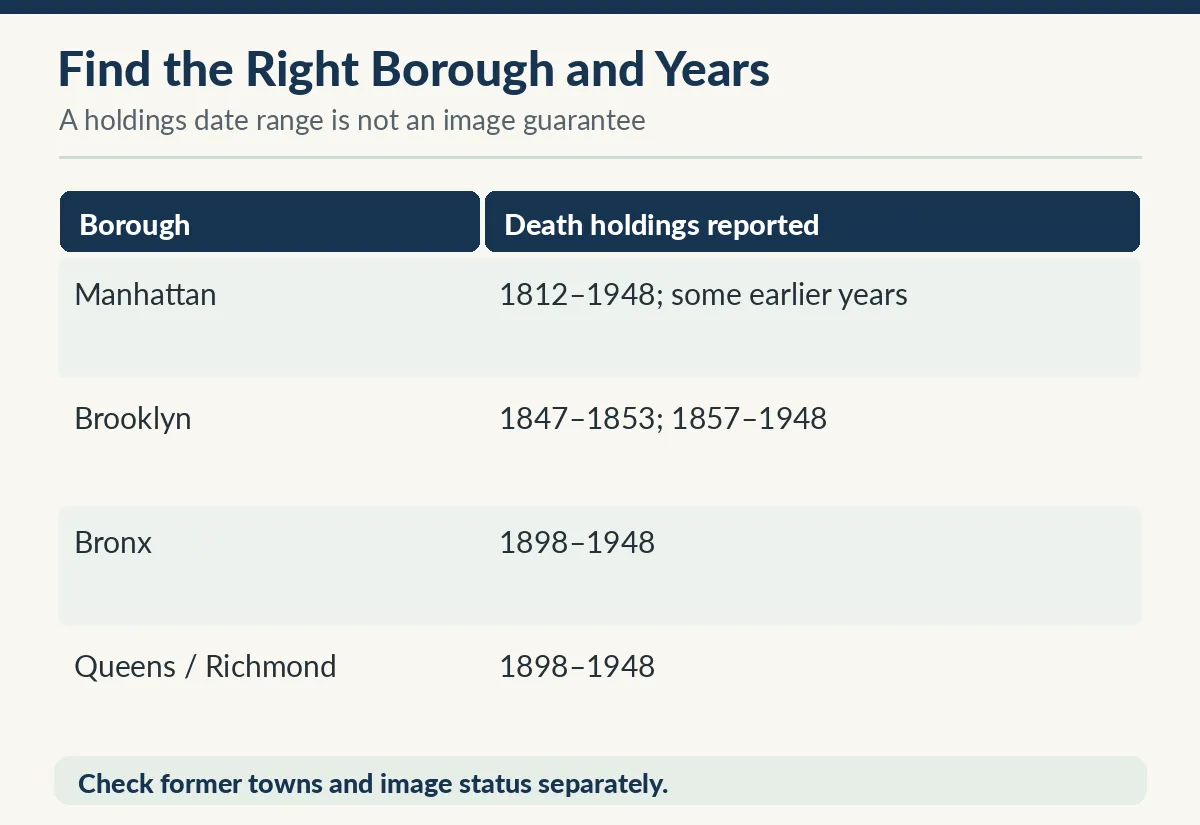
The city lists Manhattan death material for 1795, 1802–1804, 1808, and a longer 1812–1948 run. Brooklyn has 1847–1853 and 1857–1948; the Bronx, Queens and Richmond (Staten Island) are each listed from 1898–1948. These ranges describe archive holdings, not a promise that every death generated a surviving certificate or that every year is digitized. Keep a year-and-borough coverage note beside each search.
Some Kings County towns—such as Flatbush, Flatlands, Gravesend, New Lots and New Utrecht—have separate historical municipal records for particular periods. The Archives also notes pre-consolidation town and village material. This means a Brooklyn event before consolidation should not automatically be treated like a post-1898 five-borough death. The objective is to locate the government that would have recorded that event at the time, then find the correct successor custodian.
Distinguish Digital Images, Certificates, and Early Registers
The Historical Vital Records digitization page describes an ongoing project. An indexed name does not necessarily mean the corresponding image is online, and the status can change as scanning progresses. The same site explains that earlier register books may be available by microfilm rather than as full-page certificates on the web. Copy a certificate number when supplied, and record whether your actual source is a transcription, a register entry or a scanned certificate.
When the portal returns an image, inspect the entire page, reverse sides if provided, headings, amendments and adjacent fields. Do not rely only on a search snippet that omits the informant or the precise date. If the site has a gap in images, use the city’s holdings and order pathways rather than claiming the death was never recorded. For legal use, the Municipal Archives describes a separate certified-copy process; an ordinary download and an official certified document serve different purposes.

Resolve the City Boundary and Record-Custodian Problem
The Municipal Archives points researchers to Manhattan materials for certain places incorporated before the separate Bronx borough was formed in 1898. The city also lists independent Kings County town holdings, so two events only a few miles apart may require different catalogs. Make a location ledger containing street or locality as written at the time, year, then-current municipality and archival search choice. Only after that should you run an exact surname query.
If a person was buried in Queens but reportedly died in Manhattan, seek the death record in the death jurisdiction, not the cemetery’s borough. Similarly, an obituary printed in Brooklyn does not prove the event occurred there. A hospital record, home address or death notice can supply useful clues, but the original register or certificate should be read before you draw a conclusion. When the reported location changes between sources, test both jurisdictions and describe the difference explicitly.
Validate the Person Behind the Certificate
An apparently exact death date can belong to a namesake. Compare reported age, residence, occupation, birthplace, marital status and burial details when these fields are present. Make a matrix that lists the value in the death record, the corroborating record, the conflict, and the next source needed. A spouse named by an informant is a useful lead; the source of that information still matters. An absent parent name is not negative proof that no parent-child relationship existed.
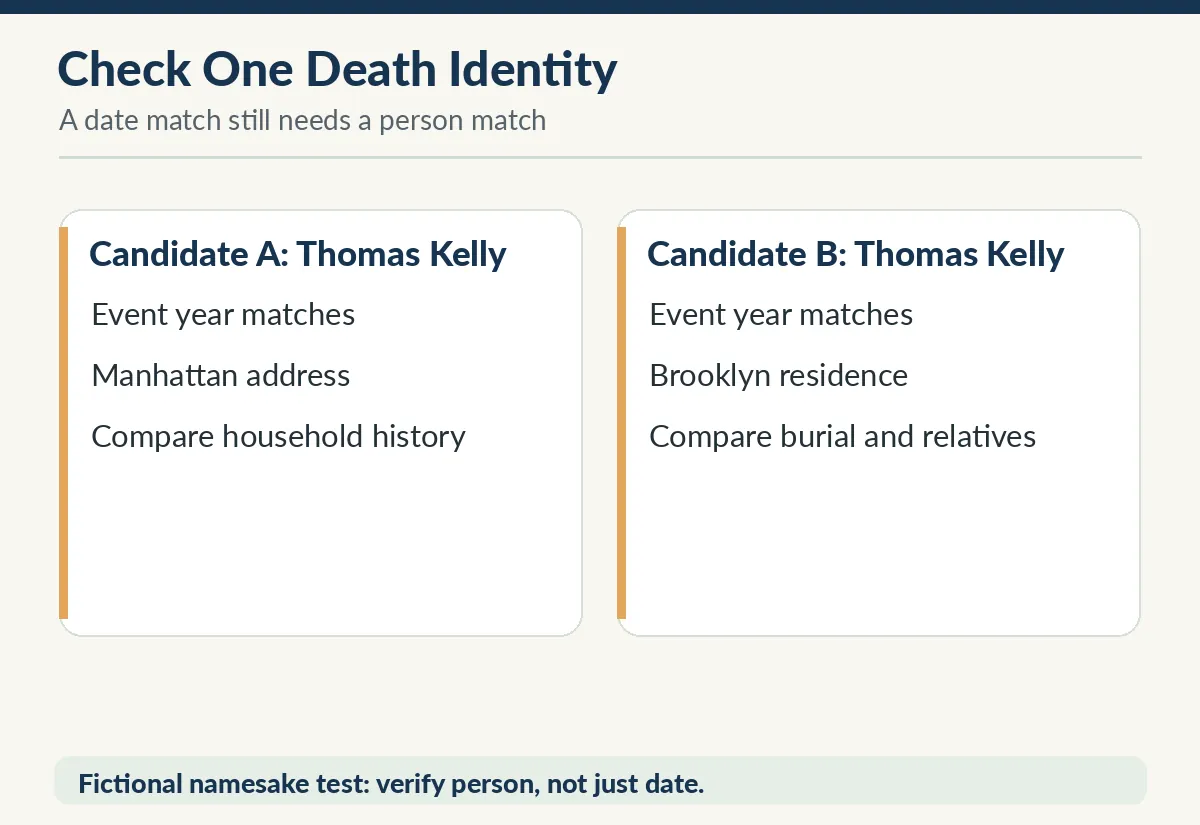
Use a fictional example: two people called Thomas Kelly died in different boroughs during the same year. One image reports a Manhattan address, while a cemetery ledger for your relative notes a Brooklyn residence. Rather than choosing the familiar name, inspect the burial and informant details and the timeline of the household. Label the example fictional in your research notes so no illustrative details accidentally become supposed archival citations.
When the death year is close to the end of an archival series, distinguish the actual event date from registration or indexing date, which can differ. Also inspect whether the portal result is an ordinary death record or another documentary class. A report that someone died while visiting Manhattan may coexist with a longstanding Brooklyn residence; those two places serve different questions. Preserve the address exactly as spelled on the document and map the historical jurisdiction separately. If your proposed certificate lacks an identifying name or number, make that a gap in the citation rather than inventing one.
More Records and Archives Guides
How We Research NYC Death Certificates
We read the Municipal Archives’ borough-by-borough holdings before consulting the online family-history access information. We then mark whether a digital original was personally seen, an index was only searched or an item requires a visit or certified request. This method intentionally treats an archive’s holdings range, a portal index, and an individual certificate as three distinct claims.
A completed citation records the municipality or borough, death event date, record class, visible number and image or microfilm location if available. We preserve conflicts and use other sources rather than copying a machine-readable name as proof of family connection. See our affiliate disclosure; the government resources cited here are selected as custodians, not as implied partners.
A substantial listed Manhattan run starts in 1812, but the Municipal Archives also lists several scattered earlier years. Confirm the relevant year and the item format.
The official holdings list 1847–1853 and 1857–1948 for Brooklyn. Coverage is not a statement that every death was registered.
The Bronx became a separate borough in 1898. Earlier records may belong to former towns or the Manhattan administrative collection depending on location and annexation.
No. The Municipal Archives distinguishes free research downloads from certified copies ordered for legal purposes.
No. Match the certificate’s personal particulars to independent family records and identify the informant before accepting relationship claims.