
Michiganology death records are searchable through the Archives of Michigan digital portal, but a hit does not always include an image of the underlying certificate. The Michiganology death-search form lets researchers combine name, county, date range, age and parent fields. Official Michigan guidance describes death certificates from 1897 through later indexed years, with restrictions and changing digitization coverage. Begin with the death year to choose the proper search tool, then distinguish an original certificate from an index record.
Select Michiganology, GENDIS or the library records by year
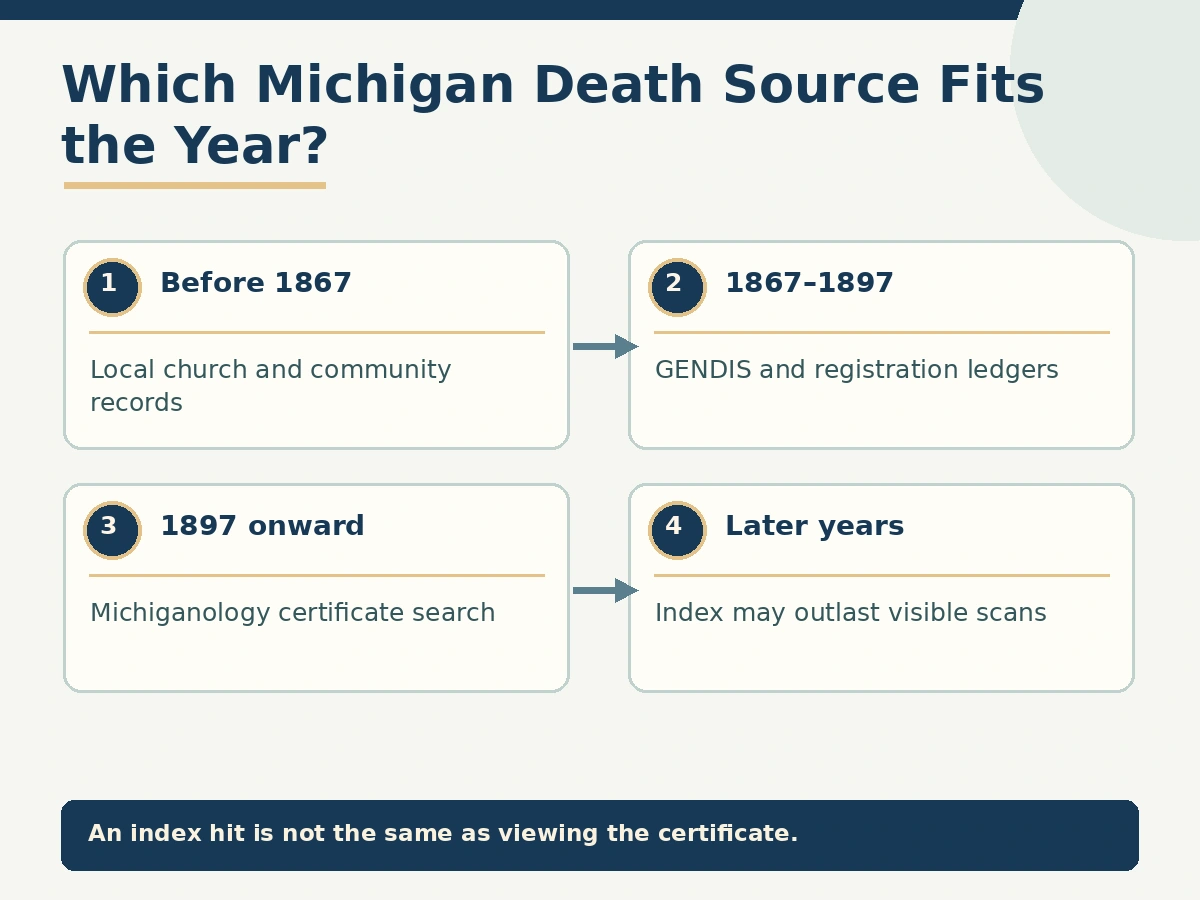
Michigan required statewide local death reporting beginning in 1867. The Michigan Department of Health and Human Services maintains GENDIS, a historical index for 1867–1897 with more than 460,000 entries. Michiganology covers digitized or indexed later death certificates starting in 1897. The Library of Michigan also lists death returns, registers and microform indexes, so one website is not the entire state death-record system.
Check the Library of Michigan’s holdings table before searching. Its current summary describes online certificate imagery to 1946 with indexing through 1952, while another state guide has older image cutoffs. Record the page and check date rather than representing an old cutoff as permanent. Later records may require a lawful copy request, and a failed online image search does not establish that a death record never existed.
Enter the Michiganology date window correctly
The Michiganology search form allows deceased first and last names, city, county, death range, age and father’s or mother’s name. Its help specifically advises searching with a range bracketing the desired date, for example from the end of the preceding year to the start of the following year when searching an entire year. That matters because typing one narrow day can exclude an otherwise correct historical match.
Start with a loose name and year, then add county or parent filters only as evidence warrants. A maiden surname, initial or transcription error may prevent an exact full-name match. Copy the input fields as part of your search log. When you find several same-name deaths in adjacent counties, compare all candidates rather than assuming the first result is your relative.
Read the certificate image as an informant-based document
If an image is available, inspect the complete certificate, not only the portal’s summary fields. Transcribe the recorded death and residence information and distinguish physician or registrar entries from statements supplied by an informant. The decedent’s parents or birthplace may have been reported by someone with imperfect knowledge. A source being original to registration does not make every statement within it firsthand evidence.
Record the registration number, county, volume or image identifier displayed, access date and any uncertain handwriting. Do not infer an exact birth date from a calculated age unless the source explicitly supplies one. If the certificate says an informant was a son or daughter, that is a reported relationship relevant to the evidence, not proof of the full biological lineage without supporting records.
| Source | What it supports | What it does not prove alone |
|---|---|---|
| GENDIS | 1867–1897 death index clue | Full later certificate |
| Michiganology index | Person and registered event candidate | A viewed image |
| Certificate image | Recorded details and informant | Every statement firsthand |
Recognize an index-only result and copy restrictions
A Michiganology collection title or indexed name might advertise a broad end year even when image access stops earlier. Privacy restrictions and digitization progress may influence what a visitor can see at a given date. A 1950 indexed death should not be presented as though a complete 1950 image was viewed. Use wording such as “indexed death candidate, image not examined” until a permitted copy or scan is obtained.
FamilySearch and library collections may supply other indexes or lawful images; compare provenance, date scope and record-level identifiers. The Library of Michigan explains that images under the relevant 75-year restrictions can be limited in some online collections. If a certificate is not accessible, preserve the full citation to the index and follow the state or county request process. Never suggest circumventing privacy restrictions.

Use GENDIS and pre-1897 ledgers for older deaths
For an 1880 Michigan death, do not begin by searching a certificate database that starts in 1897 and call its blank results negative evidence. GENDIS covers a substantial collection of 1867–1897 indexed deaths and the Library of Michigan describes bound earlier returns and registers. An early ledger’s fields can differ from later certificate forms. Search by reported locality and date, and verify whether the original pages can be consulted.
For a death before statewide reporting in 1867, direct the next search to church registers, newspaper notices, cemetery records and county or township sources that actually existed then. A Michiganology search for 1855 cannot serve as a survival test. The date-based routing decision should appear at the top of the research log so later family collaborators do not repeat a structurally impossible query.
Test identity and cite the Michigan source layer
Two same-name people may have died in Michigan in the same decade. Rank each candidate using death place, spouse, parents, residence and a separately dated census record, noting where the death record’s informant might be unreliable. A parent name that matches a published tree is not independent confirmation if the tree copied the same index. Seek a marriage record, obituary or earlier household document to resolve conflicts.
Cite Michiganology as the provider of the viewed record and name the underlying Michigan death certificate or index, year, locality and number when available. For GENDIS name the state index and date range, then separately cite any ledger page. The resulting conclusion should identify whether it rests on an original image, a derivative index, or an unverified match. Explicitly preserve unresolved discrepancies. For a related choice, see our guide “Minnesota Death Index, 1904–2001”.

More Records and Archives Guides
How We Research Michigan Death Certificates
We compared Michiganology’s live form with current Library of Michigan and Archives of Michigan guidance and the state GENDIS description. Official pages are not fully synchronized about the latest image year, so this article distinguishes indexed coverage through 1952 from image availability rather than claiming one immutable cutoff. No fabricated historical certificates appear here. Read our affiliate disclosure; no unconfirmed product link is used.
No. Broad collection or indexing coverage and viewable certificate images are different; official pages give changing image-year limits.
Start with the state GENDIS index and the Library of Michigan’s earlier death returns or registers, not a 1897-onward certificate search.
County, city, broad death dates, age and parents’ names can help when those details are supported by independent evidence.
Digitization limits and legal restrictions may prevent image display even though an index entry or a lawful copy route exists.
No. It is often reported by an informant; test the statement against independently created family and civil records.