
A failed Masterton online grave search does not mean that no local burial occurred. The Masterton District Council search covers Riverside and Archer Street cemeteries, while records for Mauriceville, Hastwell and Tīnui require contact with the Wairarapa Archive. First establish which ground and what approximate decade is plausible. Then confirm the person through a burial entry and an independent New Zealand death registration, rather than treating a grave-search name match as proof of identity, family links or the legal right to a plot.
Choose Between Riverside, Archer Street and Rural Cemeteries
The Masterton council identifies two urban cemeteries—Riverside and Archer Street—and rural burial grounds at Mauriceville, Hastwell and Tīnui. The public web search is designed for the two urban grounds. Before entering a name, write a location hypothesis based on death notice, funeral announcement, residence or another original family document. If a person lived outside Masterton town, a rural cemetery is a genuine possibility rather than a failure of the urban database. Do not let a modern council boundary substitute for where an individual or family actually chose burial.
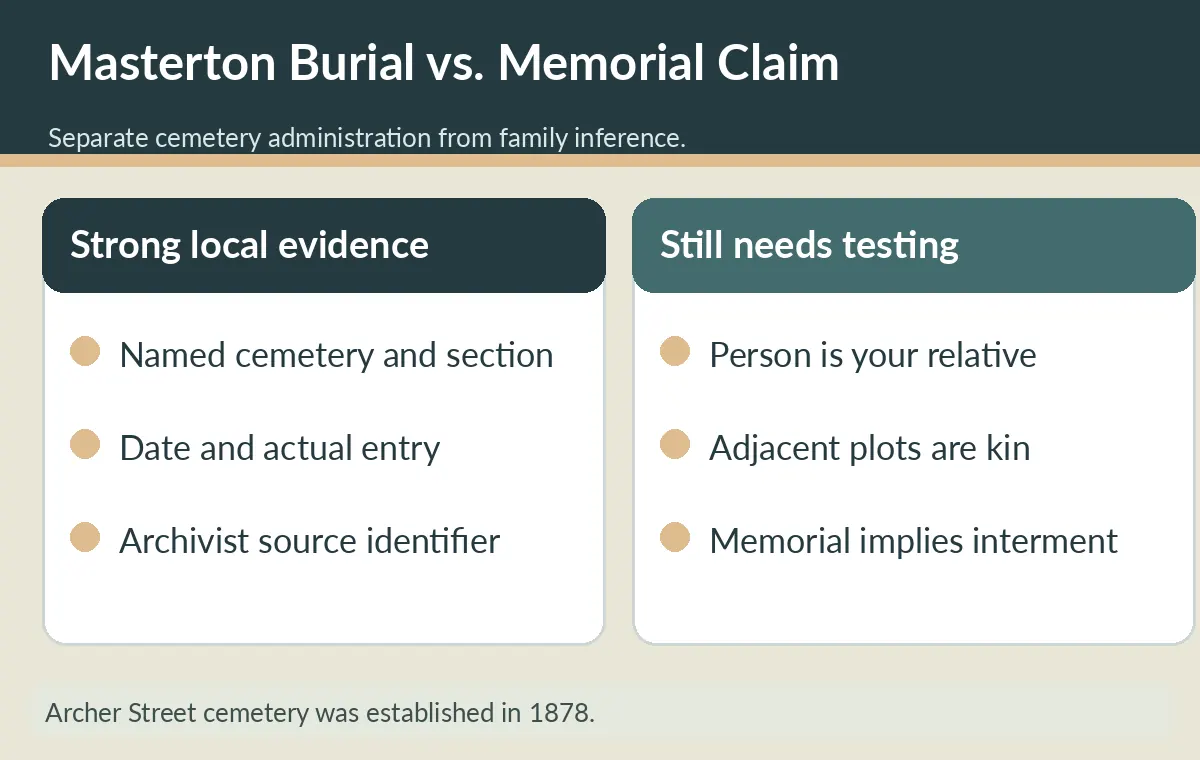
The council dates Archer Street’s establishment to 1878, making the timing of an alleged much earlier burial a reason to investigate rather than an automatic database miss. A burial in an older local ground might be documented differently. Cemetery-name spellings, historical use and transfers in administrative custody can vary; record the name supplied by the source rather than selecting the first search result matching the current city. An obituary may describe a funeral service rather than the place where the remains were interred.

Run the Official Urban Cemetery Search Carefully
Begin with the deceased’s family name and a sufficiently broad period if the form offers date filters. Test spelling variants, initials, married surnames and transcription differences. Read all returned fields, including cemetery, burial or service date, section, plot and any recorded names; save the council’s stable reference or a dated search note. If multiple people share a common name, compare independent age, residence and death notices before accepting one result. Do not infer that two occupants of a section are siblings or spouses merely because their memorials are close.
The council warns that users who have difficulty with the tool can try browser troubleshooting and should contact the Wairarapa Archive when a grave cannot be found or has been plotted incorrectly. A plotted position can be an administrative map reference rather than survey-grade location evidence. If a family document gives a specific grave number but the pin conflicts, request clarification instead of silently changing the family record. Distinguish an official interment entry, the map location and the wording on any headstone.
Request Rural Records Directly Through Wairarapa Archive
For Mauriceville, Hastwell and Tīnui, the council explicitly says that the cemeteries do not have online records, but Wairarapa Archive holds copies. Send a precise enquiry that includes alternative names, approximate death or burial year, possible cemetery and the reason for the proposed identification. Ask whether a register, plot plan, original ledger or later transcription underlies any reported result. Explain if the target is an early settler and whether contemporary newspaper notices, church books or other family papers contain relevant place clues.
An archivist may identify a relevant burial even when the web portal appears empty. Conversely, a negative reply about a surviving register does not establish that someone was never buried in the district. Record what the archivist searched, the dates of the surviving series and whether a search concerned the entire cemetery or only a subset of its entries. Do not turn a missing stone, unlocated grave or unindexed surname into a statement that the person died elsewhere.
Check the Death Registration Separately From the Burial
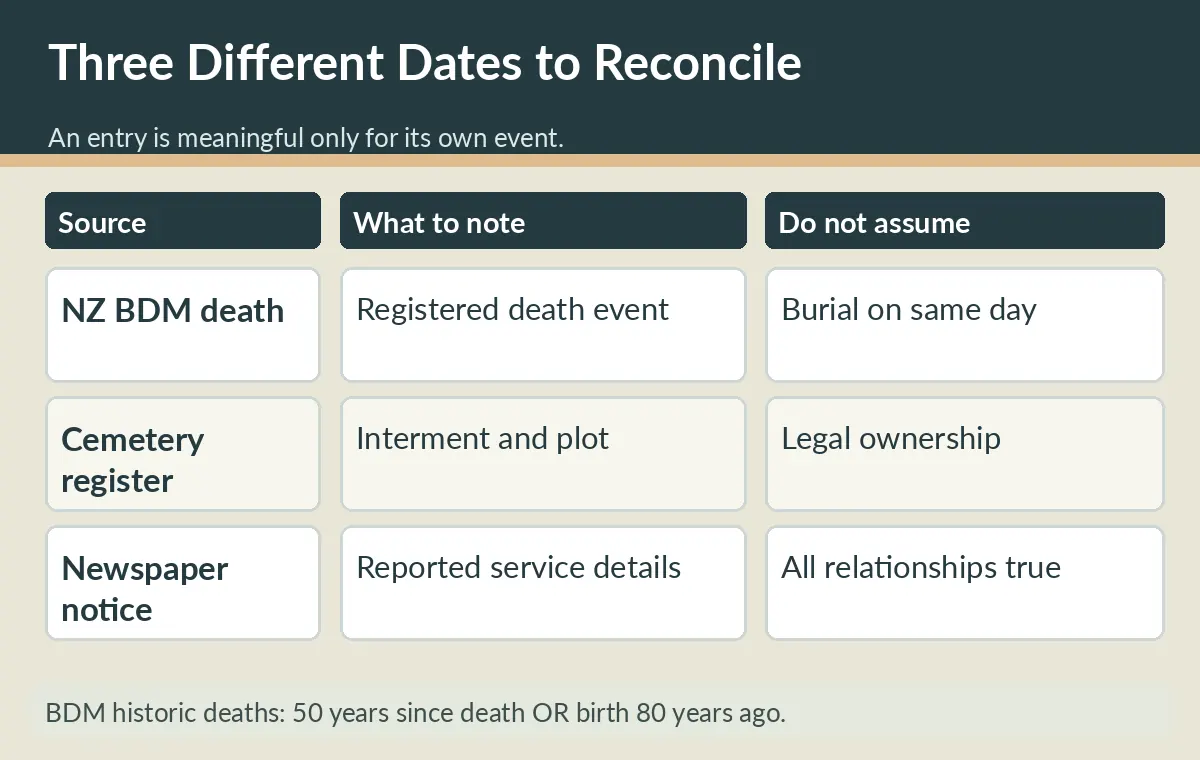
New Zealand’s Historical Births, Deaths and Marriages search is a different national collection from the Masterton burial database. Historical deaths are searchable when they occurred at least 50 years earlier or the deceased was born at least 80 years earlier. Those criteria control public index visibility and should not be mistaken for the date a death was first registered. Search the civil registration using known surname variants and a plausible period, then obtain the fuller official record when identity details matter.
A civil death registration may provide an event date, place and reported personal particulars, while a cemetery ledger documents a burial or administrative process. The dates need not be identical, particularly where transport, delays or other arrangements were involved. Make a three-date table for death, registration and interment; only fill values actually stated by sources. A funeral notice may add names of relatives, but such relationships require corroboration. Neither a burial date nor a memorial date alone establishes the certified date of death.
Separate the Grave Occupant From Plot Rights and Memorials
A grave-search result is best treated as evidence of what the cemetery operator’s records report. A plot can have more than one interment, while a memorial may commemorate someone buried elsewhere. The purchaser or holder of a plot right need not be a deceased person’s parent, spouse or descendant. Record who is named in which capacity, based on the exact document, and leave legal rights or kinship unknown where the relevant register does not say. If an image of a stone adds dates, transcribe the lettering literally and note erosion or later additions.
For two people with matching names, build parallel rows containing recorded cemetery, plot, age or date, other given names, residence and funeral notice. Check the result against an official death registration or independent contemporaneous record rather than merging candidates because a family surname appears nearby. When a location pin is wrong, preserve the original search record and the correction correspondence. Do not publicly share details of living plot-right holders or other private contacts without a legitimate reason and consent.
Make a Reproducible Cemetery and Death-Record Citation
Cite the Masterton District Council dataset or original register, cemetery, full recorded name, interment date, grave or section number if shown, and your retrieval date. If Wairarapa Archive supplies information, retain the collection or volume title, entry reference and whether the response derives from an original or a copy. For the separate national death record, give its registration identifier and source type. A database label without the underlying source information is a clue, not a fully verified historical citation.
The GenHis affiliate disclosure is provided for transparency and does not imply any endorsement by the council or BDM. Finish with a conclusion bounded by the record: ‘burial entered at Riverside on date X; death registered separately on date Y; kinship to adjacent grave untested.’ If the council search yields nothing, state explicitly whether you also asked Wairarapa Archive about the rural cemeteries, or keep the negative search limited to the two online urban grounds.
More Records and Archives Guides
How We Research This Collection
We compared Masterton District Council’s cemetery-search coverage with its full list of urban and rural grounds, then checked New Zealand’s national historical BDM visibility policy. We kept online burial records, rural archive copies, official death registrations, grave maps and memorial assertions as separate evidence layers. No result for a named person was asserted, and a negative urban search was not generalized to all Masterton cemeteries.
The council identifies Riverside and Archer Street as searchable through its public web tool.
Ask Wairarapa Archive; the council says these rural grounds have copies available but no online records.
Not necessarily. Check separate historical BDM death registrations to establish the event date.
The burial may be in an unindexed rural ground, an earlier cemetery or an incomplete record set.
No. Identify individual interments and seek independent relationship evidence.