
An Auckland surname in a Kura catalog entry is a research lead, not proof of a family relationship. Auckland Libraries’ heritage portal connects digitized objects, local newspaper indexes and materials available through specialist research rooms. Start by defining whether you need a photograph, neighborhood history, newspaper article, archival manuscript or whakapapa resource. Then check the catalog’s creator, date, format and location. A result from a photograph collection must not automatically be treated as a birth record, or a later caption as a contemporaneous identification.
Choose Kura, the Catalog, or a Specialist Research Centre
Auckland Libraries provides more than one entrance to its historical holdings. Kura Heritage Collections Online is a discovery system for digitized heritage material; the general catalog and research centres cover other formats. The library also offers tailored research enquiries and access to a Heritage Collections Reading Room. Use the title and item type to decide whether a result is viewable immediately or whether you need to request a physical object or microfilm. ‘Not online’ means not available through that digital view; it is not proof that no relevant item survives.
Search a well-documented family name, then narrow by dated school, workplace, suburb or community association. For common surnames, a place-and-date search may find a relevant photograph or local article that a literal name search misses. Capture the catalog’s original title, the repository’s identifier and any historical spelling. Do not combine two records into one person merely because their tags include the same suburb. Different creators may describe a single event using different, sometimes retrospective, labels.

Read Auckland People and Events as a Newspaper Finding Aid
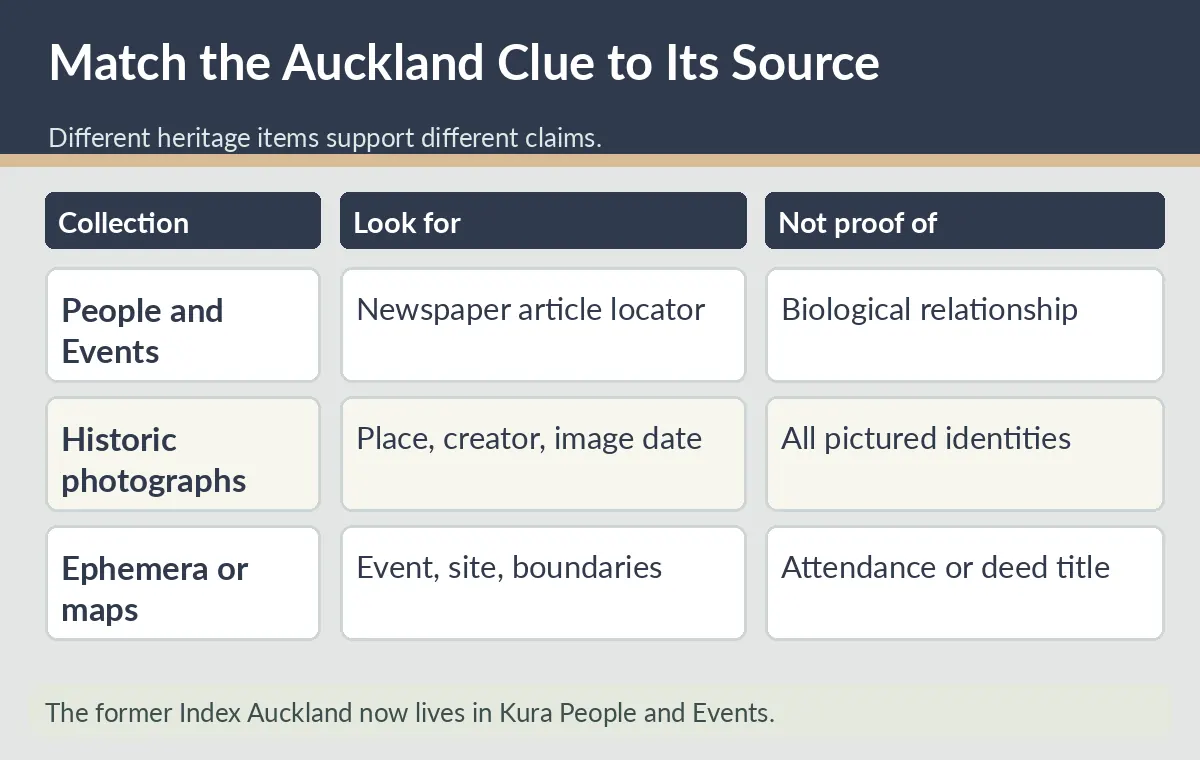
The Auckland Libraries local-history guide explains that material formerly known as Index Auckland has been incorporated into the Auckland People and Events collection in Kura. An index entry may provide a newspaper reference, a name, an event or a publication date. It is not necessarily a scan of the complete article. Follow its citation to the publication and relevant page, where accessible, to read the broader text. Preserve the distinction between date of a reported event, date the newspaper published it and date of later indexing.
A nineteenth-century notice might name a business partnership, an address or a person attending an event. Those are valuable hypotheses for a family timeline but cannot by themselves establish biological parentage, enduring residence or property ownership. If the notice is indexed only under a locality, browse surrounding dates and alternative spellings. When OCR or catalog keywords return nothing, try searching for a street, school, employer or full newspaper issue instead of concluding the family was absent from Auckland.
Use Microfilm When a Newspaper Is Not Digitized
The official library guide specifically identifies historical New Zealand Herald and Auckland Star material among publications available in microfilm collections, while other newspapers may also be online in Papers Past. An issue can survive even if the chosen full-text website does not include that title, edition or year. Verify the newspaper’s actual publication place and coverage period before searching. A surname that fails to appear in text OCR may be present in a birth announcement, electoral report or obituary on a manually browsed page.
Write a practical retrieval request: full newspaper title, estimated month or issue date, item type, locality and the name variants tried. If using microfilm, save the reel identifier if supplied, issue date, page, column and the name as printed. A clipping without its masthead or date is much harder to evaluate. Newspapers can reproduce erroneous family claims, so independently verify any relationship reported in a social column, retrospectively written obituary or anniversary feature.
Evaluate Historical Photographs and Ephemera Together
Kura and Auckland’s historical collections include images, maps and ephemera such as programs, tickets, posters and printed notices. These can place a building, organization or event in historical context. A photograph of a shopfront may identify the business advertised on a sign, while a street name can help reconstruct a route or a neighborhood. The photographer’s date, original caption, acquisition date and later catalog description are different information layers. Preserve them separately when recording what the image supports.
A written name below a portrait can come from a donor’s memory long after the photograph was taken. Do not attribute an unidentified figure to an ancestor without comparison to independently identified portraits and dated records. Ephemera can be even more indirect: an admission ticket is proof that tickets existed, not that your ancestor attended. When the historical subject or object is Māori or Pacific, respect cultural access and reuse conditions, and avoid treating a library’s broad collection label as proof of a particular person’s whakapapa.
Request an Original Item Before Writing a Family Claim
Auckland Libraries describes specialist research centres and opportunities to book access to heritage items. Start with the stable catalog identifier rather than asking vaguely for everything about a family. Tell the librarian what question you want answered: for example whether a particular business operated at a stated address between two directories. Ask whether the item has a digital surrogate, a reading-room original, an access condition or another creator’s collection in which related materials may appear. Record the response as research guidance rather than as a newly discovered historical fact.
For a family narrative, keep the library discovery record alongside independent evidence from New Zealand civil registrations, electoral rolls, newspapers, church records or land documents. A magazine feature about a family may cite interviews, but it is still a published retelling until its source basis is checked. The goal is not to accumulate the most hits, but to determine which specific piece of evidence addresses your question and which information is still only a catalog attribution.

Cite the Item, Its Container, and Any Access Conditions
A reproducible reference names the creator or publication, item title, creation date, collection or series, call number or Kura identifier, Auckland Libraries as holding institution, access link or reading-room location, and the date consulted. For a newspaper record, add the issue date and page after inspecting the original image or film. If the catalog only provides an abstract, say ‘catalog description consulted; article not viewed’ rather than silently upgrading the finding aid to a verified primary record.
The GenHis affiliate disclosure is available for site transparency and implies no affiliation with Auckland Libraries. Save a two-person comparison chart for each ambiguous surname hit: stated address, relevant dates, occupation, image provenance and contradictory clues. When no item appears in Kura, try the library’s specialist collections and a targeted librarian enquiry; the online search is only one access route. Treat living people’s privacy and any cultural reuse restrictions as part of responsible family-history publishing.
More Genealogy Tool Guides
How We Research This Collection
We reviewed Auckland Libraries’ heritage and research entry point, its historic-events guide, and Research Central’s published facilities. We specifically distinguished Kura catalog hits, Index Auckland references now housed within Auckland People and Events, microfilm newspaper issues and restricted reading-room holdings. We have not claimed that any searched family photograph identifies a named historical individual; each image caption must be tested independently.
No. Heritage and research items can be in research centres, microfilm, catalogs or the special reading room.
The library says these local-history references are now part of Auckland People and Events in Kura.
Not necessarily; check the caption creator, date and independent identity evidence.
Yes. Its research centres hold microfilm for certain historical newspaper titles and support enquiries.
Record its item title, creator, date, collection identifier, holding library and access details.