
Navigate Auckland Libraries Kura images, cemetery and people indexes, then verify names using newspapers, maps and reading-room holdings. Begin with a single research question and a dated location, then identify the surviving original record before assigning a name to your family. A database entry is a useful lead, not proof of kinship or of a field absent from the document.
Choose the Auckland Source for Your Question
Auckland Libraries is especially useful when the research question concerns a named local street, neighborhood, cemetery or public event. A library catalog does not replace a civil birth register, but it can supply photographs, local newspaper references, cemetery records and place context that a nationwide name search misses. Start with a short question: where did a family live in 1910, is there a photograph of its street, or where was a funeral reported? Write down a date range and place. Then select the matching collection instead of entering every surname in every interface and mistaking silence for no historical trace.
Search Kura as a Collection of Collections
Kura Heritage Collections Online hosts multiple Auckland Libraries heritage resources. Distinguish the top-level search from an individual collection such as photographs or cemetery materials, because metadata fields and digitization coverage can differ. Try a personal name, then search an address, street, institution or suburb and compare returned descriptive titles. An item-level description might identify a creator or collection, not the full cast of people shown. Save the permanent item reference, repository label, known date or date range and any stated rights information before relying on an image. A photograph with no identified people cannot be treated as a family portrait simply because it shows their street.
Treat Historic Photographs as Place Evidence First
The Kura photographs collection contains images and illustrations from the nineteenth century onward, but Auckland Libraries says records are still moving from its former Heritage Images database. If a name search misses an expected image, check whether the metadata moved to Kura or remains discoverable through DigitalNZ. Study a photograph’s date estimate, viewpoint, caption origin and depicted structures. A shopfront sign can indicate a business at one moment, not continuous occupancy across decades. Label the picture as a view of a location when personal identification is unconfirmed; it is better evidence for streetscape than for an individual’s family relationships.

Use the Auckland People and Events Index
Auckland Libraries explains that its older Index Auckland local-history references were moved into the Auckland People and Events collection on Kura. This can reveal names and topics in historic newspapers or magazines that are not fully text searchable elsewhere. Open the index entry and record the source title, issue date and page if provided. Then seek the actual article before quoting it. A catalog reference proves that an item was indexed, not that the newspaper claim has been independently verified. For a person with a common name, compare occupation, address or organization before attaching the clipping to a family tree.
Distinguish Papers Past from Library Microfilm
Some New Zealand newspaper issues can be read through the National Library’s Papers Past, while undigitized titles and runs may still be on microfilm at Auckland Libraries research centers. A failed Papers Past search does not establish that an Auckland newspaper failed to print a death notice or business item. First confirm which paper existed for the locality and year, then check digitized issue coverage. If the needed issue is absent online, use the library’s microfilm facilities or a research inquiry. OCR can misread ordinary names; when possible, browse the dated issue and inspect the column image rather than trusting a snippet alone.
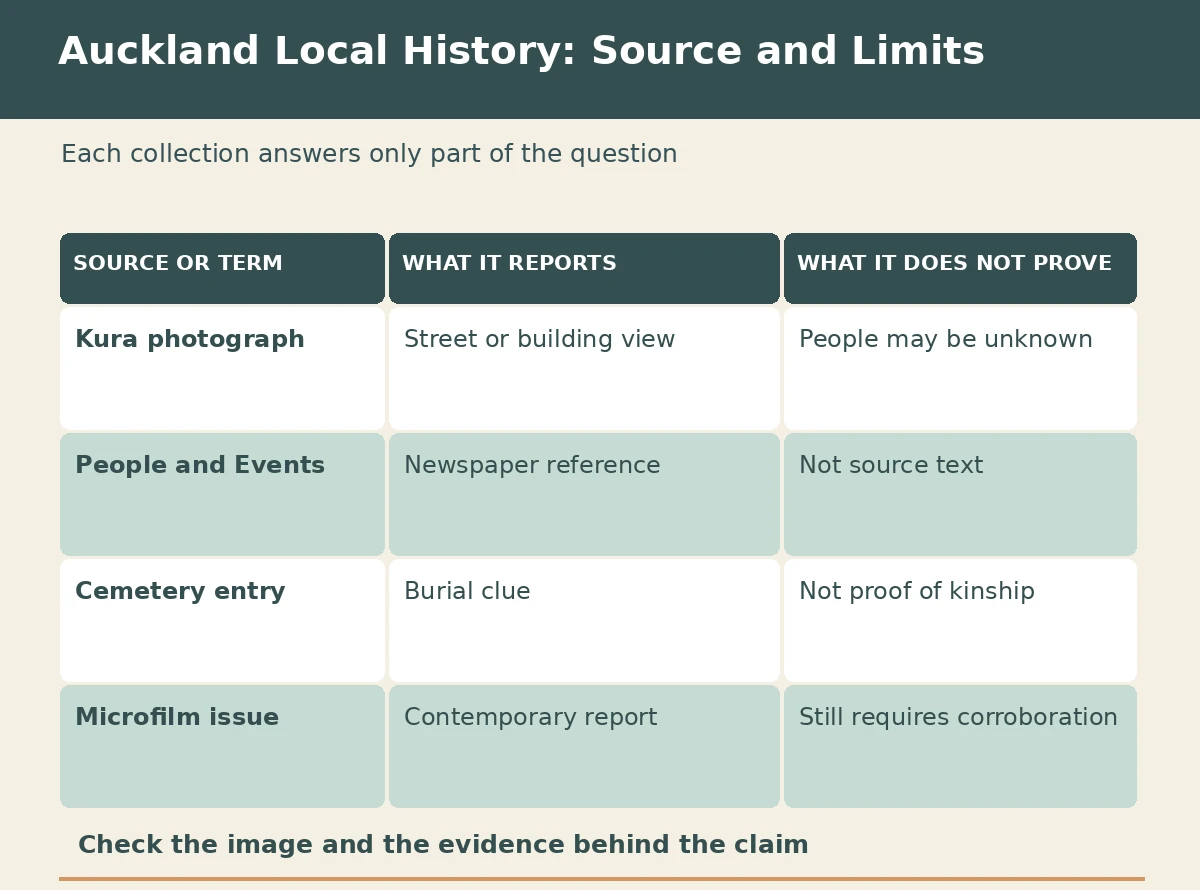
| Research question | Start with | Important limit |
|---|---|---|
| What did the street look like? | Kura photographs | Date and people may be uncertain |
| Was a person mentioned locally? | Auckland People and Events | Read the actual article |
| Where is the burial recorded? | Kura cemetery collections | Plot does not prove kinship |
| Is a newspaper issue online? | Papers Past, then microfilm | OCR and coverage gaps |
Search Auckland Cemetery and Funeral Collections
The library’s New Zealand family sources guide identifies Auckland cemetery material and historical funeral-director records within Kura, including records associated with the former C Little and Sons collection. A cemetery result might supply interment details, a plot reference or a family contact, depending on the source. That does not make every person linked to a plot a blood relative. Check the cemetery’s own register or council database for event details, and keep memorial inscriptions separate from actual interments. Use older material responsibly; avoid using genealogy tools to investigate or disclose private information about living people.
Check Addresses With Electoral and Directory Evidence
To test whether a photographed house belonged to the family, gather electoral-roll or directory entries for the same street and period. A directory can identify a subscriber, occupant or business, depending on edition, without naming everyone inside. Electoral rolls document registered voters subject to the law of the period, not an entire household. Note the roll year, electorate and eligibility rules rather than treating absence as evidence that an adult was not resident. Match any street renumbering or renamed suburb through a dated map. The strong result is a sourced place chronology with uncertain steps clearly identified, not a reconstructed household from one address.
Choose Online Search Versus a Reading-Room Request
Kura is a discovery and viewing route, but some manuscripts, ephemera, maps or newspapers require in-person consultation. Auckland Libraries directs researchers to Research Central, other local research centers and the Heritage Collections Reading Room for specialist help and collection access. Prepare an inquiry with an exact title, date, item number and the question you need answered. Staff can clarify whether an item is digitized, restricted or available for consultation. Do not assume that every catalog entry can be downloaded at full resolution or that viewing an image grants permission to reuse it in a publicly distributed family-history publication.
Build a Hypothetical Auckland Street Timeline
Imagine an 1898 address printed in a directory, a 1903 newspaper notice naming a shopkeeper, and a Kura photograph assigned a broad “circa 1900” date. These sources suggest a locality to investigate, but the photograph may show a building before or after a remodel. The business could have changed hands in between. Record each date with its actual source and keep a separate line for the claim that the shopkeeper was the ancestor. Seek independent family evidence, including a marriage or death record, before accepting it. This fictional example illustrates how a local library collection enriches rather than replaces vital registrations.

Cite Collection Metadata and Check Usage Rights
A reproducible Kura citation includes Auckland Libraries, collection name, item title, item identifier, attributed photographer or creator when known, stated date and URL. For a newspaper or microfilm item, add issue date, publication title and page or column. If a photograph was downloaded, note the version and any rights statement separately from the historical fact it depicts. Image usage permissions can differ among creators and collections. A research log should explicitly say whether the original issue, catalog record or just a thumbnail was examined. This allows someone else to repeat your search without treating a search result as a verified life event.
More Records and Archives Guides
How We Research Auckland Libraries Family History
We checked Auckland Council Libraries’ official heritage, Kura photograph, local newspapers, cemetery and Research Central guides. The method separates item discovery from access, record contents from inference and viewing rights from reuse rights. The street chronology is illustrative only. The site’s interfaces and collection transfers are ongoing and should be verified at the library before a citation or reproduction.
Reference guides reviewed on October 24, 2026: primary research guide; companion institutional resource; source collection; primary research guide; companion institutional resource. These links explain collection scope; they do not imply that we viewed every original entry or identified a particular ancestor. This article includes no paid recommendation. Our affiliate disclosure explains the site policy; no affiliate relationship is asserted here.
It is Auckland Libraries’ digital heritage discovery service containing multiple collections such as photographs and historical local records.
The library is still migrating material from the former Heritage Images database; it also directs users to discover unmigrated descriptions on DigitalNZ.
No. Some issues or titles remain on research-center microfilm and require issue-based searching rather than internet OCR.
Not by itself. Check burial and lot records, addresses and independent civil documents before inferring kinship.
Check the particular item’s rights and attribution requirements; online viewing does not automatically grant unrestricted reuse.