
To find an Orkney family in the Scottish census, start with an island, parish or district and search the official ScotlandsPeople census returns rather than only a surname. National Records of Scotland holds open Scottish census records from 1841 through 1921, indexed to digitized enumerators’ transcript books. In Orkney, a reported island or residence may be more useful than an unstable spelling. Compare every candidate household with its original page, nearby entries and independent civil or church records before building a family connection.
Choose the Correct Scottish Census Year First
National Records of Scotland describes the accessible historical sequence as 1841 and every ten years through 1921, with a century-long closure period for later censuses. Avoid assuming a census return survives for 1941: none was taken during the wartime year. Establish whether the person was likely alive, present in Scotland and of plausible age on the census date. Start with the best-documented decade and work outward, taking care not to turn an approximate census age into a precise birth date.
Use Orkney as a County and Narrow to a District
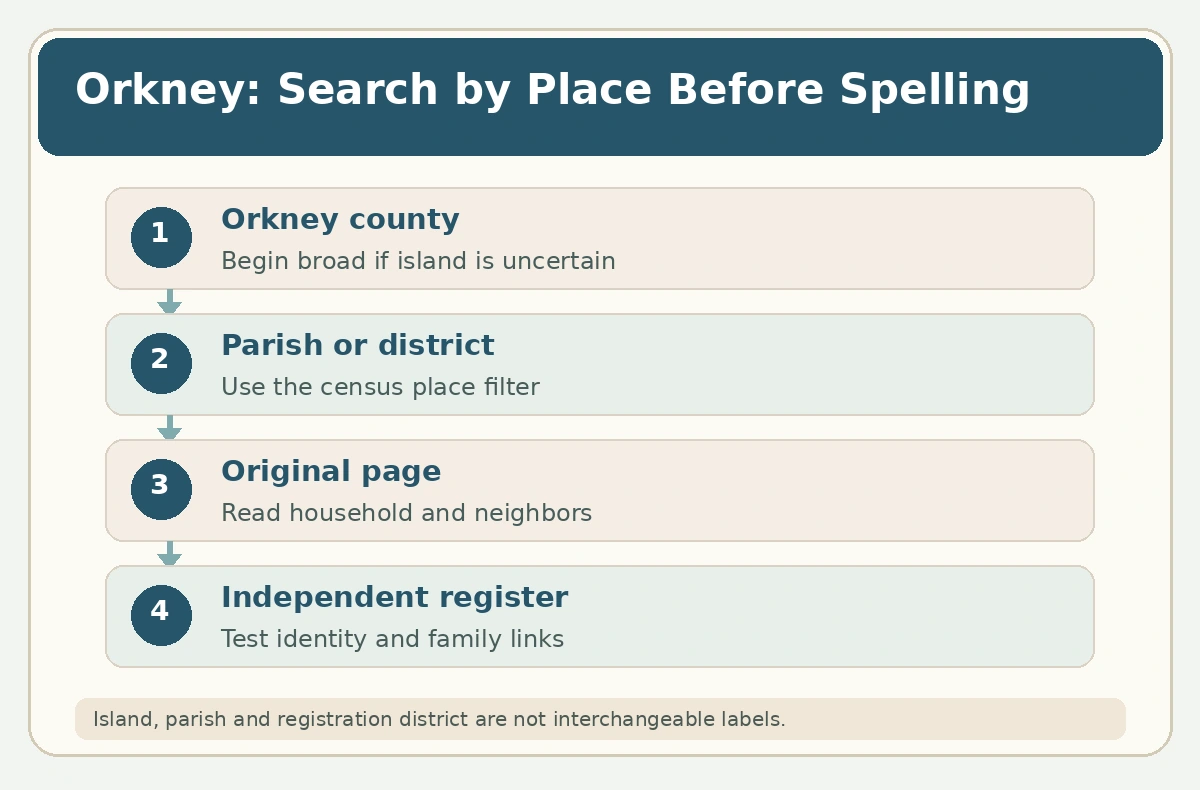
ScotlandsPeople supports county or city filters and then a district selection for census searches. Begin with Orkney if the exact island locality is uncertain, then narrow using corroborated place information rather than forcing a modern postcode into a nineteenth-century form. Copy the district exactly as shown in the database and record any locality variant in your log. If a search is empty, relax the district while retaining date and age constraints to see whether the family appears under neighboring enumeration arrangements.
Translate Island Names Into Searchable Localities
A family history may refer to Mainland, Westray, Sanday, Stronsay or another island while the census describes a parish, civil district, village or farm. Those labels belong to different geographical levels and should not be treated as synonyms. Sketch an island-to-parish-to-district hierarchy before searching a crowded surname. A person can move between islands without leaving the county. A same-named household in the correct county but wrong island needs the same careful comparison as one across a national border.
Read the Enumerators’ Books Rather Than Only an Index
NRS explains that nineteenth- and early twentieth-century Scottish census records available today are enumerators’ transcript books produced from household schedules, rather than the householders’ original completed forms. Read the full page and, when relevant, adjacent pages to recognize multiple households at one property or nearby dwellings. A typed database result can misassign an address, mistranscribe a name or hide contextual occupations. Record the book reference, year, district and page rather than citing only a search result.
Check Occupation, Age and Birthplace as Independent Clues
The official family-history guide identifies ages, occupations and birthplaces among the useful census fields. Compare several decades because a person may report a parish of birth differently, ages can be approximate, and occupational labels can evolve. Do not decide that two island fishermen are identical solely because name and profession match. Add spouse, children, neighbors and a dated address where available. A clustered household match usually carries more weight than a single descriptive field, but each element still reflects reported information. For a related choice, see our guide “Edinburgh Census Records, 1841–1921”.
| Clue | Compare | Do not assume |
|---|---|---|
| Birthplace | Wording across decades | Exact birth village |
| Occupation | Specific trade and dates | Same name = same person |
| Neighbors | Nearby households | Biological kinship |
| Vessel entry | Census-night location | Permanent residence |
Look for Residents on Vessels as Well as in Houses
NRS notes that enumerator census books include dwellings, institutions and vessels. For coastal Orkney families, a person missing from the expected home may have been enumerated afloat or elsewhere on census night. A man not present in a household entry is not automatically deceased or emigrated. Search plausible vessel or temporary-residence entries and compare subsequent marriage, death or occupational evidence. Equally, a person reported on a vessel near Orkney is not thereby proven to have been born on the islands.

Separate Relationships Reported From Relationships Proven
Where a census lists members with roles relative to the household head, record the words exactly; where a year or entry does not supply a relationship, do not infer it solely from proximity. A lodger, cousin or visitor may share a surname or birthplace. Link apparent parents and children to statutory registrations or parish records before accepting a biological connection. If two same-named people fit the estimated birth year, use residence continuity and independent relatives to keep the individuals separate.
Use Valuation Rolls to Test Addresses Between Decades
ScotlandsPeople allows place searches within historical valuation rolls and may identify occupiers or property descriptions. These can provide an intermediate locality clue when a family appears on one island in 1881 and another in 1901. A valuation entry is not itself a census or proof of ownership; distinguish an occupier, tenant and named owner where the source permits. Record each roll year before concluding the move happened in a specific interval. Shifts in parish or district terminology also require checking. For a step-by-step method, see how to find Scottish ancestry records from civil registers to parish books.
Illustrative Two-Island Household Test
Suppose a surname appears in an Orkney island household in 1871 and a different parish in 1881. Compare the adults’ approximate ages, each child’s reported birthplace and the occupations rather than assuming the family moved together. A child born between censuses might supply the next civil registration to check. Equally, the second household may belong to a namesake who never lived on the first island. Record each census’s exact district and image reference, and test the names through later certificates or valuation rolls. This is a hypothetical exercise, not a claimed Orkney family, and it demonstrates why an island-specific search provides more than a broad Scottish surname hit. Our guide “Isle of Mull Census Records” covers a related question.
Write a Search Log That Preserves Island Uncertainty
A useful Orkney search log lists census year, selected county and district, all spelling variants, page reference, household neighbors, birthplace wording and whether the original page was opened. Keep a column for competing places and persons. If a name search fails, document the district you actually checked before expanding to other islands. A negative result has meaning only in relation to the searches and records inspected. The outcome should be a defensible list of candidates, not a guessed family tree. Our guide “Anglesey Census Records, 1841–1921” covers a related question.

More Records and Archives Guides
How We Research Orkney Census Sources
We cross-checked the National Records of Scotland census guide with ScotlandsPeople’s place-filter and family-history instructions. The method is specific to Orkney locality ambiguity, without claiming that every island or vessel entry is indexed perfectly. Generic example households are conceptual, and no actual family relationship has been inferred from shared surnames.
Official custodial documentation reviewed: NRS census years, originals as enumerator transcripts, vessels and public access. ScotlandsPeople indexed census place filters by county and district. ScotlandsPeople census facts and cross-reference with statutory registers and valuation rolls. The links are research sources, not paid endorsements. Our affiliate disclosure explains the site-wide policy.
The currently open historical Scottish census sequence runs from 1841 through 1921 at ten-year intervals on ScotlandsPeople.
NRS describes the surviving accessible pages as enumerators’ transcript books prepared from collected household schedules.
ScotlandsPeople supports county and district place filters; results and access rules should be checked on its current search interface.
They may have moved, visited elsewhere, been enumerated on a vessel or been missed in your search. Do not jump to death or emigration.
No. Combine names, household context, dated localities and independent civil or church records before claiming a relationship.