
Aberdeen census records can be searched by name for Scottish enumerations from 1841 to 1921, but a difficult city family is often found more reliably by address and street. Scotland’s People explains the official indexed census books and lists Aberdeen among cities with separate street indexes for several census years. Identify the historical street, choose the census night and work from the street index to the actual enumeration entry before accepting a household match.
Choose the Scottish census year and understand its snapshot
Scotland has open ten-year census books from 1841 through 1921. No wartime census was taken in 1941. For Aberdeen the national series is not a city directory taken throughout a year; it records who was enumerated on a particular census night. For example, 1841 was taken on 6 June, while 1921 was taken on 19 June. A person reported in a house on census night may have been a temporary lodger, visitor or servant, and not an owner or permanent resident.
Begin with the person’s most firmly documented time and place and choose the census date that best tests it. The 1841 form has fewer relationship details and rounded adult ages, so use more caution than for later years. From 1851 onward household relationship and birthplace information usually helps separate candidates. Do not assume that two matching surnames in one urban building represent a biological family; read each reported relationship and preserve residents who do not share the name.
Use Aberdeen street indexes when names fail
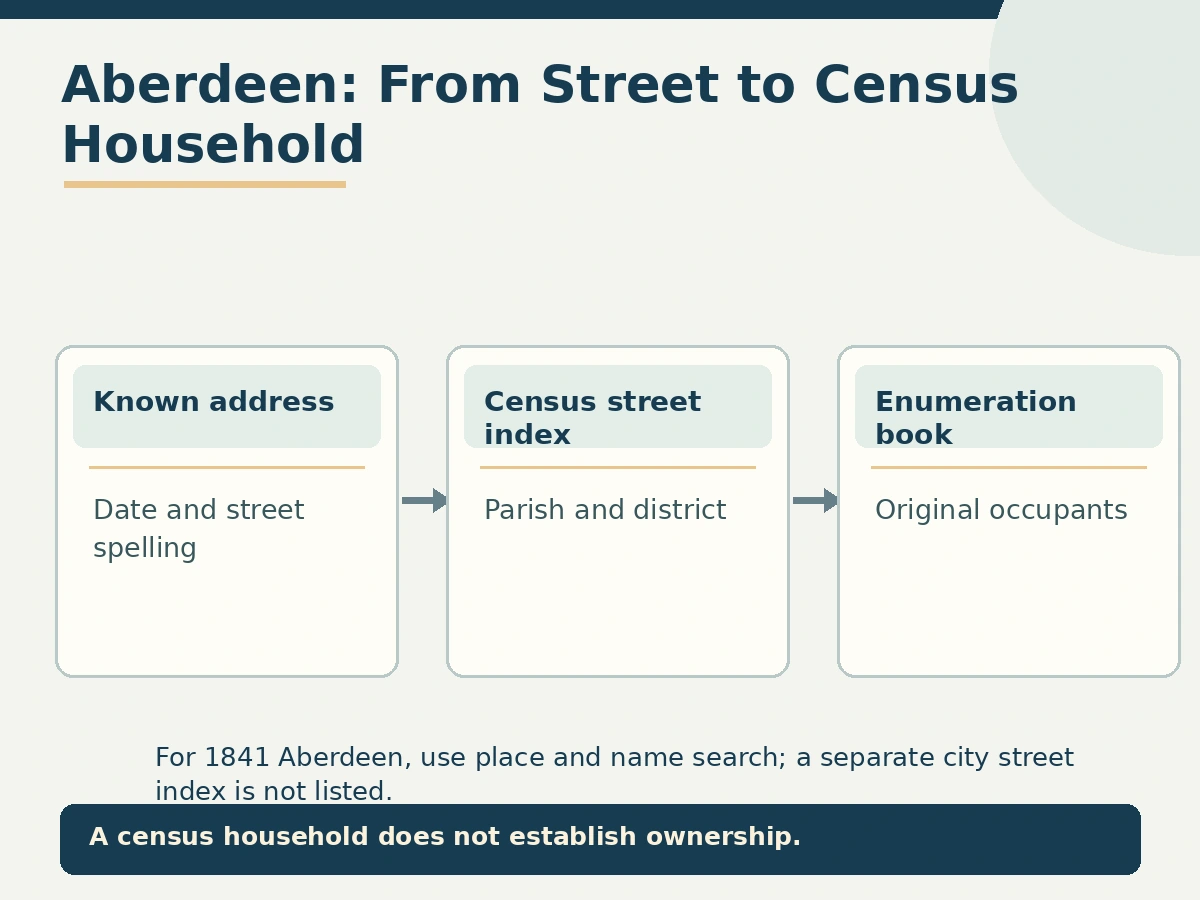
The Scotland’s People guide lists Aberdeen street indexes for 1851, 1861, 1871, 1881, 1891, 1901, 1911 and 1921, with street-index references also available via National Records of Scotland. Its current list does not identify a dedicated Aberdeen street index for 1841; use a locality and name search for that year. An index may identify a parish or registration district and an enumeration-book reference for a historical street. That is a route into the manuscript page, not proof that a specific ancestor lived at one house number. Check the date of the index before using it; streets could be renamed, renumbered or shifted in administrative description.
Start from an independently documented address in a dated city directory, marriage record or valuation roll. Copy the exact street name and any district designation, then look for that street in the appropriate census-year index. If the name does not appear, try historical variants or a nearby street. Record the street-index reference and the subsequent enumeration book separately. A street that did not exist under its modern name in 1841 should not be treated as evidence that a family was absent from Aberdeen.
Search Scotland’s People and examine the original census book
The official census search allows name fields, a year and other filters; it also supports a second person’s forename in the household to help narrow candidates. Use a surname and a second known household member to reduce false matches instead of forcing a full exact name. Search result lists are finding aids. Scotland’s People provides indexed images of enumeration books; the National Library of Scotland explains that image access can involve fees, while some transcription-only indexes and library resources may be free. For the fuller picture, see our guide “Scottish Census Records”.
When opening a likely page, transcribe household order, address, ages, birthplaces, occupations and each relationship entry. Also examine the line above and below in case an enumerator split a building across pages. Preserve the document’s original spelling rather than silently regularizing a person’s name. If a birth county or parish differs from another decade, log the conflict and investigate, especially for workers who moved between rural Aberdeenshire and the city.
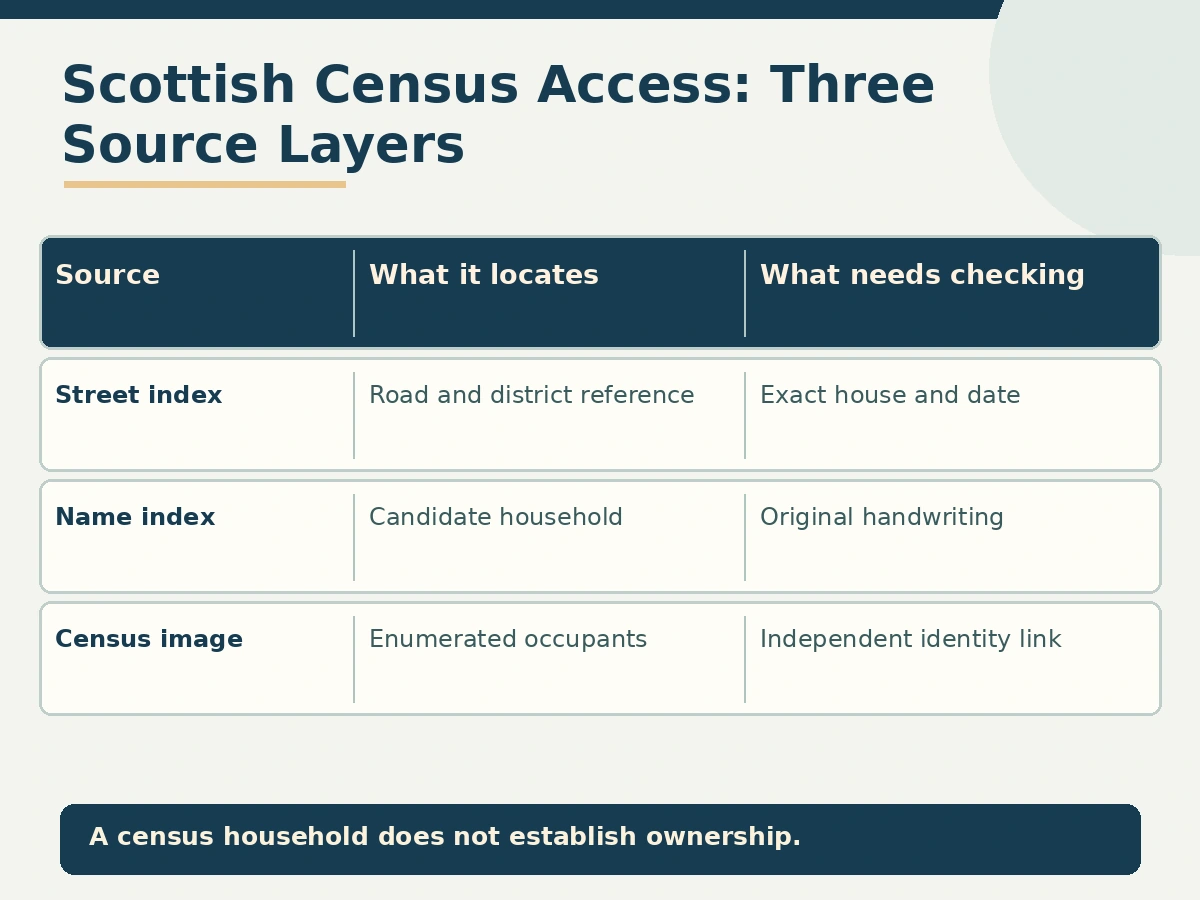
| Source | What it can show | What it cannot prove alone |
|---|---|---|
| Street index | District and road reference | Specific family residence |
| Census image | Enumerated household | Legal title to property |
| Valuation roll | Named occupancy or valuation | Certain biological relationship |
Distinguish Aberdeen city, county and registration geography
Aberdeen the urban settlement and Aberdeenshire the surrounding historical area are related names but not interchangeable search filters. People may have an Aberdeen postal address while a historical entry uses a parish, registration district, burgh or census subdistrict. Check the place field printed on the census image and the associated district reference before deciding you have found the right person. Avoid treating a nearby rural parish as a city household because its index results happen to sort first. Our guide “Anglesey Census Records, 1841–1921” adds more detail on this.
If a person moved between the city and villages, create a two-column timeline for the urban address and the surrounding parish, using dated deeds, valuation rolls or directories to anchor each location. A marriage at an Aberdeen church does not prove residence in the corresponding census district. Whenever you use a street-index route, note both the modern standardized place spelling and the historical wording used in the source. That will make a later archive request reproducible.
Compare ages and relationships across two census nights
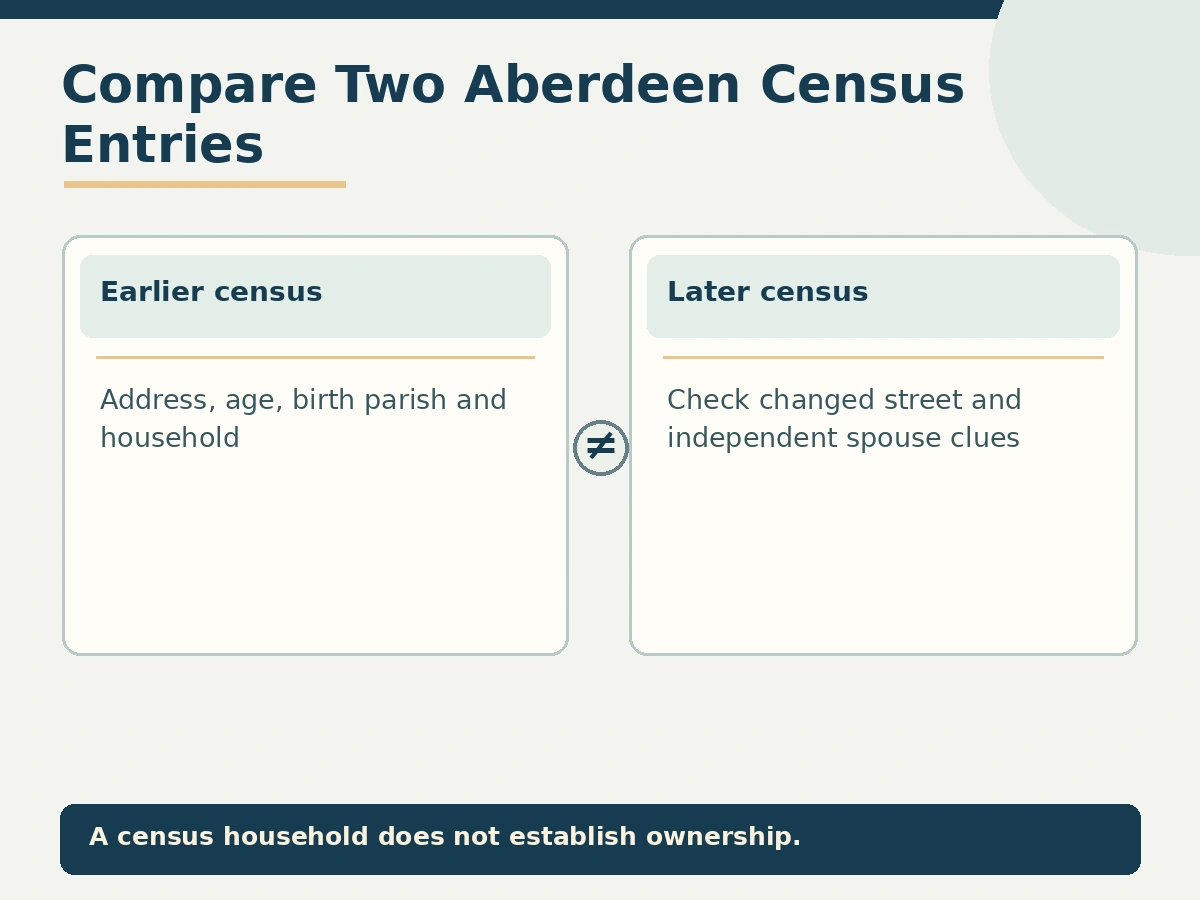
A practical identity worksheet has one line per census year with the person’s reported age, occupation, birthplace, marital status where available, housemates and full address. A five- or ten-year age difference by itself is not necessarily a contradiction because ages can be misstated or rounded, especially in 1841. By contrast, two similarly named adults with different spouses, occupations and birthplaces should remain separate candidates until evidence connects them. Build a comparison rather than forcing one family tree branch.
Use statutory birth, marriage and death registers from 1855 onward to test parent or spouse details against census households. Valuation rolls may connect a household address across adjacent years, but the named occupier is not automatically the same person as an owner. Scotland’s People and Aberdeen local studies collections supply complementary sources. Cite each as a separate record, even if the same commercial platform aggregates their results. For the next step, our guide “Scottish Valuation Rolls, 1855–1940” explains how to track owners and occupiers.
Write an Aberdeen census citation that retraces the street route
A good census citation states National Records of Scotland or Scotland’s People, census year, place or registration district, enumeration-book reference, page and the named household, together with the image platform and access date. If a street index helped you locate the page, add a separate reference to that index and the historical address as searched. Avoid presenting an index location as if you had inspected the corresponding original entry. Our guide “Edinburgh Census Records, 1841–1921” shows how to find a household by district and address.
For a no-result search record all filters and the exact years or districts tested. The final claim may be limited to “an indexed Aberdeen household with a plausible age and associates,” not a proven identity. Once the original book and corroborating records agree, explain which details connect the person to the known family. A transparent evidentiary trail is more useful to readers than a confident-looking but untraceable city-census name match. Our guide “Isle of Skye Census Records, 1841–1921” covers a related question.
More Records and Archives Guides
How We Research Aberdeen Census Books
We checked the National Records of Scotland census guide, Scotland’s People’s dated census and street-index guidance, the National Library of Scotland access explanation and Aberdeen Central Library’s local-history holdings. We distinguish an index, an original image and an independently verified family link. The scenarios are illustrative and do not expose living people. See affiliate disclosure.
The open Scottish census series contains 1841–1921 returns at ten-year intervals. The 1941 enumeration did not take place.
Yes. Official guidance identifies Aberdeen street indexes for 1851 through 1921 at ten-year intervals, but not a separate 1841 Aberdeen index.
Some transcriptions may be free, but Scotland’s People generally charges for image access; check current terms and library alternatives.
No. It records occupancy on census night; land title and valuation rolls address different questions.
Compare addresses, a second household member, birthplaces and original enumeration pages before assigning identity.