
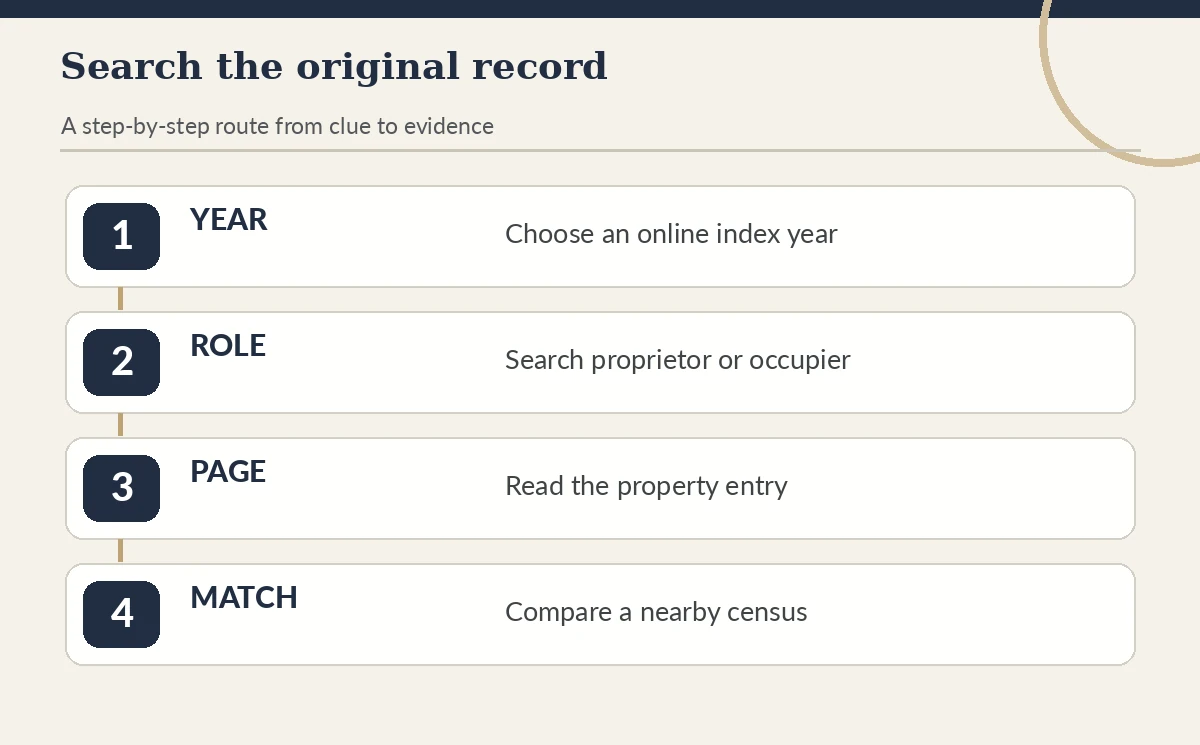
Scottish valuation rolls help locate properties and the people responsible for them between population censuses. Scotland’s People makes selected rolls searchable from 1855 through 1940, often naming a proprietor, tenant and occupier with the assessed annual rateable value. Start with one exact indexed year and locality, inspect the original image, and separate each role before linking the entry to your family. A property name or a matching surname alone does not establish legal title, physical residence or kinship.
Select an indexed valuation year instead of assuming every year is online
The National Records of Scotland guidance on Scotland’s People explains that valuation rolls were compiled annually after the 1854 legislation. However, the online indexed images represent selected years: 1855, 1865, 1875, 1885, 1895, 1905, 1915, 1920, 1925, 1930, 1935 and 1940. That distinction matters: an annual historical series is not the same as a complete year-by-year digital search.
Choose the selected year closest to the event you are investigating, then compare with a census or statutory record on either side. Do not describe a person as missing in 1880 because Scotland’s People does not offer an 1880 indexed roll in that selection. Make a small availability table showing the year searched, locality, spelling and whether you viewed the actual page rather than relying on the name result.
Search proprietors, tenants and occupiers separately
The search interface permits year, surname, forename, status and place filters, among others. The archive distinguishes owner or proprietor, tenant and occupier; those roles may refer to different people. An owner could live elsewhere and a tenant could sublet to an occupier. A person may also appear in more than one capacity. The rateable value is an annual valuation measure, not a statement of the property’s sale price.
Use the status filter with care and repeat searches under the “all” option if results seem inconsistent. A proprietor named only by surname and title should not be merged with a tenant of the same surname without evidence. Some married or widowed women appear under forms such as “Mrs William Fraser,” as the archive’s family-history guide notes. Preserve that wording and then pursue an independent marriage or death record to identify the person.
Work through spelling changes and address descriptions
Scotland’s People expands Mc surnames to Mac in its valuation-roll indexes to manage assessor spellings. That does not mean every original manuscript used the expanded form. Search variants, initials and occupational descriptors as needed, but avoid using one modern address as the sole key for a nineteenth-century property. Street names, building numbers and administrative boundaries can change over time.
The official guide notes that numeric property-number searching is not supported in the online form. Begin with county or burgh and parish, then search plausible surnames and inspect the image to recover the exact property wording. Keep a literal transcript for the field as written and a separate normalized modern location. Use maps or a city directory for a location test, not for substituting one street address for another without proof.
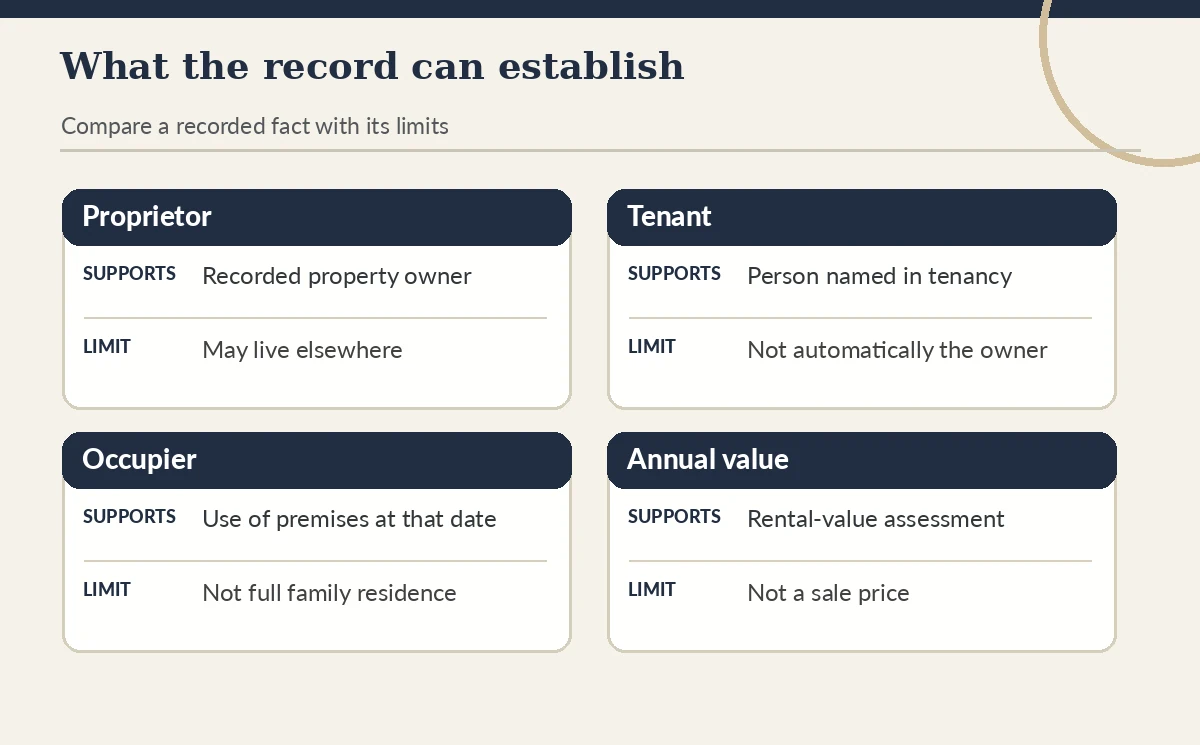
| Roll role | What it describes | Do not presume |
|---|---|---|
| Proprietor | Person listed as owner | Resident of the premises |
| Tenant | Person under tenancy | All household members |
| Occupier | Person recorded in occupation | A permanent address |
| Rateable value | Annual valuation basis | Market sale price |
Compare successive entries as a property-based timeline
A practical worksheet has one row for each searchable year: location, proprietor, tenant, occupier, assessment and the reference to the viewed image. Keep different names in different columns. An unchanged landlord does not prove a tenant remained; an identical surname on successive rolls might refer to a different member of the family. Likewise an assessed rental value can change for reasons other than a sale or building reconstruction.
Suppose a hypothetical roll lists “Mrs Fraser” as tenant in 1895 and “W. Fraser” as occupier in 1905. Without a complete first name and outside evidence, the two entries cannot establish a widow’s death or a son’s inheritance. Compare the 1891 and 1901 census households, statutory death and marriage entries, and local directories. A discontinuity in the property record is a targeted next-question rather than permission to fill in a family story.
Recognize whom a valuation roll leaves out
These are property valuation records, not full household enumerations. The official family-history guidance says they generally list only the proprietor and resident head of household, rather than spouses, children, domestic workers or lodgers. Properties with low valuation may also be described sparsely in earlier returns. Absence of a child’s name tells you nothing about whether that child lived in the building.
The list of roles has legal and administrative significance at the date of assessment. It should not be interpreted as the ownership history of a specific modern house without title records, nor as a migration certificate for a family that disappears between two selected years. State exactly which capacity the roll attributes to the person. If the main question is household membership, go to the census and vital records rather than trying to force a valuation roll to answer it.
Cite Scottish valuation-roll images and role uncertainties
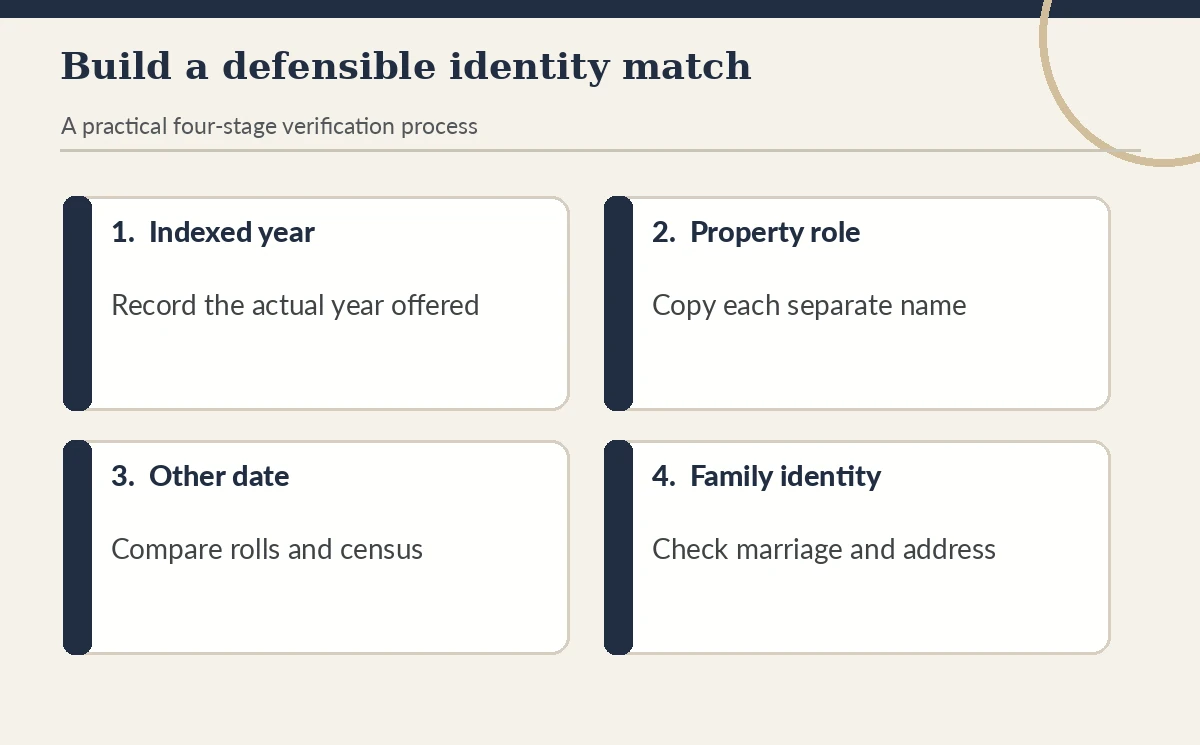
Save the searched year, county or burgh, parish, property description, page and original repository citation visible on the image. A screenshot of a search result without a reference is less reproducible than a page citation. When an indexed form expands a surname, quote the original image spelling in your transcription and add a separate note explaining the index normalization. Note access conditions and whether the image was purchased or viewed via an institutional subscription.
A careful conclusion might establish that one person was listed as an occupier at a named address in 1905; it does not establish that the same person owned it or that an entire household resided there for ten years. Present separate corroboration for each claim. A short, well-cited role-by-role timeline is more useful than an attractive but undocumented chain of assumed ownership.
How We Research Scottish Valuation Rolls
GenHis starts with the official archival description and distinguishes an index, the original record and any inferred family claim. For this guide we examined the repository instructions, stated date coverage, available search fields, documentary limits and relevant historical terminology. The sample identity checks are hypothetical and not records of identified ancestors. This is historical research guidance, not a guarantee that every record survives, is indexed or is free to obtain.
More Records and Archives Guides
Official archives and collection guides for Scottish Valuation Rolls
Official record guide with online years, names, index fields, value, spelling and search limitations (api.scotlandspeople.gov.uk).
Family-history guide on missing household members and interpretation of tenant/occupier names (scotlandspeople.gov.uk).
National Records of Scotland explanation of assessment system, property roles and early gaps (scotlandspeople.gov.uk).
Editorial disclosure: This guide includes no paid recommendation or verified affiliate partnership. See the GenHis affiliate disclosure. Record holdings, image availability, access restrictions and prices can change. Verify them with the cited repository before ordering documents; protect information about living people and present uncertain family conclusions as hypotheses.
No. They focus on properties and listed roles, not every household member.
Scotland’s People lists selected years from 1855 through 1940; the full historic series was annual.
The official online valuation-roll search does not accept numerical property values as search keys.
The index expands Mc forms to Mac; check the original handwriting for the exact wording.
No. Proprietors, tenants and occupiers can be different people.