
Tasmanian assessment and valuation rolls can put a property, its recorded owner and its occupier in the same dated source. They are not a census, a legal title register or proof that every family member lived at the address. Libraries Tasmania provides an assessment-roll index by municipality and year, with page references to the Tasmanian Government Gazette and its historical predecessors. First identify a town or municipality and approximate date; then find the correct Gazette issue and roll page. Transcribe the premises description, proprietor, occupier and assessed value separately and compare the property with a map, directory or title record before making a family-history claim.
Choose the municipality and years that fit the property
Libraries Tasmania explains that the earliest surviving Hobart and Launceston valuations appear across 1853–1855, 1858–1860 and 1862–1863, with an earlier Hobart assessment in 1847. Municipal structures and assessment practice evolved; the Rural Municipal Act 1858 helped extend valuations to rural areas. Do not assume every district has a complete annual roll beginning in a single uniform year. Work backward from a confirmed address, parish, locality, business premises or property name.
For Hobart and Launceston, rolls frequently provide street-organized listings; outside the larger towns, the organization may be alphabetical by occupier. This determines your search strategy. Record the town’s historical name, municipality, potential ward and at least two neighboring assessment years. A family’s address written in a birth registration may use an older street description that does not appear in modern mapping tools.
Use the Gazette roll index before browsing thousands of pages
Open the Libraries Tasmania assessment-roll index, select the municipality and year, and copy the Gazette issue and page number for that assessment. Its historical newspaper titles include Hobart Town Gazette and Hobart Gazette as well as Tasmanian Government Gazette. The index is a locator; the Gazette page is the evidentiary text. Download or record the image of the original roll and identify the column headings on that edition before extracting names.
An online Gazette search can return an issue without showing an individual result in ordinary text search. Try the issue-and-page route rather than abandoning the search because optical character recognition misses a surname. Preserve the publication date, municipality, printed page and original entry order. If you cannot locate the cited page, check image pagination against printed pagination; digitized page counts can differ because covers and supplements are included. To go further, our guide “1891 NSW Census Collectors’ Books” shows how to find a household without inventing names.

Separate proprietor, occupier and the valued land parcel
The rolls distinguish a property owner or proprietor from its occupier, sometimes with a description of site or assessed value. The same person can occupy and own, but the fields must still be transcribed separately. A person shown as an occupier might rent, manage or operate business premises; the proprietor might live elsewhere. Assessment was designed for local administration and taxation, not for documenting kinship, every roomer or legal ownership transfer.
Create three columns: recorded proprietor, recorded occupier and identified parcel or street frontage. Put the entry’s language into each column exactly. If a name appears in a later year but not an earlier year, consider ownership or tenancy change, altered boundaries, a different compiler or an omitted assessment. A change in annual value might indicate a building alteration, subdivision or a valuation decision affecting the entire street; it is not a construction date by itself.
Follow a historical street through changed numbering
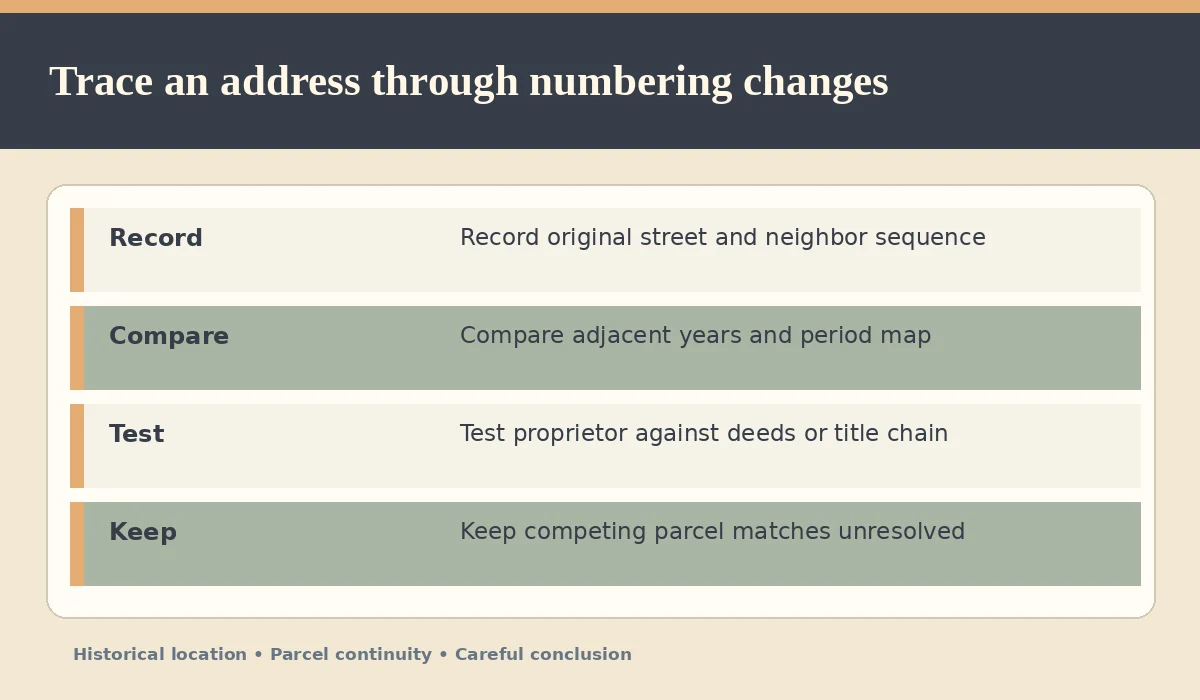
Imagine a fictional shopkeeper, Ellen Price, listed at a Hobart street property in the 1880s. A later street directory places an Ellen Price under a different number. Rather than merging them, inspect assessment rolls on both sides of the change, the adjoining owners, a contemporary town map and the nature of the premises. The neighbor sequence can reveal a renumbering or a split lot even when a modern number seems unrelated. A similar decision comes up in our guide “Scottish Valuation Rolls, 1855–1940”, which explains how to track owners and occupiers.
Give each proposed property identity a confidence note. A street name, neighboring occupiers and area description may together support continuity, while a mere surname match does not. Keep owner and business occupier timelines distinct. If the assessment reports an estate or an executor, that is an administrative label; consult a probate record before assigning an exact inheritance or date of death to a family member.

| Research checkpoint | Document a defensible observation | Do not assume |
|---|---|---|
| Proprietor | person named in the owner field | The same-name index proves the complete event |
| Occupier | person named in occupation field | The record proves a family relationship |
| Identity test | Match place, period and independent detail | A matching surname establishes the person |
| Coverage or access limit | Log missing years, item status and search route | A no-hit result proves nonexistence |
Compare valuations with deed and directory evidence
Libraries Tasmania points to historic title material through The LIST land information system and its historical deeds functionality. Use a deed or title chain to ask who legally held the parcel, and a directory to test who resided there or ran a trade. These sources answer different questions: a deed concerns legal transactions, a valuation allocates an assessment, and a directory is a published listing with its own collection or publication lag.
Set up one row per dated observation, with a column for the source type. When two sources disagree, leave the conflict visible and consider their different reference dates. Do not infer that an assessment owner lived in the building, or that a directory occupant owned it. If the parcel identity remains uncertain, the next step is a period map or plan, not a family-tree update declaring an ownership chain.
Handle incomplete issues and cite the exact Gazette roll
The Libraries Tasmania guidance acknowledges missing online items and offers hard-copy and microfilm alternatives for some periods. A failed name query in an issue is not evidence that a person never occupied land there. Write down which municipality, year, supplement and pages were searched, then consider a changed spelling, alphabetical arrangement or a neighboring locality. If the roll is unavailable, label the missing volume and seek a different dated source.
Cite the exact Gazette title, issue or date, printed page, named municipality, assessment-roll entry, Libraries Tasmania digital collection or other repository and access date. Keep an image citation distinct from a modern assessment-index reference. A rigorous conclusion can say the roll listed Ellen Price as occupier of a described property in a particular year, but it does not itself prove a legal title, a relationship to the proprietor or year-round residence. To go further, our guide “Tasmania School Admission Registers” shows how to find pupils and schools.
How We Research Tasmania Valuation Rolls
We checked the linked sources on 2026-10-22. Source descriptions are not a substitute for inspecting a specific original manuscript. The worked identities are fictional and intended only to show how to test a record. Rights, fees, privacy rules, digitization and finding aids can change: recheck item-level conditions when requesting or reproducing documents.
More Records and Archives Guides
Original Archive Finding Aids for Tasmania Valuation Rolls
Libraries Tasmania describes assessment rolls in gazettes, 1853–c.1950 index, town-specific arrangements and owner-versus-occupant fields (www.libraries.tas.gov.au).
Official building-history guide details assessment-roll chronology, Gazette use, valuation changes and owner/occupier search (www.libraries.tas.gov.au).
Libraries Tasmania identifies complementary later valuation and land-tax archival series (www.libraries.tas.gov.au).
This guide contains no affiliate links. Respect restrictions on identifiable living persons, sensitive allegations and copyright when researching or sharing historical sources. See the GenHis affiliate disclosure for our site-wide link policy.
No. They identify taxable or assessed properties and often proprietors and occupiers, not all residents or family relationships.
Use the Libraries Tasmania assessment-roll index for the municipality and year, then open the cited Gazette issue and page.
They may name a proprietor, but confirm legal ownership and changes through deeds or title records.
Street numbering, subdivisions, municipal boundaries and descriptions can change; compare neighbors and contemporary maps.
Libraries Tasmania describes hard-copy and microfilm alternatives; log the unavailable issue instead of assuming no assessment existed.