
Begin a Tasmanian will search in the Tasmanian Names Index, filter to wills, and open the original image when available. The main probate series is AD960 (1825–1999); estates without an effective will may lead instead to letters of administration in AD961 (1825–1997). A probate entry does not automatically prove that every named beneficiary was related to the deceased, and a missing probate record does not prove that no will was written.
Choose the legal event you are trying to find
A signed will, a grant of probate and an administered estate represent different events. A person may have executed a will years before death, but probate arises when an estate requires the court’s process. Libraries Tasmania explicitly warns that not all wills legally require probate. State your question before searching: Do you need the wording of a will, proof that the will was admitted, or information about who handled an intestate estate? The distinction changes the archival series and the conclusions you can draw. Start with a death date and locality independently documented, not with a bare surname search. Our guide “Queensland Wills, 1857–1940” adds more detail on this.
Learn the four Tasmanian series
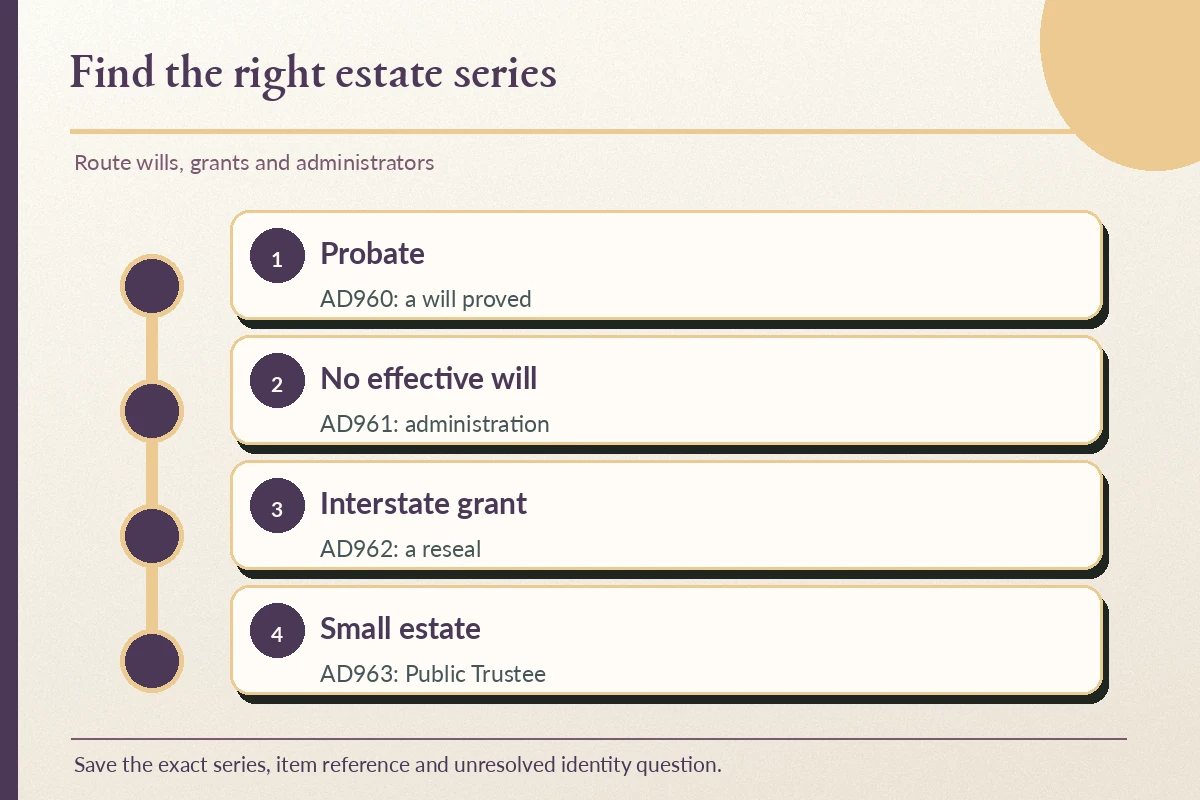
The official wills guide separates AD960 grants completing wills through probate (1825–1999); AD961 letters of administration for intestate estates (1825–1997); AD962 reseals for deaths in another jurisdiction (1950–1992); and AD963 Public Trustee elections to administer certain small estates (1913–1962). A probate grant concerns proof of a will, while a letter of administration can arise when a person dies without a will. A reseal may concern a deceased resident elsewhere and should not be treated as proof that the person died in Tasmania. Record these series as finding tools rather than combining every hit into a generic “will.”
Use the Tasmanian Names Index carefully
Search Libraries Tasmania and select Names Index, then narrow results to the record type for wills where available. Try a full name and variations in spelling, initials, hyphenation and married surnames. The archive says original spellings are retained in its indexing, while its search can return related spellings. Search a broader death-year range if the probate occurred afterward. Open the Resource link for an image where present. Use the catalog permalink and a precise item identifier rather than saving only an unstable results-page URL. If an image is not available online, follow the catalog’s current access or copy-request instructions.
Reconcile apparently different date ranges
Libraries Tasmania’s guide describes AD960 from 1825 to 1999, while the Names Index source list summarizes indexed wills as 1824–1990; the introduction says online wills can be viewed up to 1989. These are descriptions of different series, index and online-display boundaries, not a guarantee that every date or file is digitized. Do not merge them into a single universal access promise. For an early or late death, inspect the relevant guide, series record and current catalogue entry. For a will after the commonly searchable online range, the archives note physically held index books and later AD960 wills. Our walkthrough on how to find wills and probate records in U.S. Archives sets out each step.

Read each document according to its purpose
A will may identify an executor, individual beneficiaries, property and a date of signing. A grant can identify when the court accepted an estate process, not when death happened. An administration record can name an applicant but should not be interpreted as a person’s complete family tree. Transcribe the words “son,” “daughter,” “friend,” “trustee,” or any other stated relationship exactly, then seek a second record to verify it. An executor is not always a child, and an equal bequest is not proof of equal kinship. Note if the will contains a later codicil or crossed-out wording before making a claim. To go further, our guide “NSW Deceased Estate Files, 1880–1958” shows how to find property and death duty clues.
Create a dated estate timeline
Build a small ledger with separate rows for will execution, later codicils, death, probate or administration grant, and any later estate action. A fictional example: a testator signs a will in 1887, dies in 1894 and receives a grant dated 1895. The three dates answer different questions. The fictional example is not an archival record. If a will seems signed after death, investigate whether the document was a copy, an erroneous date, an amendment or a namesake. Distinguish a date transcribed from the document from one supplied by the index. Never silently substitute probate year for death year. If you want the full process, read how to find probate records in England before and after the 1858 court change.
Test identities before linking beneficiaries
Common surnames in Hobart or Launceston can yield several plausible probate candidates. Compare residence at death, occupation, spouse name, signature, executor and property location where available. One matching given name alone is insufficient. Record every individual’s precise legal or descriptive role: executor, administrator, witness, beneficiary or named relative. A business partner may appear without any family tie. If a beneficiary has a familiar surname, do not assert that person is a child without an independent birth, marriage or other documented relationship. Consider whether property described in a will belonged to the same testator at death.

When a will or probate record is missing
Check AD961 where the person could have died intestate, then review possible reseals or Public Trustee records when the date and circumstances fit. Broaden variant names and inspect physical finding aids or request guidance from Libraries Tasmania. A negative online search means only that the combination of collection coverage and query failed, not that the deceased had no estate. Many estates did not require probate, and a will might have remained privately held. Newspaper notices, land transactions and death entries can suggest a next archival lead but do not replace a grant or will. Preserve the limits of each negative search. To go further, our guide “Tasmanian Land Grants, 1804–1935” shows how to find deeds, indexes, and historic maps.
| Series | Record purpose | First caution |
|---|---|---|
| AD960 | Probate of a will | Grant date is not death date |
| AD961 | Administration of intestate estate | Administrator may not be next of kin |
| AD962 | Interjurisdictional reseal | Tasmania may not be place of death |
| AD963 | Small estates through Public Trustee | Not a general wills index |
Handle inheritance claims and privacy respectfully
A will is evidence of the writer’s stated intentions at a point in time; it is not a universal inventory of biological relationships or a final account of property distributed. Be especially cautious when referring to illegitimacy, estrangement or other sensitive historical labels, which may be one person’s wording rather than a neutral description. Where an estate approaches modern access boundaries, obey repository restrictions and avoid exposing personal details of living people. Colonial property records also sit within a wider history of dispossession of Aboriginal Tasmanians; archival ownership assertions describe a legal system, not the complete history of land or belonging. For a related choice, see our guide “Victoria Wills and Probate Files”.
Cite the image, the series and the index separately
For the file citation, capture repository, AD series, item and volume identifiers, date, testator or administrator, exact page or image sequence, and the catalogue permalink. When you have consulted only an index, label the source accordingly and leave the will’s contents unknown. Save the search date and a one-sentence uncertainty note such as “beneficiary listed, relationship unverified.” A copy with its physical or digital context is more useful than an isolated screenshot. This documentation also helps distinguish two estates with the same common surname or adjacent probate years.
How We Research
We used Libraries Tasmania’s own wills series guide, Names Index scope and public search help, explicitly preserving the different stated date ranges. The worked chronology is fictional. The method treats a legal estate role as a documented role, not a presumed biological relationship.
More Records and Archives Guides
Official sources and archival guidance
Libraries Tasmania describes online wills in the Names Index and later physically held records (libraries.tas.gov.au).
Official archival series guide identifies AD960, AD961, AD962, and AD963 and says probate is not mandatory for every will (libraries.tas.gov.au).
The Names Index collection list includes wills and administration entries, with dates described as 1824–1990 (libraries.tas.gov.au).
Official Names Index guidance explains record-type filters, digital images, permalinks and name variation (libraries.tas.gov.au).
Educational archival research guidance, not estate administration or legal advice. This guide contains no affiliate links. See our GenHis affiliate disclosure.
Use Libraries Tasmania’s Names Index, filter for wills and inspect the original image or item reference when available.
AD960 relates to probate grants for wills; AD961 relates to letters of administration for intestate estates.
No. Libraries Tasmania explicitly warns that not every will legally requires probate.
No. The full AD960 series range differs from the published Names Index and online-image boundaries; check the item-level availability.
No. Record the stated role and use an independent record to substantiate any claimed relationship.