
To find English probate records, begin with two dates: when a person died and when the estate was proved or administered. The 1858 reorganization of probate administration separates older church-court record series from the national civil system used afterward. A probate index or calendar entry can establish that proceedings occurred, but it is not the will itself. Some estates generated grants of administration rather than wills, and many people left no probate record at all. The workflow below helps locate the correct archive without assuming that a named beneficiary proves a particular biological relationship.
Use the probate date to choose the correct record system
The National Archives states that the Principal Probate Registry was established on 12 January 1858, after earlier church-court arrangements. Do not decide which repository to use from the death year alone: a person might have died months or years before a later grant. For a nineteenth-century estate, first estimate the likely date of probate using a death entry, memorial, newspaper notice or known will copy. Then search the appropriate side of the reorganization, leaving room for delays. Scotland and Ireland have different record systems and should not be silently folded into an England search. For a related choice, see our guide “Danish Probate Records”.
Also separate the possible legal outcomes. Probate can confirm the legal validation of a will, while letters of administration may be issued where there is no will. An archival catalog entry with ‘administration’ in its title should not be summarized as ‘will located.’ Some small estates were resolved without a surviving proved document. This affects what a negative search means: you cannot conclude an individual died without heirs, property, or relatives solely because a probate index has no match. Build a question about an estate, not a foregone conclusion about a family.
For 1858 onward, start with the official probate index
The GOV.UK search service provides probate searching for England and Wales deaths after 1857, including records from 1858 onward and options to order a copy when available. Its help advises researchers to search years after the death if no result first appears. Start with surname variants, approximate death place and date, then check matching entries in the National Probate Calendar where linked. Do not confuse an index snippet stating the estate value or probate registry with a complete distribution of assets, beneficiaries, and original will clauses. For the same kind of choice in another place, see our guide “Tasmanian Wills and Probate Records”.
Write down the grant date, named deceased, address or occupation if shown, registry, case reference, and exactly what the entry says. A probate date may be later than death; an executor named in a calendar is a person appointed to act, not necessarily the deceased’s child or spouse. When obtaining a document, note whether it is the proved will, a grant, or another probate product. The official service lists current ordering charges; verify those at checkout rather than printing prices as evergreen history advice.
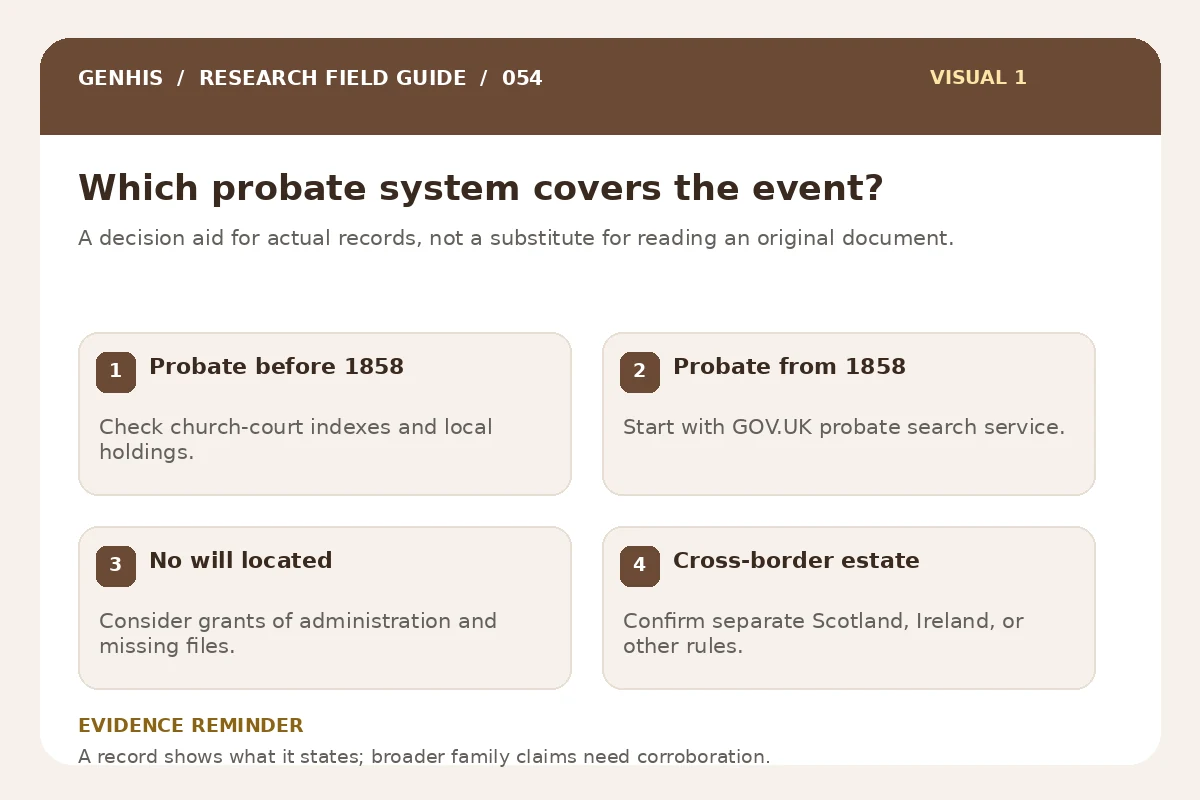
Before 1858, identify the likely ecclesiastical court
Earlier probate in England and Wales commonly passed through church courts, with many local and regional jurisdictions. The National Archives guide advises looking at ecclesiastical courts and says its own holdings cover particular series rather than every proved will. The Prerogative Court of Canterbury (PCC) was prominent, but an ancestor’s residence, assets, and period can direct you to another court. Locate the place and legal jurisdiction in the relevant historical period. Modern county borders are not enough to identify the court that handled an old estate.
Use a local record office’s court jurisdiction guidance and its surviving indexes before assuming that no PCC match means no probate. The Archives’ PCC wills series PROB 11 consists of registered copies for selected probates from 1384 through January 1858, not original signed wills for everyone. Some records may be digitized, others require archive ordering or onsite consultation. A named repository must be checked for coverage before you tell a reader to buy a particular image. Build a shortlist of courts and note which one you searched. If you want the full process, read how to find wills and probate records in U.S. Archives.
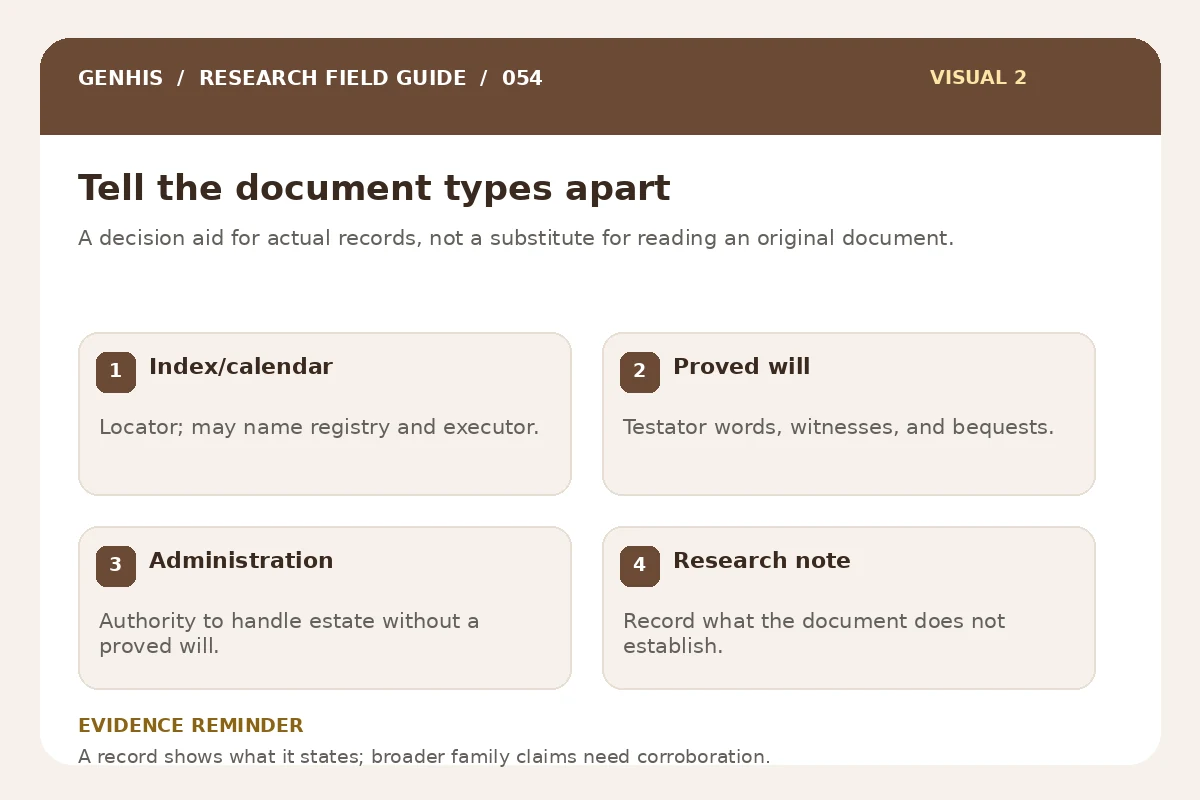
Extract evidence from the whole will or administration
A will may name executors, legatees, residences, property and family descriptions; the National Archives describes such details in its PCC guide. Copy the precise words and the date of the will separately from the later probate date. If the will says ‘my nephew’, that is a historical person’s statement of relationship, whose intended meaning and identification may still require corroboration. A bequest to a person with a shared surname is not proof that the beneficiary was the deceased’s child. Nor does silence about a relative prove that the person had died.
An administration can provide a distinct form of evidence about who was authorized to deal with the estate. Read how the administrator is described rather than labeling the document a will. Note whether an item is an abstract, an index, a court copy, or the full text. Keep burial and death records separate: an estate can be probated long after death or across jurisdictions if property was held elsewhere. The final family-history conclusion should distinguish a person’s recorded designation in a legal proceeding from the broader genealogical hypothesis being tested. For the same kind of choice in another place, see our guide “Western Australia Probate Records, 1832–1947”.
| Decision point | Recommended research action |
|---|---|
| Probate before 1858 | Check church-court indexes and local holdings. |
| Probate from 1858 | Start with GOV.UK probate search service. |
| No will located | Consider grants of administration and missing files. |
| Cross-border estate | Confirm separate Scotland, Ireland, or other rules. |
Test alternative searches when probate is not found
If an initial 1880 search produces nothing, move to later years and variant spellings before assuming the deceased had no estate. Check whether a similar name appears in a different registry or area, and whether place or occupation identifies the same person. For a pre-1858 death, look at the appropriate local church-court index and the PCC catalog, recording coverage and dates of the surviving material. Some material may be unindexed or separately cataloged. A failed surname search in a single national database cannot exhaust those possibilities.
As a hypothetical example, suppose a family letter says a baker in Devon died in 1857. If the probate case was proved in early 1858, searching only pre-1858 church indexes could miss it. Conversely, a will proved in 1857 should not be assumed to appear in a later national probate calendar. This is a hypothetical illustration of the date rule, not a claim about a particular baker. Log each repository, index range, spelling and result so a later researcher can tell whether the absence is genuine or merely untested.
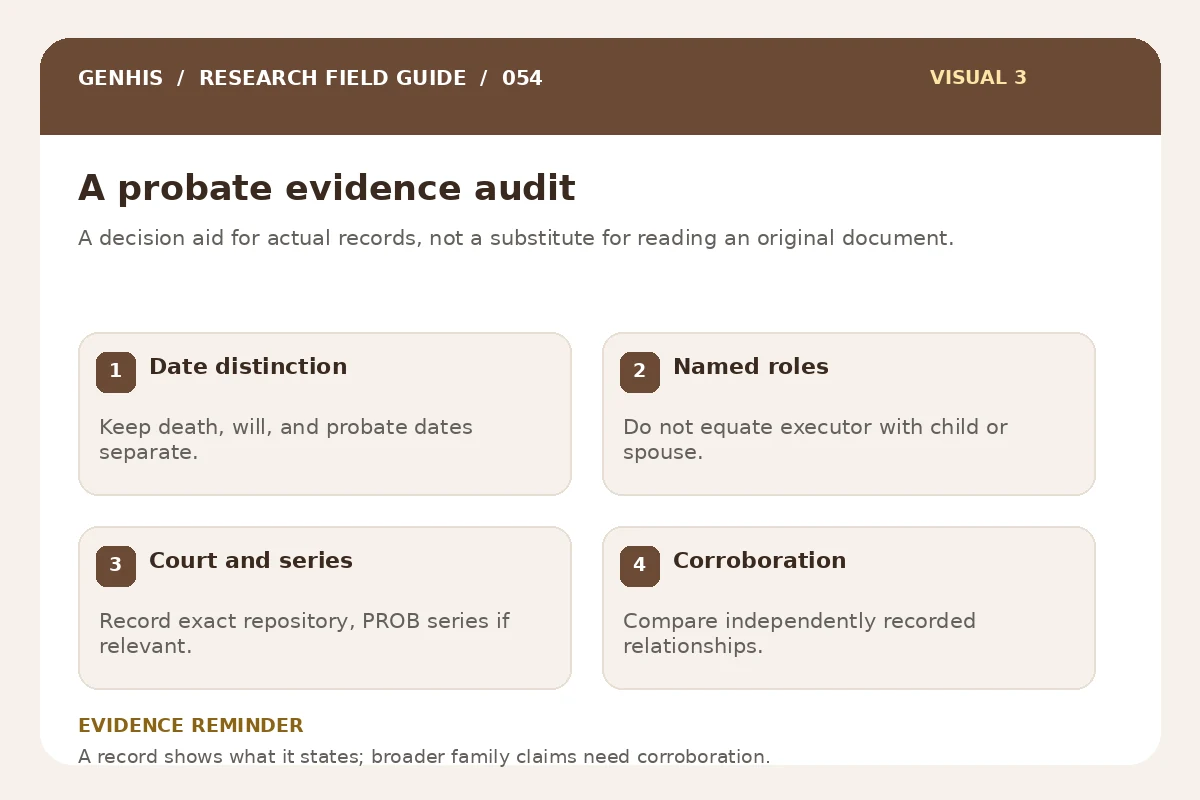
Cite probate status and protect living relatives
For each document, record the deceased’s name as written, relevant locality, record type, execution or administration date, grant/probate date, registry or court, archival series or index reference, and the image or page consulted. If a website gives only a calendar abstract, call it an abstract. Retain spellings and unexplained abbreviations until a source guide clarifies them. Keep heirs, beneficiaries, and executors in separate columns; their roles may overlap but are not interchangeable. A well-cited probate packet can narrow an identity question even when it cannot settle a biological relationship.
Wills can mention descendants and family members alive long after the testator. Take care with sensitive details about recently deceased people and their living relatives, property, and addresses. Respect access restrictions and avoid publishing full contemporary estate documents in public family-tree profiles. This guide is about archival research, not advice on administering an estate or resolving a disputed will. For a legal question about current probate, consult the responsible probate service or a qualified professional rather than treating a historical research checklist as legal instruction.
How We Research: map dates, documentary scope, and uncertain conclusions
We checked the official GOV.UK search service against National Archives guides for the date of the registry transition, the scope of church courts, and registered PCC copies. Illustrative cases have no identified individual or invented archival finding.
Authoritative sources and collection-specific limitations
www.gov.uk — institutional source. Official post-1857 probate search and ordering service for England and Wales.
www.nationalarchives.gov.uk — institutional source. TNA explains historic church-court probate and why its archives are not exhaustive.
www.nationalarchives.gov.uk — institutional source. TNA describes Principal Probate Registry transition and the later probate calendar.
www.nationalarchives.gov.uk — institutional source. TNA identifies PCC wills PROB 11 as registered copies within its defined historical range.
More Records and Archives Guides
Privacy, disclosure, and responsible interpretation
Probate research may reveal sensitive details about surviving relatives. This is educational archival guidance, not estate or legal advice; check current prices and access rules with the responsible custodian. These archives and public services are cited independently; none is a paid partner or an endorsed affiliate. Read the GenHis affiliate disclosure for site policy.
Yes. The Principal Probate Registry began on 12 January 1858; before then many probate matters went through church courts.
Yes, if the estate was proved after the system changed. Search by the probate date as well as the death date.
No. An entry may relate to administration without a will, and an index is not the full document.
No. Its guide describes selected holdings, including PCC material, while many local court series are held elsewhere.
No. Executor status is a legal role; any relationship requires evidence from the will wording and corroborating records.