
To find a U.S. will or probate record, begin with the court jurisdiction at the time of death, then read the full estate file rather than stopping at a surname index or one signed will. An estate may have an administrator and distribution orders even when no will was preserved. The most reliable genealogy result is a documented inventory of proceedings and named persons, with family relationships separately tested rather than assumed.
Start with the death location and the court that handled the estate
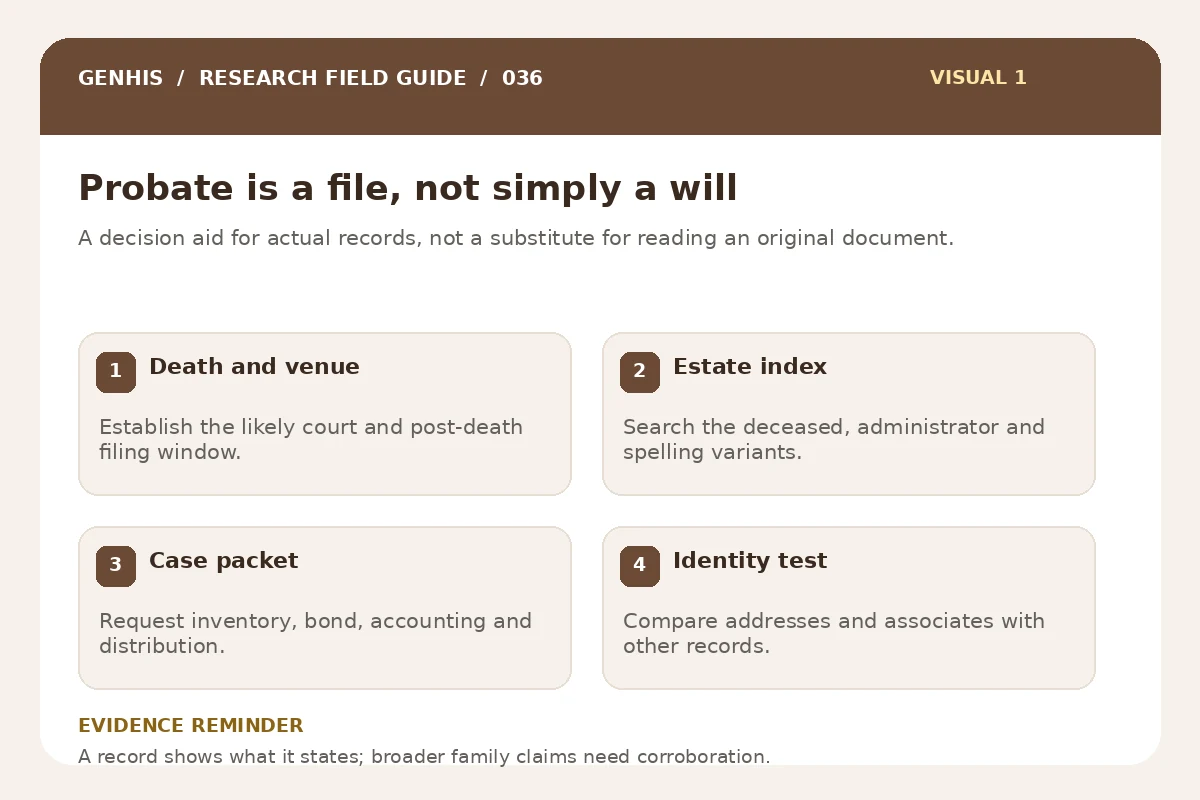
Unlike a modern surname database, probate is organized by legal jurisdiction. Assemble a short identity card before you search: the person’s approximate death date, likely residence, variants of the full name, spouse or associates, and any property location. Search a window after the death rather than restricting results to the death year. Proceedings can continue for years or begin after a delay. Treat the location as a hypothesis until a court citation fixes the venue.
Most U.S. estate proceedings began in local courts, but court names and archival arrangements vary by state and era. A probate court, surrogate’s court, chancery court, county clerk or successor court may hold the relevant series. Use a state archive finding aid or local court records guide to discover which institution created the papers and where the older volumes are now held. Never infer that the National Archives automatically holds a county probate file. For a related choice, see our guide “Danish Probate Records”.
Search indexes, then examine the underlying volumes and packets
Start with the deceased person’s surname in an estate docket, general index or will-book index. Record every matching entry, including a volume, case or file number, approximate filing year and the precise wording of the name. When the interface provides only indexed names, look for an option to browse digital images by county, court and book. A handwritten alphabetical index may direct you to a page that an online search does not retrieve.
Different pieces of one administration may live in separate bound books. An entry in a will book does not establish that you have the final settlement, and an estate packet may contain more than the original testament. Request the petition, appointment papers, bond, inventory, account and distribution order if the court series preserved them. FamilySearch describes probate estate case files as groups of legal documents, not a guaranteed uniform checklist. Record absence as “not found in this series,” not “never existed.”
Separate legal roles from genealogical relationship claims
A will may name a spouse, child, cousin, godchild, charity, friend or household servant. The label beside a name matters more than whether the person appears in a prominent position. An executor manages the estate; a witness attests an act; a legatee receives a gift; an heir receives property under applicable inheritance law. These roles can overlap but are not interchangeable, and an executor or neighbor cannot be promoted into the pedigree by proximity alone.
For every named person, transcribe the exact description into a claim ledger. Put “my son” in the wording column, “stated relationship” in the evidence column, and a proposed independent source in the next-action column. Note that words such as “daughter,” “brother,” or “heirs” may need contextual interpretation in a blended household or a different legal era. If the document does not explain a biological relationship, keep it unknown rather than supplying one.

Use a worked example to test a plausible identity
Imagine a hypothetical estate index for “J. Morgan” with two entries in neighboring counties. One has an administrator called Clara; the other lists a farm inventory and a son named Joseph. A family tree says the ancestor Joseph Morgan died at that time. Neither match is decisive. Compare residences, signatures if available, spouse names and deed references. The correct file may be the less obvious entry, or neither entry may belong to your ancestor.
Now suppose the estate names a “nephew Samuel” and also includes a bond signed by a different Samuel. This is not permission to combine them into one person. Build two candidate identity rows and check age, occupation, residence and witness network against independent documents. If the records do not distinguish the two, explicitly state that the relationship remains unresolved. A carefully documented unknown is more useful than a confident but invented branch. For a related choice, see our guide “Swedish Estate Inventories”.
| Record component | What it may show | Do not assume |
|---|---|---|
| Estate petition | Initial court, residence and party names | Each named person is a relative |
| Inventory | Assets, debts and local context | List is a complete picture of wealth |
| Distribution order | Named payees and court-approved action | The order proves biological kinship |
| Administration bond | Executor or surety names | A surety is always a family member |
Cross-check estate land and chronology against other records
An estate inventory may list parcels, household goods, livestock or debts. Land mentioned in a will may have been purchased much earlier or sold during administration. Look for deed books and the appropriate grantor–grantee indexes using parcel descriptions and names of representatives. A deed signed by an administrator may carry an estate case citation that connects two otherwise separated record systems. Track document dates separately: will signing, filing, inventory, sale and distribution represent different events.
Where a historical probate record lists enslaved people as property, do not reduce those persons to an ownership fact or infer a relationship from proximity. Preserve names and the original wording with context, investigate separate freedom and identity records when available, and avoid repeating dehumanizing terms except as needed in carefully attributed transcription. Similar care is required for guardianships: a named guardian does not necessarily establish a parent-child relationship.
Keep the citation and a completeness checklist with your notes
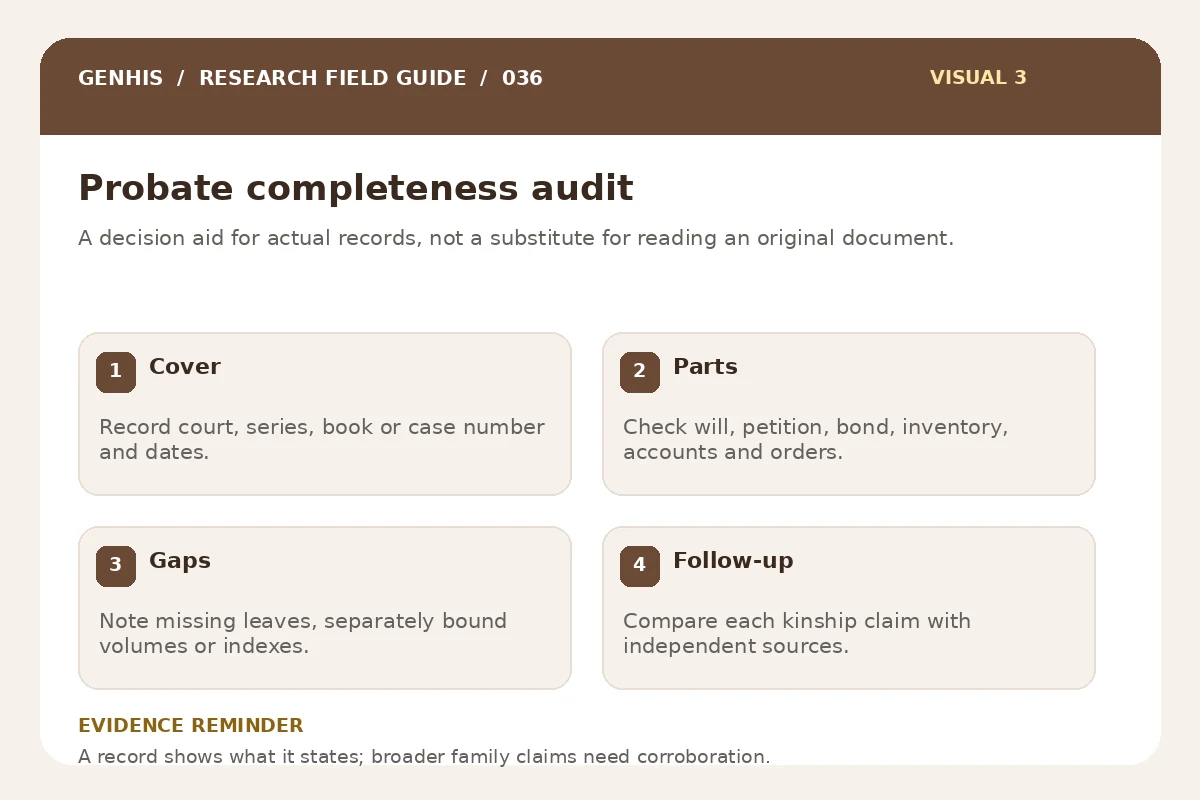
Create a source citation that identifies the creator and jurisdiction, collection or series, case or book number, page or image number, and repository or stable image link. A commercial website is a delivery platform, not always the creator or custodian of the document. Save an image showing the entire page and record the adjacent page if a relationship or date continues there. Retain the version consulted because online image arrangements can change.
Close the file with a miniature audit: which estate components you inspected, which were absent, which names are stated explicitly, and which claims still lack independent confirmation. Capture negative results together with the repository and date of search. This turns a single interesting will into a reproducible research trail and makes it possible to resume later without retracing the same misleading index hit.
How We Research: jurisdiction, source provenance, and uncertainty
Our probate research checks FamilySearch guidance on estate packets against the different legal roles that may appear on a single page. We follow the deceased person from the local court index to the possible case-file components and keep the dated legal actions separate from the date of death. The Morgan and Samuel examples are invented teaching cases, not recovered ancestors or hidden archival findings. Probate laws, court names, document survival and viewing arrangements depend on the historical jurisdiction, so confirm them with the actual custodian.
Authoritative record sources and repository limitations
www.familysearch.org — repository reference. FamilySearch identifies the probate case-file components and local court provenance. Use estate series references and original court pages to establish whether a particular deceased person is actually represented.
www.familysearch.org — repository reference. FamilySearch explains US probate terminology, regional variation and record search paths. Use estate series references and original court pages to establish whether a particular deceased person is actually represented.
www.familysearch.org — repository reference. FamilySearch illustrates evidentiary potential of inventories, witnesses and estate relationships. Use estate series references and original court pages to establish whether a particular deceased person is actually represented.
www.familysearch.org — repository reference. FamilySearch explains indexed versus image-only historical collections and browsing. Use estate series references and original court pages to establish whether a particular deceased person is actually represented.
More Records and Archives Guides
Privacy, disclosure, and the limits of this guide
Estate research is not legal advice and cannot establish parentage by the mere presence of an heir or witness. Local courts control the accessibility and copying terms of their records; indexes and images can have different rights. This guide names no paid probate service or confirmed affiliate arrangement. The official links lead to record guidance and the GenHis archive category. Consult the GenHis affiliate disclosure for site-wide transparency, and withhold any private data about living beneficiaries.
Yes. An intestate estate may still generate petitions, administration letters, inventories, accounts and distribution orders. Search the broader estate index rather than only will books.
No. Legal inheritance categories and family relationships depend on the applicable law and the wording of the record. Corroborate any biological claim with independent evidence.
Start with the jurisdiction handling the estate at death, then examine the court serving the person’s residence and any counties holding property. Court boundaries and probate venue vary.
The collection may be incomplete, browse-only, missing a year or indexed under a variant. Check collection descriptions, handwritten indexes and the courthouse catalog.
No. An inventory usually follows death and its date records an administrative action. Seek a death certificate, contemporaneous notice or other direct evidence for the event.