
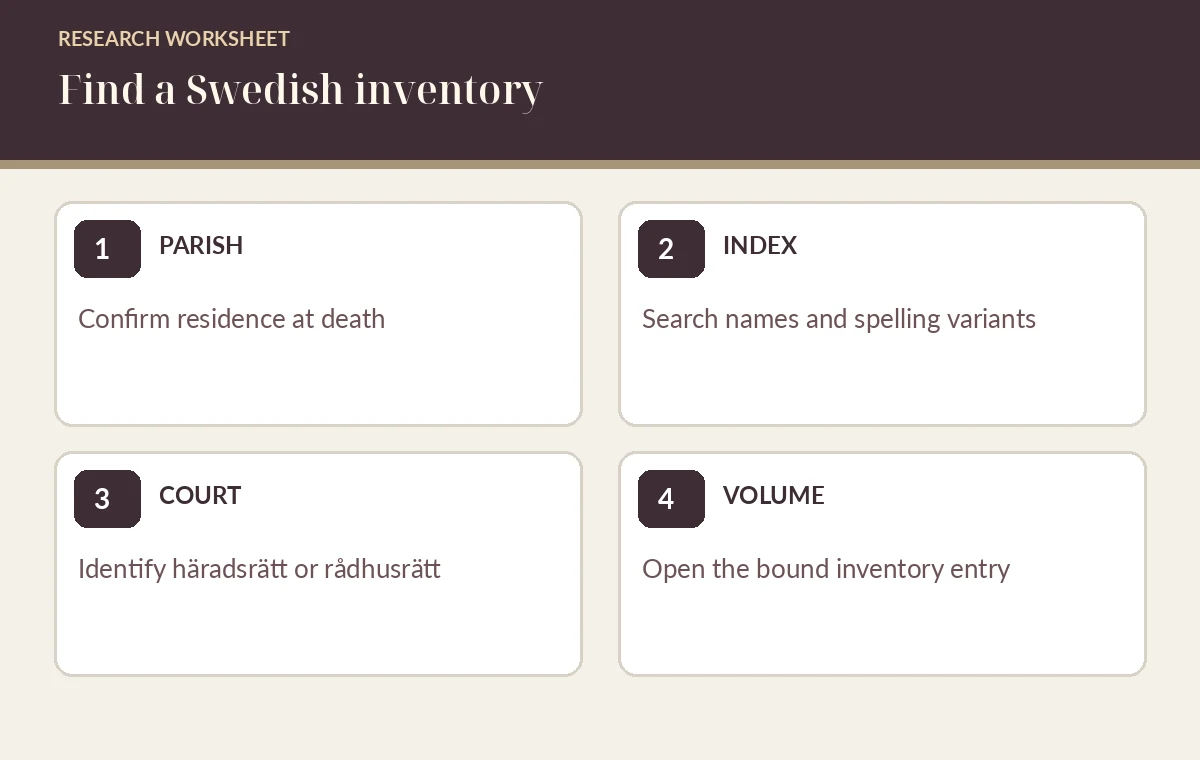
A Swedish bouppteckning is an estate inventory reporting a deceased person’s assets and debts, often with details of surviving relatives. To find one, establish the person’s death and home parish, search the Swedish National Archives index, then open or request the inventory in the court archive that handled the estate. An indexed relative’s name is a valuable lead, but relationship labels, guardians and later household connections must still be tested with church records.
Understand what an estate inventory actually records
Riksarkivet explains that estate inventories were required under the 1734 law, although examples exist earlier, and that not every person left an inventory. Older records may list property, household goods, animals, books, debts and people associated with the estate. The administrative goal was to account for a deceased estate, not to construct a modern genealogical pedigree.
An inventory date can occur after death, so store death, preparation and court-recording dates in different fields. An inventory can contain legal representatives, creditors or guardians who are not children or heirs. When assigning a relationship, transcribe the Swedish wording and identify exactly who the phrase describes rather than automatically attaching everybody named to the deceased as kin.
Start from the home parish and historical court jurisdiction
Before searching a surname, locate a credible death date, death parish and residence in Swedish church books. Court custody follows historical judicial districts, not simply the modern municipality. Rural estates commonly appear in häradsrätt archives and urban estates in rådhusrätt archives, with later tingsrätt custody. Riksarkivet’s court archive guide is the starting point when an index result does not link directly to a page.
If two people have the same name, add age, home parish, spouse or residence to the identity grid. A church moving-out register can explain why a person died under another court district than the one used by the family in an earlier household examination book. Use the correct court for the death-time residence, and search neighboring jurisdictional holdings only when evidence supports the move. For the fuller picture, see our guide “Swedish Household Examination Rolls”.
Search the Riksarkivet index and record the exact locator
The searchable bouppteckningar index covers material with dates from the seventeenth century through 2001, but the National Archives explicitly says it is incomplete and combines records from multiple indexing projects. Some regions are missing from that database. Search patronymic spelling variants such as Carlsson/Karlsson and female forms, plus death and inventory year ranges rather than one exact entry.
A hit may supply the deceased person’s name, a related person, place, court, archive and volume reference; some provide a digital image link. Save those fields before opening the scan. An absent result is a negative database search, not proof that no inventory was created. Check scanned alphabetical registers and the appropriate court’s digitized volumes as alternate paths.
| Evidence source | What it can support | What it does not establish |
|---|---|---|
| Riksarkivet index hit | Court, place, person and volume clue | Complete inventory or complete coverage |
| Original court inventory | Estate assets, liabilities and named roles | Unquestioned biological relationship |
| Parish household and death books | Independent residence and family context | That every inventory participant was kin |
Open the scanned protocol and inspect its context
Court documents may be bound chronologically rather than indexed by person name. Compare the index’s volume reference to the archive catalog and follow the original image numbering. Read the beginning and closing portions of the inventory, not just a cropped name list: roles, signatures and appended notes can affect how each person should be interpreted.
Build a transcription table with original Swedish phrases beside your English interpretation. Older handwriting and occupations can be ambiguous. Label difficult words unresolved and revisit them with a handwriting aid rather than imposing a neat but unverified reading. A list of belongings is evidence of what officials recorded, not necessarily a complete or independently valued account of the family’s wealth.

Test apparent heirs against the household books
Hypothetical example: an inventory for a fictional Karin Andersdotter mentions a man called Anders as a representative. It would be unsafe to call Anders her son without a role statement or independent evidence. First transcribe the relevant clause. Then compare the deceased woman’s household examination and death record to see whether an adult son, guardian or other person is documented in the correct place and time.
Where a label explicitly describes a widow, child or other relation, preserve it as a reported relationship and check against birth, marriage or communion records. Probate-era guardianship does not by itself establish biological parentage. Record exactly which details agree across different sources and which remain uncertain. This method avoids merging same-name Swedish families merely because their inventories list overlapping given names.
Know where the accessible records stop
Riksarkivet notes that court archives include both scanned material and holdings not fully digitized; its general index is especially incomplete by region. For newer inventories, access and custody differ. The archive points researchers to its own request routes for documents dated through June 2001 and to Skatteverket for later ones. Avoid assuming online access to all twentieth-century material or unrestricted information about living people.
A careful no-result note names the index searched, spellings, court district, years and scanned registers consulted. If no inventory is located, try the documented death record, other court finding aids and local historical sources. Do not infer poverty, estrangement or a missing death simply because the surviving estate inventory system has no matched file. For a related choice, see our guide “Danish Probate Records”.

How We Research Swedish Estate Inventories Bouppteckningar
We verified the National Archives explanation of Swedish estate inventories, its named database and court-volume retrieval methods, and its request guidance for more recent material. The invented Karin example demonstrates why identifying heirs depends on original role wording plus independent parish evidence. We do not treat an index omission as an inventory that never existed.
More Records and Archives Guides
Archive catalogs and original-source guides for swedish estate inventories
Riksarkivet: record classes, court custody and digitization limits (sok.riksarkivet.se).
Riksarkivet: index fields, incomplete regional coverage and spelling advice (sok.riksarkivet.se).
Also, Riksarkivet: scanned court archives and chronological inventories (sok.riksarkivet.se).
Riksarkivet: copy-request routes and custody dates (riksarkivet.se).
These links lead to official or archival research resources, not approved paid endorsements. Read the GenHis affiliate disclosure. Access conditions and digitization coverage may change. Research historical people with appropriate context; do not disclose private details about living people or treat allegations and administrative labels as proven facts.
It is a Swedish estate inventory recording the assets and debts of a deceased estate.
No. Riksarkivet’s combined database is incomplete and some court books require browsing.
Use the deceased person’s home parish and historical judicial jurisdiction at the time of death.
Not automatically. Read the original role wording and verify it with church records.
Check Riksarkivet guidance for inventories through June 2001; later ones are handled by Skatteverket.