
PROB 2 is a starting point for early original inventories associated with the Prerogative Court of Canterbury, particularly before 1660. These itemized accounts can be unusually vivid evidence of a deceased person’s goods, tools, stock, debts and living environment. They do not automatically identify the legal owner of a house, every family member, or what beneficiaries ultimately received. The responsible question is which estate and which document the items belong to, then what independent records confirm the surrounding circumstances.
Decide Whether You Need an Inventory or a Will
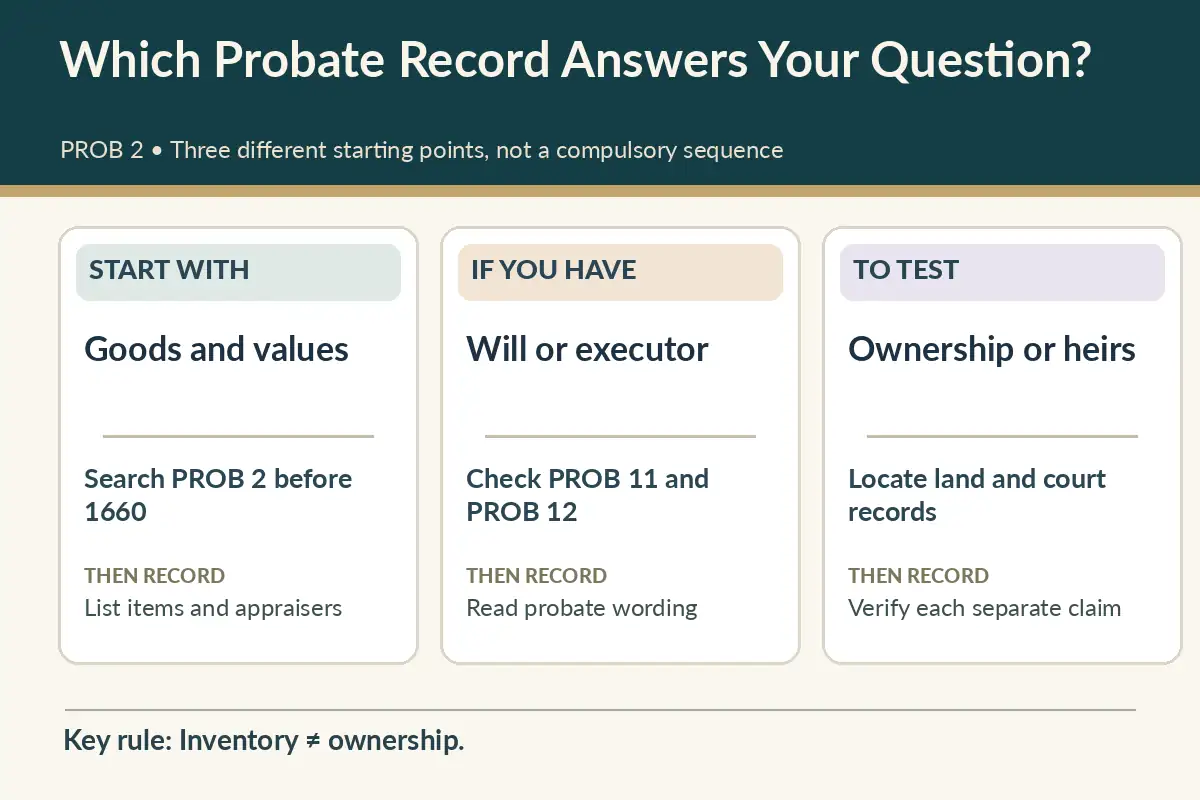
An inventory describes an estate’s assessable moveable contents; a will records dispositions or wishes under a different documentary process. Search the proper record class rather than assuming every probate result is interchangeable. The National Archives places the earlier PCC inventories in PROB 2, but inventories for later periods can be in PROB 3, PROB 4, PROB 5, PROB 31 and PROB 32.
If your research question is “what goods did a trader hold?” an inventory may be more direct than a will. If the question is “who was appointed to deal with the estate?” look for the grant or act entry. If it is “who acquired the lease or freehold?” turn to deeds, manorial or court material. Record the question first; it governs what an absence actually means.
Establish the Correct Court and Historical Place
The PCC was not the only probate jurisdiction. A name absent from a PCC search is not proof that the person left no estate, died elsewhere or was unmarried. Verify the parish and county in contemporary usage, whether property lay in more than one jurisdiction, and which court had authority over the relevant estate.
Search spelling alternatives and shortened place names, then note the exact archival reference rather than citing only a search-result screen. A record may be catalogued with a place abbreviation, occupation or a variant surname. Keep competing same-name candidates separate until a dated parish event, occupation and estate connection align.
Read Each Appraisal as a Claim, Not a Household Census
Inventories can enumerate linens, furniture, livestock, crops, professional tools, debts and merchandise. Transcribe the wording and original units rather than silently modernizing the object or converting the value into present-day money. A valuation is an appraisal made for a particular purpose and date, not a current market assessment.
The presence of beds, cookware or animals does not demonstrate precisely who used them, who lived under that roof or whether goods were stored elsewhere. Some lists group objects by room and some do not. An appraiser’s name establishes a role in compiling the account, not a biological or marital relationship to the deceased.

Keep Death, Inventory, and Probate Dates Separate
Write three columns: reported death date from an independent source, inventory or appraisal date from the document, and date of probate or administration from the grant. They may differ substantially. The fact that a dated list survives establishes when the list was made, but a date written beside an item need not be the death date.
Use the same rule for money entries. A debt owed to the estate is not proof of a completed payment, and the list of creditors is not an exhaustive map of all commercial relations. Where the hand is unclear, preserve an uncertain reading with a bracketed alternative and an image locator.
Follow PROB 2 with the Right Companion Sources
A PROB 11 registered will or a PROB 12 calendar can establish an associated probate path, but neither replaces an original inventory. Compare name, date range, locality, occupation, executor and any archival cross-reference rather than merging records on surname alone. In some estates there may be no surviving companion record, or no will at all.
If a supposed heir or landlord appears in a later deed, ask whether the instrument specifically relates to the same person and property. A deed buyer is not necessarily a resident; a named recipient in a will has not necessarily taken possession. Capture these as separate propositions until documentary links join them.
Handle Lost Pages and Uncatalogued Material Honestly
The archive guide describes survival across several inventory series rather than claiming a complete census of estates. Failed catalogue searches should be logged with spelling, place, date, record series and filters. If a specific piece is inaccessible or damaged, say that rather than stating that a particular transaction never occurred.
A broad search for “inventory” may find another kind of list. Inspect the creator, court, reference and document opening before treating it as a PCC appraisal. A partial transcription can be useful, but cite the original when possible and distinguish the words actually read from editorial expansion.
Use the Inventory to Reconstruct Work and Consumption
A smith’s tools, a merchant’s stock or a farmer’s livestock may illuminate occupation and economic scale, yet these descriptions can reflect multiple livelihoods. Make a claim-level table: literal object, valuation, possible use, confidence and missing corroboration. That approach prevents an evocative object from turning into an invented biography.
For local history, compare contemporary tax assessments, parish records and occupational references to test whether the household fits its neighborhood. A rich inventory is evidence about recorded assets; social status, financial solvency and the physical address require independent checks.
A Worked Example of Cautious Attribution
Imagine an inventory describes a loom, wool, two bedsteads and a debt due to the deceased. It is reasonable to report that these items were recorded in an appraised estate. It would be unsafe to call the deceased a master weaver solely because a loom appears, to identify the people who slept in the beds, or to assume the debtor paid. The next documents might be a contemporary occupation entry, probate grant, creditor account or tenancy instrument.
In your worksheet, write “loom listed and valued” in the observation column and “textile work possible” in a distinct inference column. In the evidence-needed column place “occupation in parish or trade records.” Apply the same separation to the inventory’s named appraisers: their signatures may help identify a local network but do not by themselves establish kinship, friendship or a business partnership.
If a related will describes a property, do not transfer that legal description into the inventory citation. Quote each original separately and say exactly where the conclusion about property rests. This discipline is particularly important when a seventeenth-century estate passes through multiple probate jurisdictions or contains ambiguous names.
How We Research the Original Archival Evidence
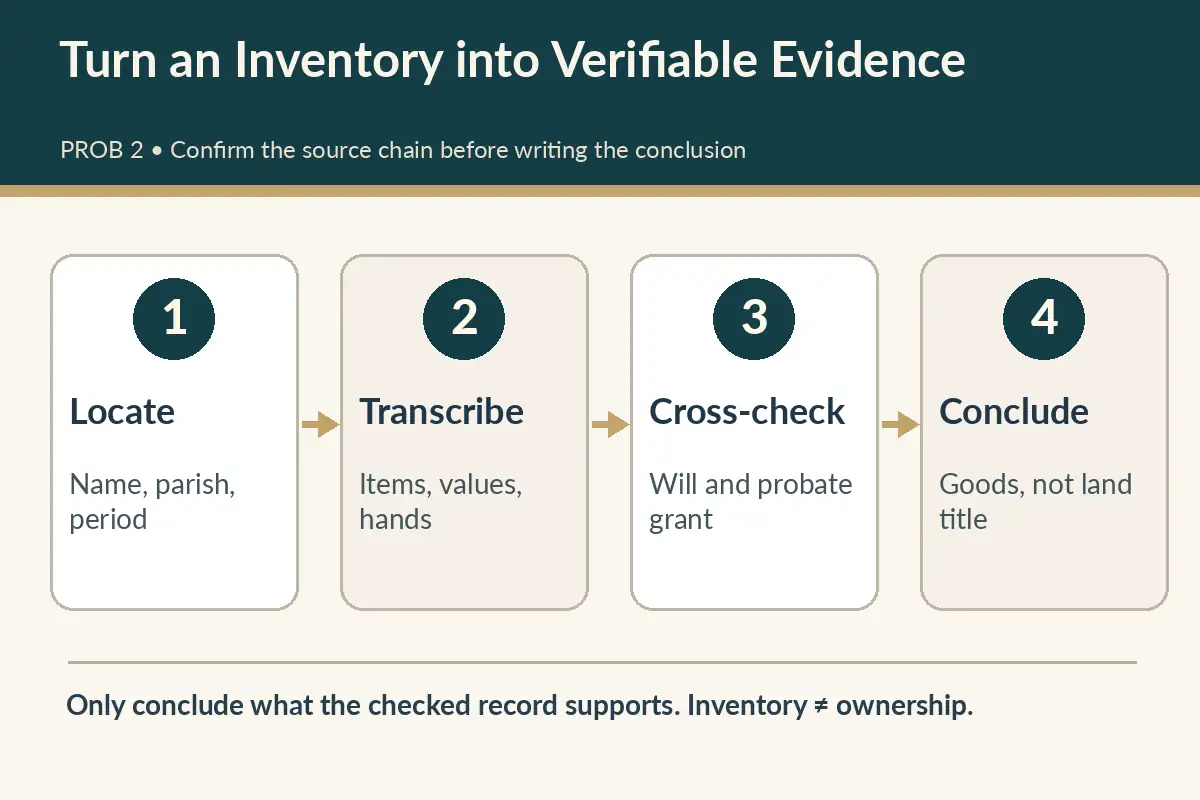
Our approach begins with the document itself, not a surname match or a search snippet. For a inventory, we log the archival creator, full series and piece reference, date and scope of the item, and the question under test. We then check testator or intestate, county and parish, appraisal wording, and whether a separate probate grant survives. A missing field is recorded as missing, not reconstructed from another person’s record. This procedure distinguishes what was written at the time from a plausible modern interpretation.
We cross-check PROB 2 alongside PROB 11 and PROB 12; title and kinship require other sources. We keep a separate column for contradictory observations, use contemporaneous spelling as a citation anchor and allow multiple candidates to remain unresolved. Where a catalogue summary substitutes for an original not yet inspected, we say so. The National Archives guidance cited below supplies the record-class boundaries; it does not certify any named historical person as a match.
More Records and Archives Guides
Sources, Access, and Evidence Boundaries
The following official research guidance explains the holdings and the search route: The National Archives: Wills Or Administrations Before 1858. The National Archives: Wills 1384 1858. The National Archives: Disputed Wills. Check each catalogue entry for the particular piece’s access conditions and ordering options. A source description is not a substitute for reading the original image, and digitization varies by collection.
Our editorial and affiliate policy is available in the affiliate disclosure. No purchase is required to follow the record-class decision process, although a repository or third-party image supplier may charge for document copies or access. Check the current terms directly before paying.
No. Survival and court coverage are incomplete; a missing search hit is not proof that there was no inventory or estate.
No. An inventory lists appraised goods; a will records testamentary instructions and may survive in a different series.
No. Household contents and legal title to a building are different claims requiring property evidence.
No. Their names show an appraisal role. Relationships require independent identification and supporting records.
Keep the literal spelling and page locator, note alternative readings, and cite the archival item rather than only an index.