
BT 162 is useful when you need to establish whether a ship appeared in a historical return associated with a British or colonial port. It is not a register of everyone who sailed aboard that vessel. The National Archives describes annual lists sent to London, first by convention and later under changing registration rules. Begin with the port, approximate date and vessel identity; only then move toward separate evidence of ownership, a named master, a voyage or an individual seaman.
Identify the Ship Before Choosing an Annual List
Write down the name exactly as it appears in the earliest dated source, including initials, spelling variants and any identifying suffix. A ship name is reusable and may belong to several vessels. Add a known port, approximate tonnage, rig or construction detail, and an official number when the period allows one. Never treat a newspaper mention of a familiar name as sufficient identification. The goal is a vessel profile that can be compared with more than one archival series.
The National Archives explains that lists in BT 162 were supplied from UK and colonial ports, described in some historical contexts as plantation ports. Their administrative geography is not identical to today’s country boundaries. A ship may appear under a port of registry rather than the port where it last loaded cargo. If a family letter says “sailed from Liverpool,” do not silently change that into “registered at Liverpool.” Enter those two port claims in separate columns before searching.
Choose the Right Date and Return Category
BT 162 mostly concerns lists submitted between 1786 and 1880. The returns were not necessarily produced, preserved or described with uniform coverage every year. The official guide notes that reporting began before the 1854 Merchant Shipping Act made submission compulsory for UK ports. Colonial ports continued to supply lists under a different legal position. Treat the year a return was compiled as an administrative date, not necessarily the date of an individual sailing or first registration.
Make a year-by-year search log. For each likely port, record whether the catalogue shows a UK or colonial category, a usable volume, and the period actually covered. Do not turn a blank result in one catalogue search into an assertion that the ship was absent from that port. Some volumes are browsed by reference or chronological order rather than individually indexed by vessel name. A first unsuccessful search may be a finding-aid problem rather than negative evidence.

Read an Annual Return at Vessel Level
On the original page, transcribe the document heading, return year, port, vessel line and adjacent column labels before extracting a name. Compare any numerical identifiers, vessel description and master detail actually present. Do not assume fields from a later ship register are also printed on the annual list in hand. If the scan is unclear, retain the uncertain character rather than silently normalizing a vessel name to a known ship. A citation should preserve volume, page or folio and the series reference.
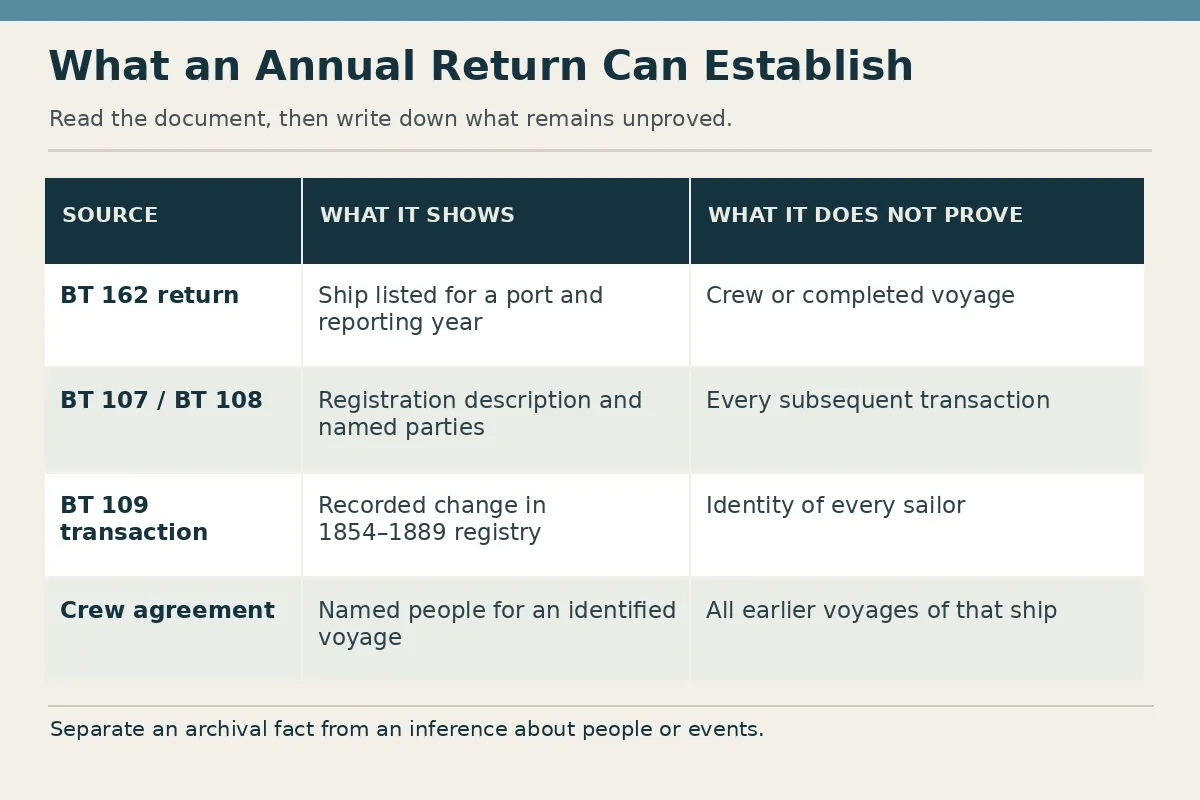
The existence of a ship in a return normally supports a narrow claim: it was reported as registered under that administrative context. It does not demonstrate that the ship was seaworthy, in active service on a particular day, operating a given route or carrying a specific ancestor. Even a master named on a registration record may not have commanded every passage during the year. Write observations and inferences separately so the return is never asked to prove more than it records.
Compare Registration Records Without Mixing Number Systems
Before 1854, a registration certificate number was assigned in the context of a port and year, and the same number could recur. From 1854, a ship acquired an official number that can be used across later sources. These are not interchangeable identifiers. For the earlier period, compare BT 162 against BT 107 registration transcripts, using port and contextual details. For 1854 onward, examine the BT 108 transcripts, BT 109 transactions and the available indexes in BT 111 when appropriate.
Changes in owners, shares, masters and registration status must be checked against the particular document capable of recording them. An annual list can point toward a vessel, but it is a poor substitute for the underlying registration transaction. If a vessel was sold, renamed or transferred to another port, create a dated chain rather than merging two name matches. Note conflicts explicitly: different tonnage, port or owner might reflect genuine changes, a transcription error or entirely different ships.
Resolve a Crew Claim Through Different Records
If the research question concerns a sailor, switch from vessel registration to the separate record systems for crew agreements and seamen. Look for the correct ship and voyage period using the official number where available, and then seek the crew list for that interval. Registration can establish the vessel’s identity while a crew agreement may identify the people who actually signed on. Neither record alone proves a family relationship to someone with a matching surname.
For a claimed master, compare the person and certificate information with the relevant professional and service records rather than assuming the ship name settles identity. For a crew member, look for age, birthplace, rating, dates of engagement and discharge if those particulars survive in the record. Record gaps honestly: a missing list is not proof the sailor never boarded. A properly identified ship is the beginning of the person-level investigation, not its ending.
Use a Two-Vessel Example to Test Identity
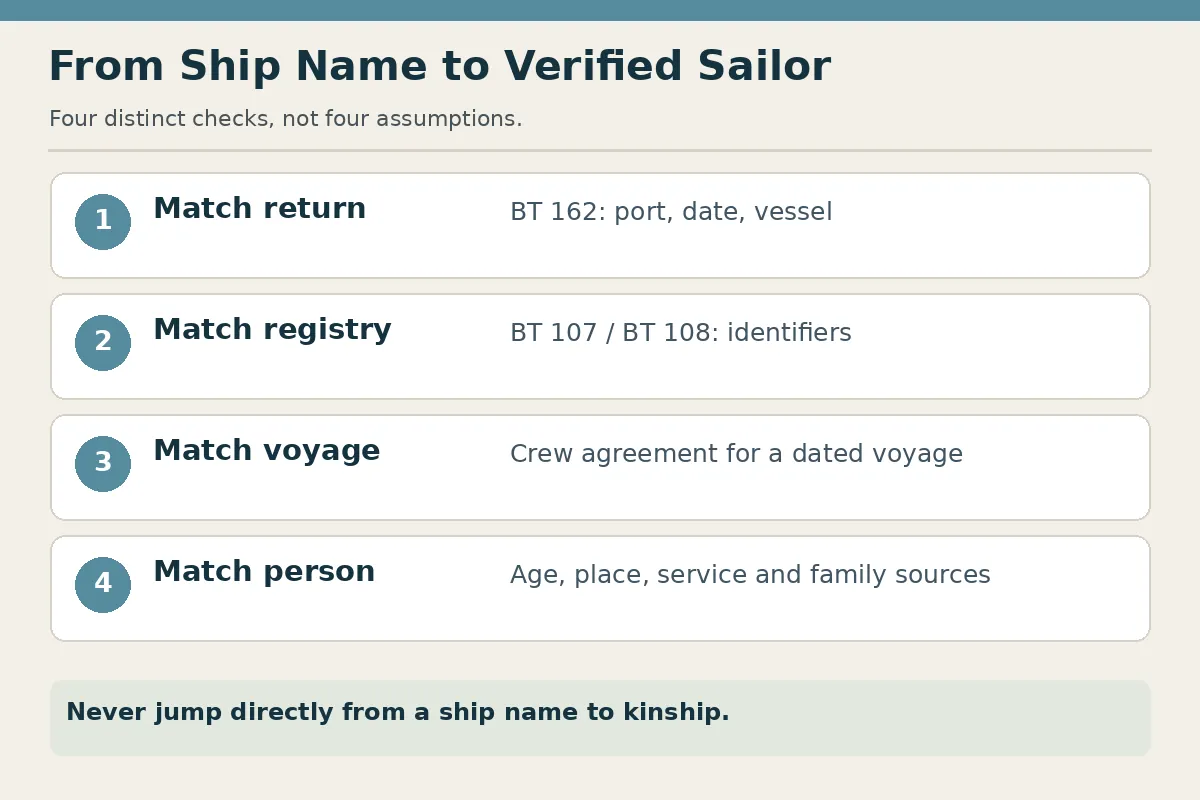
Imagine one source mentions the brig Hope at an unspecified Atlantic port, and a second notes a Hope in a later British ship return. Those statements do not automatically refer to the same hull. Create two rows, each preserving name, report date, port, construction information and number. If the return and subsequent registry show incompatible descriptions, keep both candidates live until a better identifier appears. An apparent name match should not erase conflicting original facts.
If a later crew agreement names a sailor, join it to a vessel only after checking its official number or a strong combination of ship characteristics and voyage dates. The illustrative Hope example is not a claim about any real ship or person. Its purpose is to demonstrate a verifiable decision point: ship identity first, then voyage identity, then personal identity. A family story may survive scrutiny, but the return itself cannot supply every missing link.
Record Access, Citation and Negative Searches
The National Archives indicates that BT 162 annual lists are available as digital microfilm, but the level of indexing differs from a searchable full-text database. A downloaded reel may still require page-by-page inspection. Record the download reference and its internal page position. If only a catalogue description has been viewed, say so; do not cite a presumed original page. When a needed volume is unavailable, document how the missing interval affects your proposed conclusion.
A defensible citation names BT 162, the specific piece, the port category, return date and page or image number if known. Keep a separate search log for variant spellings and registers examined. A genuine negative result requires evidence that the relevant volume survives and has been inspected at the right place. Without that coverage step, the absence of a matching ship is simply an unresolved search, and other registry sources may still carry the answer.
More Records and Archives Guides
How We Research This Archive Series and Verify Its Limits
We anchor the series description to The National Archives research guidance and use additional official guidance to test the difference between cataloguing, surviving documents and interpretation. The evidence trail follows the record creator, exact series and piece, original wording, historical jurisdiction, and a separate corroborating source for any person-level or outcome claim. We label illustrative scenarios as fictional and do not treat absences from poorly indexed collections as evidence of nonexistence.
An archival catalogue entry is not a substitute for reading a page. Availability, description detail and access conditions can differ by item and change over time; check the current record page before making travel, copying or subscription plans. We do not infer a paid relationship from archive references. Our affiliate disclosure explains site-level disclosure principles. The methods here are for reconstructing historical evidence, not for locating or revealing sensitive information about living people.
No. The series concerns annual lists of registered ships. Search surviving crew agreements and seamen records for individuals.
No. Inclusion in a registry return is an administrative observation, not a dated voyage log.
Not always. Earlier port-and-year certificate numbering differs from the official numbering introduced in 1854.
The records can require browsing by port, year or piece; uneven survival and sparse catalogue descriptions also affect results.
Use the matching registration transcripts and transaction records, rather than reading ownership into an annual listing.