
BT 387 contains agreements and crew lists of allied foreign ships requisitioned or chartered by the British government during the Second World War. The National Archives’ merchant crew guide says the collection includes details of UK merchant seamen serving aboard these vessels and is organized by ranges of ship names. Search the ship first, then inspect the actual agreement for the individual and the dates of joining or leaving. A vessel listed in wartime correspondence does not automatically mean that a named seaman joined it, and a crew agreement is not a complete port-by-port voyage diary.
Decide Whether the Vessel Belongs in BT 387
BT 387 is not an ordinary annual list of all British merchant ships. Its specific scope is allied foreign vessels whose service involved requisition or charter by the British government during the war. Start with a ship’s name as used at the time, approximate year, flag and evidence of charter or requisition where known. Do not use the person’s nationality to determine record custody: UK seamen could be listed on a foreign vessel, and a British-registered ship could be in a different crew-agreement series.
For British merchant shipping in the same era, the National Archives directs researchers to BT 99, BT 380 and BT 381 for relevant years and record types. Choose the series by the vessel’s documented status and the agreement you seek, not simply by saying ‘Second World War crew.’ The company or convoy name from a family anecdote is only a lead. Check the name against a contemporary shipping list or vessel register when possible, especially if it appears in several spellings.
Browse Ship-Name Ranges Instead of Searching Surnames
The official guide explains that BT 387 is arranged by alphabetical ranges of ship names, so browsing the series structure is often more effective than a direct surname search. A catalogue result headed with two ship names may describe a range of material rather than a single vessel. Record the full range and open the relevant piece or request a copy. A search for a ship’s old spelling might miss a file grouped under a later or alternative name, so build a controlled list of variants before concluding it was not retained.
Do not assume a search result for a vessel contains an agreement for every wartime year. A crew agreement records a particular accounting period or engagement and the surviving sets can be incomplete. Note the date printed on the agreement, any voyage number and the form’s heading. A scanned name index can omit poorly written entries or names appended in a later page. When the person does not appear, inspect whether the document is complete before drawing a negative conclusion.

Extract the Crew Agreement Without Expanding Its Meaning
Crew agreements may identify a seaman’s age, birthplace, capacity on board, date and place of joining, and the recorded date or reason for leaving. The National Archives crew guide describes these as typical fields, not guaranteed contents of every BT 387 document. Record exactly which fields actually appear in the agreement at hand. Do not substitute a birth year calculated from a rough age for a separately proven date of birth. Likewise, an occupation such as fireman or steward belongs to the particular engagement, not necessarily the person’s lifetime career.
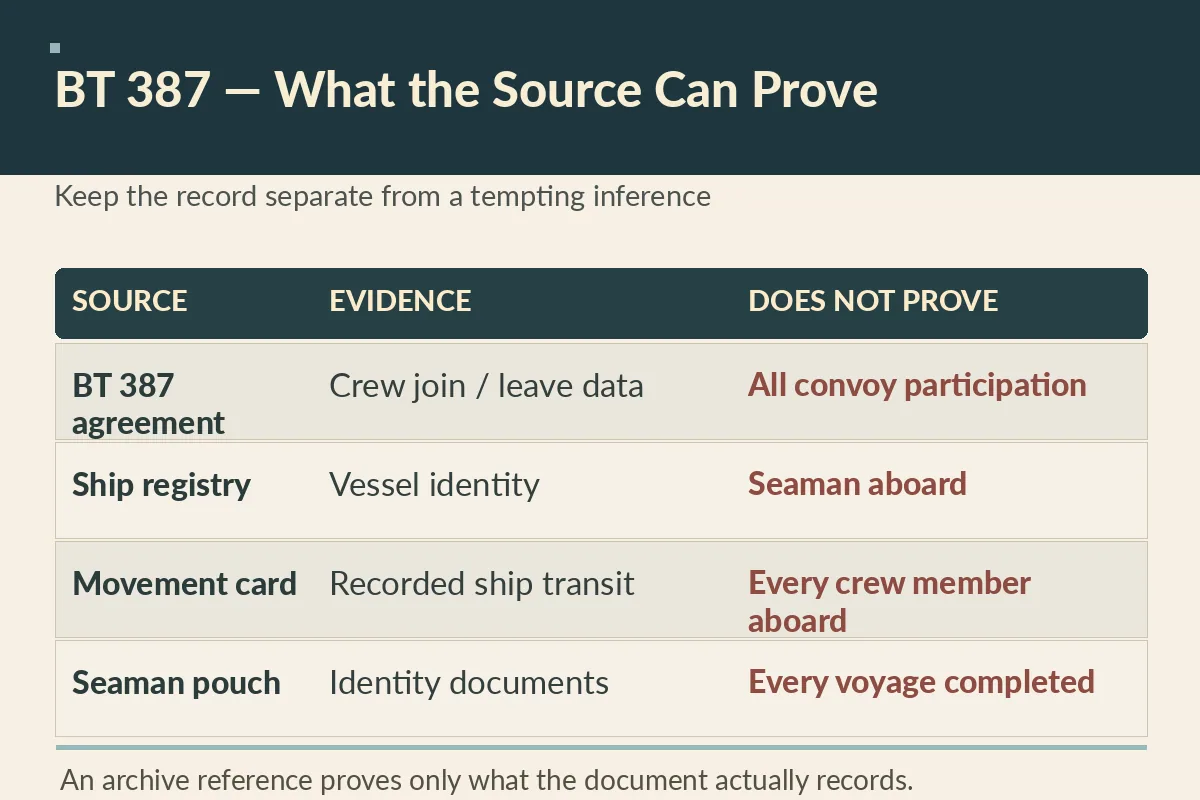
If a column states that the individual joined at a named port, that entry can support a documented embarkation for that engagement. It does not on its own prove that the seaman remained aboard for every later stage of the voyage, participated in a specific convoy action or survived until a presumed arrival date. Inspect discharge fields, endorsements, replacements and any notes of transfers. When the form is undated or the signature is illegible, describe that uncertainty rather than supplying a plausible date from nearby maritime events.
Keep the Ship’s Identity Separate From Its Name
A single vessel may change name, owner, flag or charter arrangements. Conversely, several unrelated ships can carry similar names. Where an official number or stable registry identifier is available, use it to reduce mistaken identity; foreign vessels may use different registry systems, so a British official number is not universal. Check tonnage, flag and registry details against a contemporaneous list and ensure that you have not combined two ships solely because of their name. A crew entry only belongs to the specific vessel shown by the original document.
To build a route, use separately dated movement cards, port registers, convoy records or ship logs when available. The National Archives warns that a movement card’s absence may reflect the type of ship or trade and not an absence of sailing. A vessel’s recorded movement does not automatically locate every crew member at that moment: transfers and hospitalization may interrupt an engagement. A solid table keeps vessel identity, agreement period, individual join and leave dates and later movements as different columns.
Connect a Seaman to Personal Wartime Records
The official merchant seamen guide identifies the central wartime registers and seamen’s pouches as potential sources of individual service evidence, though not every temporary worker or apprentice received the same documents. A pouch may contain support papers and identification that help distinguish common names. Match more than one detail across sources: age or date of birth, discharge number if recorded, birthplace, previous ship and signing dates. Do not mistake an identity card application or a central index entry for an agreement that places the person on a particular foreign ship.
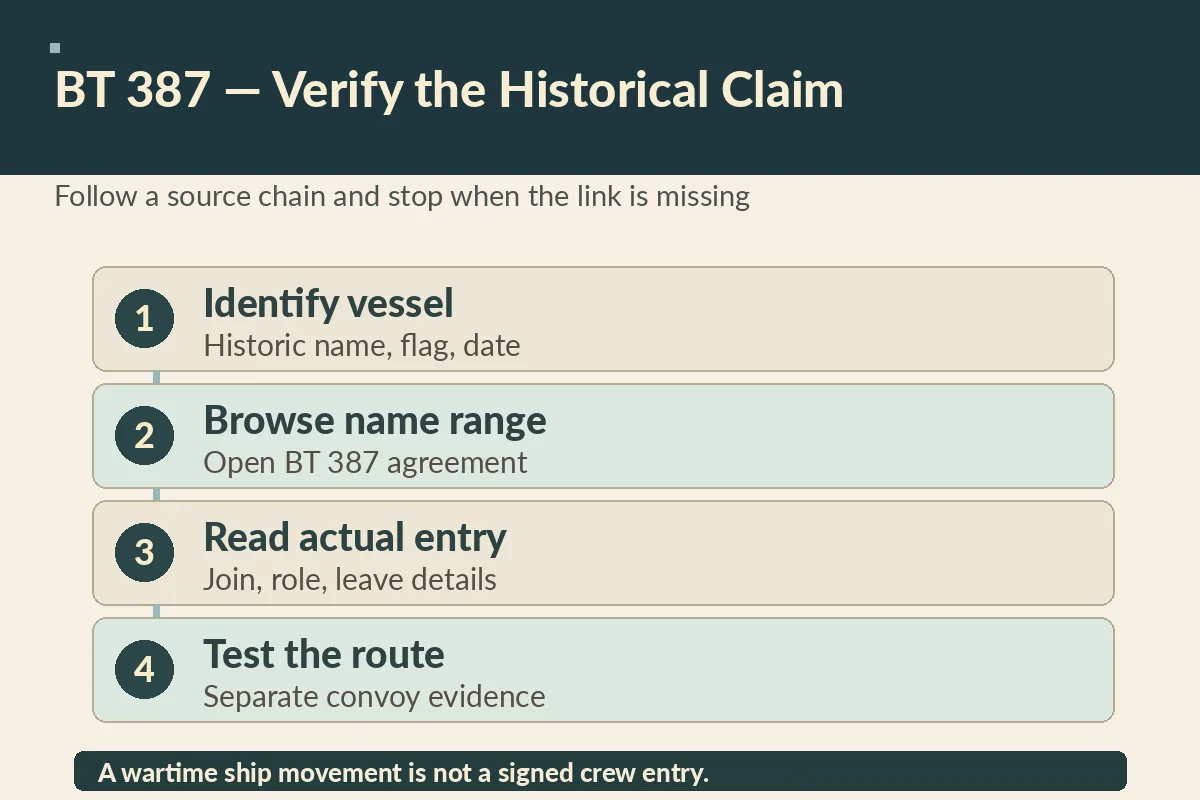
A practical evidence ladder moves from family clue to vessel identity, from vessel to the BT 387 agreement, and from the agreement to a person-level register or pouch where one survives. If the agreement names someone but the later register is missing, you still have evidence for the dated engagement; you do not have a continuous wartime service history. Conversely, a personal service record listing the ship may support the connection while leaving the ship’s port movements uncertain.
Cite the Exact Agreement and Avoid Imagined Convoys
Write the BT 387 piece number, ship name as given, agreement date range, page or folio and the seaman’s recorded capacity and signing details. Keep a separate citation for the shipping list or registry that supplied a name change. If your conclusion depends on a convoy, use an actual convoy or movement record for that claim and examine whether its dates overlap the person’s confirmed engagement. An accompanying ship history written decades later may have useful context but should not replace a surviving primary source.
It is legitimate to conclude that a seaman signed on to a particular foreign vessel in a given period without being able to reconstruct the full voyage. Do not invent a sinking, a battle or arrival from the ship’s wartime reputation. The correct negative statement may be that the searched name-range piece lacked the relevant agreement, not that the seaman never sailed. Keep evidence and conjecture visibly apart so future researchers can build on the work.
More Records and Archives Guides
How We Research and Cite These Records
We use the National Archives merchant-crew and post-1918 seamen guides to determine whether BT 387 is appropriate before looking for a name. Our audit records the historical ship name, name-range piece, agreement period and individual fields separately; vessel movement evidence is not used as a substitute for a signed-on crew entry. We do not claim every document is digitized. The affiliate disclosure explains commercial transparency.
Allied foreign vessels requisitioned or chartered by the British government during the Second World War.
By ranges of ship names, making vessel-first browsing important.
It principally documents crew engagements, not a complete passenger manifest.
Not automatically. Compare independent movement or convoy evidence.
Look for central seamen registers, a pouch and other dated crew agreements.