
C 140 contains Chancery inquisitions post mortem from the reign of Edward IV (1461–1483). Search for an estate holder, county and likely inquisition date, not simply a family surname. A jury could report the lands, tenure, valuation and apparent heir of a deceased tenant-in-chief; that is evidence of the inquiry’s finding, not automatic proof of a later transfer of possession. The National Archives’ inquisitions guide explicitly separates inquisitions from records of livery of lands.
Start With the Correct Reign and County
C 140 belongs to Edward IV, while C 139 covers Henry VI and C 141 Richard III. An event near a change of monarch may have been investigated after the death, so sort by the date of the inquisition rather than assuming the date of death fixes the series. Record both the regnal date and a cautiously converted calendar date. Do not silently merge similarly named heirs across the Wars of the Roses.
Use the person’s title, estate place and historic county to narrow Discovery. The National Archives describes name, title and county searching for Chancery records from the later fifteenth century. Because estates could spread across counties, the same death could produce more than one return. Check related localities, variant spellings and repeated personal names before declaring a single result sufficient. A county in a catalogue entry means the inquest’s jurisdiction, not necessarily the subject’s residence.
Translate a Calendar Lead Into the Original Reference
Published calendars are a way in, not the underlying evidence. The detailed Calendar of Inquisitions Post Mortem extends to 1447; for much of Edward IV’s reign the research route relies on original records, catalogue descriptions, printed lists and older manuscript finding aids. The National Archives describes a paper list covering C 138–141 and an older Calendarium. Its coverage and level of detail must not be mistaken for a complete transcript of each inquest.
Copy the full item reference including the last item number and regnal year where supplied. The archive’s guidance explains that the C-series piece reference may be enough to order a file, but the item number is still needed to locate the right inquiry within it. Write the catalogue wording exactly before translating the place or relationship. If a summary calls someone a ‘son and heir’, do not expand that phrase into a documented baptism or marriage unless another record supports the link.

Read the Jury Finding Rather Than a Modern Family Story
An inquisition was an inquiry into Crown rights as well as descent. Its jurors could identify a deceased tenant, property holdings, their annual value, form of tenure, and the person regarded as next heir. The age of an adult heir might be approximate, and a widow’s dower could be treated in a separate inquiry. These are historically meaningful legal claims but not a complete genealogy of everyone related to the deceased.
Build a transcription grid with fields for deceased person, county, escheator, land description, tenure, valuation, named heir, relationship, age and stated death date. Mark unreadable words and uncertain abbreviations. A manor name that occurs twice may refer to different shares; a feudal valuation is not a modern property price. Do not substitute a contemporary map parcel for a fifteenth-century landholding without evidence bridging the two descriptions.
Compare Chancery and Exchequer Evidence
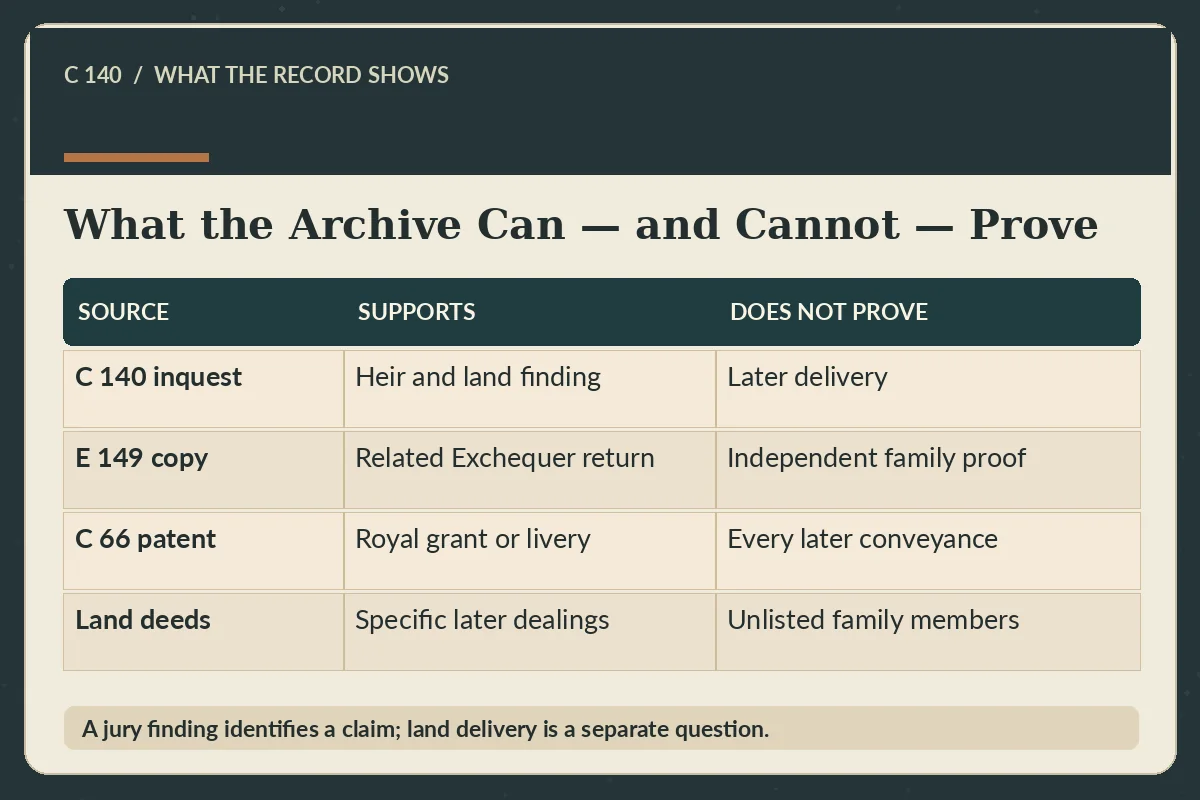
The National Archives notes that Chancery returns are grouped in C 132–142 and Exchequer copies or parallel returns are in E 149–150. Those versions may differ because their purposes and copying practices differed; some Exchequer copies omitted jury lists. Where both survive, compare names, relationships, values and item references instead of assuming that two documents are independent eyewitness testimony. They can derive from one proceeding.
If a C 140 file is damaged, try the Exchequer version and relevant extracts or estreats, such as those enrolled in E 152. Record provenance as carefully as wording: a duplicate supports what the administration recorded, but it may not independently settle a disputed succession. If two versions disagree over a place or heir’s age, retain both readings until palaeography and archival context explain the discrepancy.
Test the Heir Against Later Land Delivery
A finding that a person was heir is not proof the Crown actually delivered every estate. The heir might be under age, the widow might retain dower, lands might be under wardship or competing claims could continue. The National Archives identifies Patent Rolls in C 66 among records useful for tracing later delivery of lands and wardship transactions. Search them by person, place and date rather than asserting an unbroken transfer.
A sound case file distinguishes an inquisition date, a proof-of-age date if relevant, any grant or livery, and subsequent deeds or accounts. If only the first is known, write ‘named as heir in the inquisition’, not ‘inherited the manor on that date’. Later conveyancing may reveal trustees or purchasers absent from the inquest. A missing later grant is a research gap, not evidence that the heir never possessed the land.
Build a County-Level Evidence Ledger
Imagine a return naming an apparent heir to several Essex and Kent holdings. Enter one line for each property, with the exact source text and jurisdiction. Separately record which claim depends on the jury, which depends on a printed calendar, and which rests on a later royal record. This prevents a claim about one estate from being copied indiscriminately to every property in a list.
Keep a controlled identity table for recurring names: titles, spouses if explicitly identified, office, chronology, age and land associations. Check each relationship statement for the actual wording. A claimant may be an heir at law for a particular tenure without being a sole heir to every asset. Document contradictions rather than forcing all records into an attractive but unsupported pedigree.

Record What the Inquisition Cannot Establish
The absence of a listed child, tenant or widow is not proof of nonexistence. Inquisitions focused on tenures and Crown revenue, not a household census. Historic spellings, damaged parchment and uneven finding aids also make modern full-name searches unreliable. A summary may compress several phrases that are crucial for understanding tenure or a contingent inheritance.
For each conclusion use three columns: the exact record statement, the limited inference it warrants and the unresolved fact. Keep images, transcriptions and modern-language interpretations separate. A well-documented answer may end with ‘the inquest names this claimant as heir; later livery has not been verified’. That is more useful than a family tree that quietly converts a Crown investigation into proof of ownership.
More Records and Archives Guides
How We Research Sources and Boundaries of Proof
Our research method starts with the official subject guide and compares it with a second archival source. We record the holding archive, series, piece, document date, compiler and whether the document itself was inspected. A catalogue description is a lead, never a substitute for reading the original. We distinguish an administrative statement from a later event and a plausible interpretation from independent confirmation. Not every person, date or place can be proved from a surviving record; damaged, missing or unindexed items are noted explicitly. For information about our commercial relationships, review the affiliate disclosure.
No. C 140 covers Edward IV; check adjacent reigns and Exchequer copies for other dates.
Not usually. It may state an heir relationship, but parish and other family evidence must be evaluated separately.
Land held in different counties could require separate local inquiries and returns.
No. Use it as a finding aid and retrieve the original Chancery or related document.
No. Search later livery, wardship, patent and property records for the outcome.