
The National Archives describes 265 photographic prints of amphibious landing demonstrations at Fort Edwards, Massachusetts, in 1942, filed in Record Group 337, series FE. These images belong to the records of Headquarters Army Ground Forces. They can help explain how an Army demonstration was represented and documented, but they are not a combat record, a unit roster, or proof that a particular soldier served overseas. The official RG 337 guide states the subject, place, year, series code and number of prints; individual captions must be checked before adding details to a specific frame.
For family history, three questions need separate sources: what was demonstrated, which command or unit participated, and whether the person you are researching took part. FE can help with the first, perhaps with the second if captions identify an organization. It cannot normally answer the third without independently named evidence. Do not infer weapons used, battlefield location, mission results, or a soldier’s identity from a generic training image. Treat the photos as historical documentation of a demonstration, not as instructions for carrying out the techniques portrayed.
Start With the FE Photographic Series
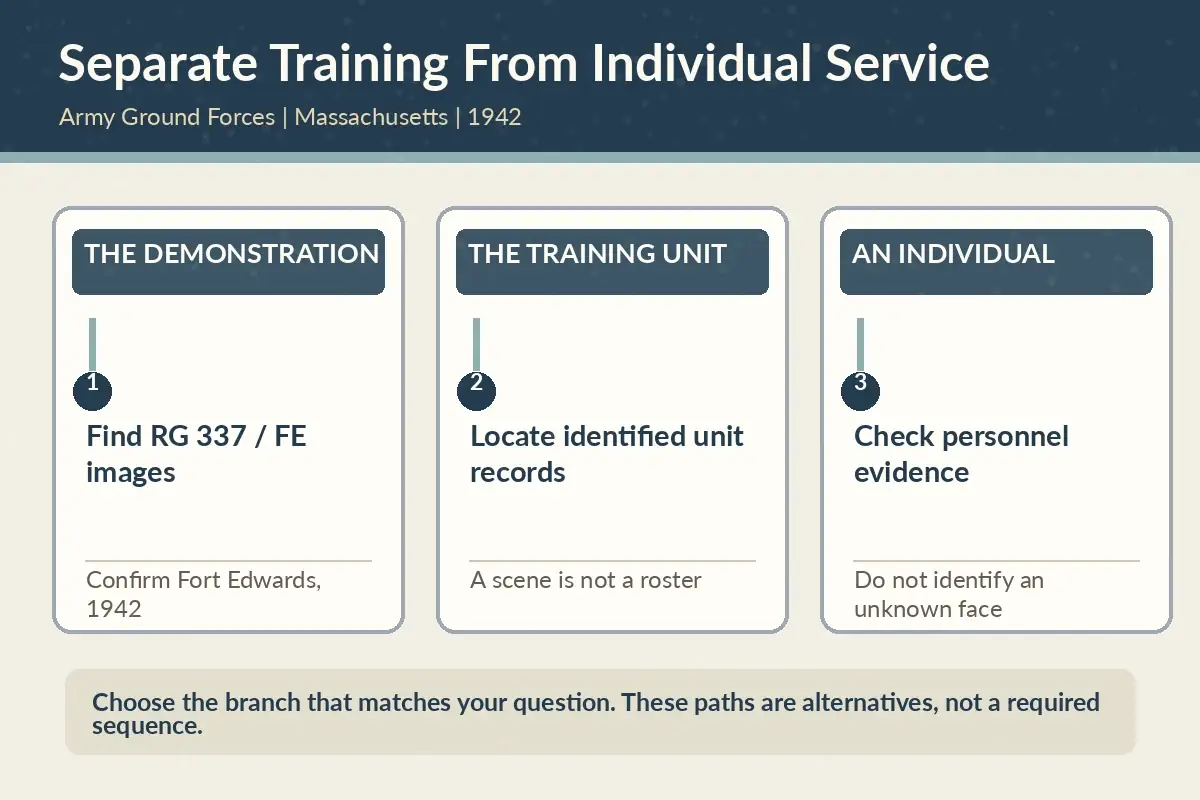
Search for “RG 337 FE” and the Fort Edwards, Massachusetts, 1942 entry. Because RG 337 contains many Army Ground Forces training, administration and staff records, a picture found under the same record group need not belong to FE. Capture the original print identifier, any series arrangement information, caption and documented date. Ask NARA for a finding aid or contact sheets when the individual images are not discoverable online. An image reposted without the archive’s identifier should remain an unverified illustration until its provenance has been checked.
The published count of 265 is a description of prints in the FE series; it is not a count of exercises, individuals, units or distinct days. The guide says demonstrations of landing techniques at Fort Edwards in 1942, but it does not promise an exhaustive chronology or explain each setup. Study a full frame rather than a dramatic crop. Original edges, photo numbers and back-of-print annotations may clarify the intended description, while one cropped image can easily exaggerate the apparent scope of an event.
Identify the Demonstration Without Turning It Into Battle
A training photograph should be read as an arranged or documented exercise unless original evidence establishes something else. The visible landscape, equipment, participants and signs can help identify the depicted activity, but a staged demonstration is not evidence that a particular technique was employed in any subsequent operation. Do not identify a battlefield, combat casualty or unit history from the visual impression of movement or military equipment. Use the exact wording of the original caption for a narrow description and label any unverified interpretation as tentative.
The geographic distinction matters: Fort Edwards in Massachusetts is not an overseas invasion site. Photographs may resemble widely circulated war images, so check the archival code before applying an event name. If a caption labels an organization or speaker, look for a contemporaneous program or unit record rather than generalizing it to all people present. Even a clearly dated demonstration photo may not supply the event’s full start and end date.
Find Units Through Dated Army Ground Forces Records

RG 337 contains more than still pictures. Its textual administrative and training holdings can provide command context when a sufficiently precise unit, date or topic is known. Search those series by documented organizational identifiers and time period; do not assume the FE captions provide a complete list of participating units. Separate an office’s training directive, an after-action report and a demonstration photograph because each records a different administrative act. A stated intention to train does not prove that all scheduled personnel completed an exercise.
When examining a unit history, distinguish official assignment from temporary attachment and from attendance at a one-day event. The presence of one vehicle or insignia in a photo is not proof that an entire unit participated. A unit stationed in Massachusetts during 1942 may be geographically plausible but cannot be tied to the exact FE print without another connection. Keep the working hypothesis and the sources that could test it in a dated evidence ledger.
Research an Individual Through Name-Based Evidence
If a relative’s military service is the real research objective, start with named service records, unit rosters, orders, correspondence, letters, or documented captions where those materials survive and access is appropriate. A uniformed figure in the distance is not identifiable by rank, height or resemblance alone. Even a named and verified training-unit member may not appear in any given print. Family testimony that someone trained at Fort Edwards should be recorded as testimony until a documentary connection is located. The distinction protects the veteran’s real history from an invented scene.
Make the claim no stronger than the supporting evidence: a service document may establish assignment at a particular time; a unit record may establish a demonstration; a photograph may document the depicted scene. Together they may provide reasonable context, but they do not automatically prove that the person appears in the photograph. If the person is not named in image-level evidence, describe the picture as an illustration of a documented training setting, not as a personal portrait.
Present the Series With Accurate Limits

A responsible exhibit or genealogy article can cite FE as “RG 337, 265 photographic prints of Fort Edwards demonstrations, 1942,” then add the exact print identifier when discussing a specific image. Distinguish any modern interpretive drawing from an archival photograph, and do not attach invented technical specifications or timelines to it. An original caption may include historical terminology; transcribe it with attribution, but avoid sensationalized claims about what the photographs prove. Any account of later deployment or outcomes needs its own source, not an arrow leading out of an exercise scene.
Before publication, compare the caption, exact date and record-group guide with the intended statement. If equipment or participants cannot be verified, retain the general description. Use NARA’s still-picture and reproduction guidance for requests. The research goal is not to make the historical demonstration more dramatic; it is to make each verifiable fact easy to trace while keeping person-level questions appropriately open.
More Records and Archives Guides
How We Research These Archival Images
This article anchors its central archival claim in the official National Archives guide, which states: The NARA RG 337 guide lists 265 photographic prints under series FE covering demonstrations of amphibious combat landing techniques at Fort Edwards, Massachusetts, in 1942. That establishes the described series and timeframe; it does not authenticate the caption, place, individual or event outcome of an unseen item. Each diagram here is an original explanatory illustration and not an actual historical negative, photograph or document facsimile. For an item-level claim, verify the original identifier, exact caption and any annotations. The same series can contain several subjects, and a broad guide cannot confirm that every frame has been digitized.
We also use NARA Still Pictures research guidance for practical access and research visit planning for questions requiring archival staff. Source dates in the article document when the public guide was checked, not the creation of an image or the date of its subject. Distinguish observed details, the repository description, and independent evidence in notes and citations. Read the site’s affiliate disclosure for editorial transparency; no paid repository arrangement is implied. The goal is to keep an illustrated 1942 training demonstration separate from a specific wartime deployment, unit roster or named soldier, without promoting guesses to documented facts.
The National Archives uses FE for 265 prints showing 1942 training demonstrations at Fort Edwards, Massachusetts.
They are described as demonstrations at a training location, not as battlefield photographs.
Not without a reliable named caption or independent personal service evidence.
No. The number describes prints, not events or participants.
Ask for RG 337 series FE, the print number if known, and any caption or finding aid for 1942 Fort Edwards.