
Start With the Archival Series and a Specific Question
RG 15 VR consists of 650 photographic prints of vocational training facilities, classes, and trainees from 1918–1928. The National Archives places them with the rehabilitation work of the Federal Board for Vocational Education and its successor veterans agencies. This collection is an excellent way to visualize what a training school offered after World War I. It does not show that every veteran who lived near the school attended, that every person photographed was identified, or that an individual finished a course.
A productive search begins with one testable claim: a school, a particular veteran, or a training outcome. Those claims take researchers to different evidence. NARA describes alphabetical and state lists of universities represented in the photo series, but also separate trainee record cards and a sample regional training case file. Preserve the distinction between an image’s caption, an institution’s presence in a finding aid, and a person’s administrative history.
Understand the Federal Rehabilitation Timeline Before Searching
Congress assigned vocational rehabilitation to the Federal Board for Vocational Education in 1918. The rehabilitation operation moved into the Veterans Bureau in 1921, then the U.S. Veterans Bureau, while its training program continued into 1928. A label from the 1920s may therefore name a different federal office than a later archive heading. It would be misleading to call every print a Department of Veterans Affairs photograph, because that department designation dates from 1989. Use the agency name applicable to the record, followed by today’s RG 15 custody.
Build a timeline with three columns: date of training, office administering the program, and date of any later caption or catalog description. Keep a separate entry for a school’s changing name. A photographed workshop might have been used by different institutions during the decade. If a family story mentions a Veterans Bureau course in 1920, check whether the wording was retrospective rather than silently redating the course to fit the federal reorganization.

Use the University Finding Aids to Locate a School
The federal records guide specifically mentions alphabetical and state lists of universities represented in VR. These are discovery tools for the photographic collection, not lists of all enrolled veterans. Begin with the state and the historical campus name; allow for spelling variants, merged institutions, and separate trades offered off campus. Record the form of the institution’s name in the original list, then preserve the exact negative or print identification supplied by NARA.
One vocational program could occupy a university laboratory, a commercial workshop, or an adapted building. Do not assume a caption naming a university identifies the specific room. Compare architectural features, course equipment, and contemporary campus maps before assigning an address. If a school appears nowhere in the VR lists, that proves only that the surviving described photo collection has not supplied a match; it does not disprove the existence of a training program.
Separate Demonstration Pictures From Personal Enrollment
A photographed machine, class exercise, or instructor can help establish a training environment. It cannot establish the legal name, service number, disability status, or attendance of an unidentified person. When a print names a participant, transcribe the name exactly and seek a separate source; the spelling might reflect caption preparation rather than the student’s own usage. Uniforms and tools alone do not distinguish veterans from civilian instructors or visitors.
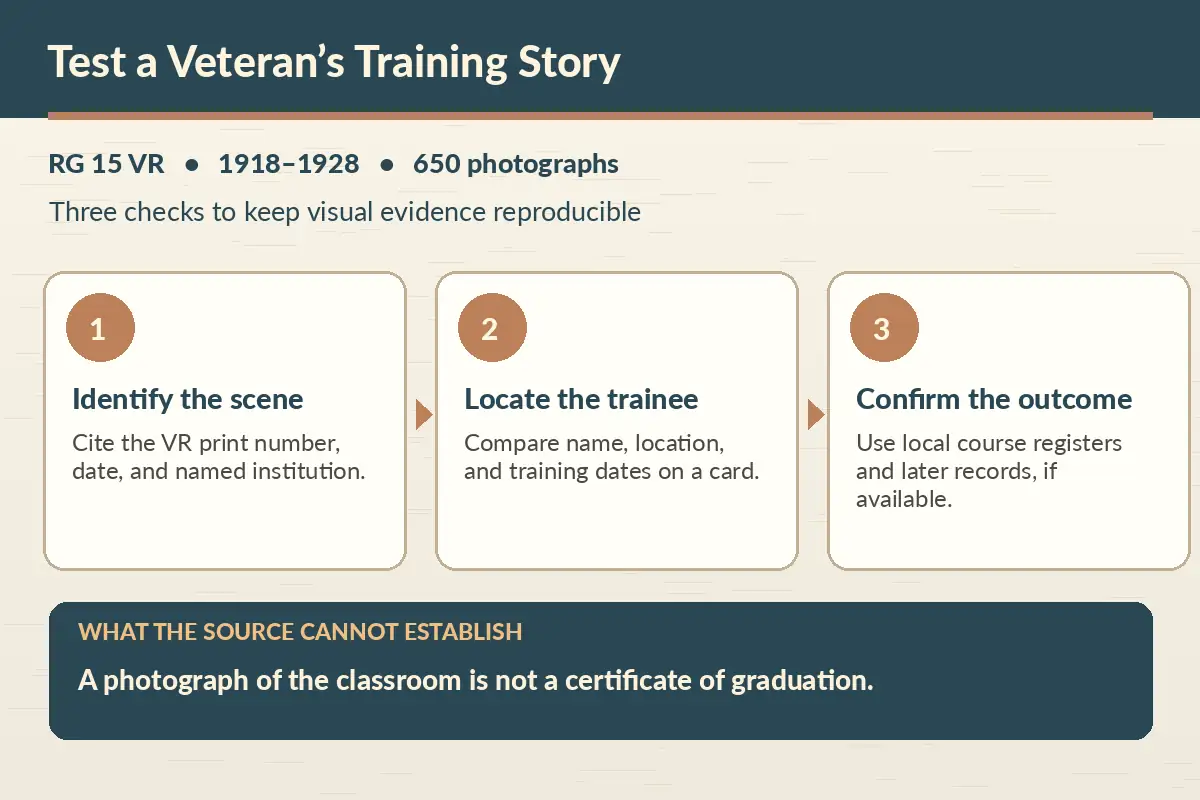
NARA separately describes trainee record cards covering 1918–1928 and some training-center files. Search for the individual using name variants and the dates implied by military discharge or postwar residence, not just the campus photograph. Compare the card with contemporary school records if preserved. A record of authorization, an enrollment entry, and a record of completion are different stages. Write precisely which stage is documented and where the evidentiary gap remains.

Cross-Check Training With Later Work and Residence
Rehabilitation photographs may suggest a trade such as machining, accounting, or agriculture, but the visible class may not be a person’s chosen occupation. Compare subsequent city directories, employment registers, census occupations, apprenticeship records, and personal correspondence. Work performed ten years later may be consistent with training, but does not retroactively establish enrollment or completion. Equally, a person might have changed trades after illness, family moves, or the local labor market shifted.
Use a place-and-date check before matching an unidentified student to a veteran in family records. Was the person in the same city during the training term? Is the age plausible? Do photographs of other students carry reliable names that help establish the classroom? Avoid inferring a veteran’s medical history from visible apparatus or assistance. Medical information and private case files require careful handling and may not be openly accessible.
Record Both the Photograph and the Personal Document
For every relevant VR view, note RG 15, VR, caption wording, school, local image number, and any box or folder reference. Record whether the date is a verified exposure date or merely a range assigned to the series. If the image was reproduced from another print, document the reproduction provenance. Search results may display a modern title without showing the original photograph or back-of-print annotations; never claim to have inspected unavailable physical details.
Create a second citation for the trainee card or actual training file and a third for the independent school record. The strongest answer might be modest: a school hosted veterans training, and a named veteran’s card reports training there during compatible dates. It does not follow that the person appears in an anonymous image. Keep the difference explicit even when a compelling picture would make a family story easier to illustrate.
Write a Defensible School-to-Person Conclusion
A useful research ledger has fields for school alias, location, image identifier, candidate veteran, named-document identifier, dates, and unresolved discrepancies. Rate each connection as direct, corroborated, or tentative. A matching surname in a nearby town does not reach the level of a named course document. If the school’s training records no longer survive, describe the gap rather than treating a failure to find records as proof of nonparticipation.
When publishing a family history, caption a group photo with what the archival record actually says, such as a rehabilitation workshop at a named institution during a date range. Put the veteran’s training evidence in a separate sentence supported by the trainee card. Obtain permission where required for restricted personal material. This method allows a reader to enjoy the historical scene without confusing a real classroom with a verified individual biography.
More Records and Archives Guides
How We Research This Collection and Its Limits
The series description, dates, and record designation were checked against the official National Archives research guide on November 16, 2026. Independent context was compared with a second official research source, while NARA still-picture citation guidance establishes the information needed to locate an exact image. The site topic list and earlier production titles were compared for duplication. A series description does not identify every subject, date, or object in every frame, and access to a fully digitized item cannot be assumed. The figures in this guide are newly drawn explanatory editorial illustrations, not historical negatives or genuine reproductions. We make no unverified claims of commercial endorsements. See the affiliate disclosure for site policy.
NARA lists 650 photographic prints of rehabilitation training activities.
The VR photographs and related trainee card descriptions cover 1918–1928.
No. The list identifies photographic representation of a university, not a named enrollment.
Start with trainee record cards and training-center records described under RG 15.5.1.
No. Completion requires a record of training outcome or an independent credential.