
A 1942 photograph of a Civilian Conservation Corps training exercise can show an instructional method, equipment, and people at a particular moment. It cannot, by itself, establish that the people shown later worked in an emergency, belonged to a named company, or completed a certified course. The National Archives lists 41 negatives of civilian defense training methods in Record Group 35, series CD. Begin with that narrow series, not with the assumption that all CCC photographs depict the same program.
The period matters. The CCC was a New Deal employment and conservation program; wartime civilian defense material appears at the end of its operation. An original caption may establish a camp or exercise, while a generic label such as “1942 defense training” may not establish the precise site. The safest research question is: what does the individual CD negative actually document, and what extra records could support a family claim about a particular enrollee? Keep those questions separate from the beginning.
Find the Forty-One Defense Training Negatives

NARA lists the CD negatives separately under RG 35, 35.3.2, with an overall date of 1942. Record that citation precisely. Ask for the item identifier, any original caption, negative envelope, photographer credit, and the arrangement of the sequence. The still-picture guide attributes the civilian defense images to photographer Bluford W. Muir of the Forest Service, but attribution should be checked for the exact frame being used. Do not convert a catalog summary into a caption for a photograph you have not seen.
Create a frame-by-frame worksheet: archive ID; exposure date, if known; location as literally supplied; visible technique; attributed photographer; and unanswered questions. A frame showing a demonstration may be a staged training situation rather than an incident response. Distinguish the people instructing, observing, and practicing where the source supports that difference. Avoid labeling unidentified faces as fire wardens, soldiers, or a named CCC company just because protective clothing or tools appear.
Separate CD From the Larger CCC Photograph Collections
The same RG 35 description includes general Emergency Conservation Work pictures, the G and GE series; Army-area activities in GC; company photographs in SU; and other records. Those are alternative resources, not consecutive steps in a mandatory chain. An image from CD should not be refiled as an SU company photograph simply because both concern CCC activities. The exact series is the source-provenance anchor, and dates for these collections differ.
If an ancestor worked at a CCC camp in 1938, the 1942 CD negatives may illuminate what training later looked like but do not demonstrate that the ancestor remained enrolled. Check a camp directory for the correct year and seek contemporaneous company or personnel material. Conversely, a person present in a 1942 image may have been a visiting instructor or staff member rather than a regular enrollee. Keep a separate column for source type and the inference each item actually permits.
Use Camp and Employment Records Carefully
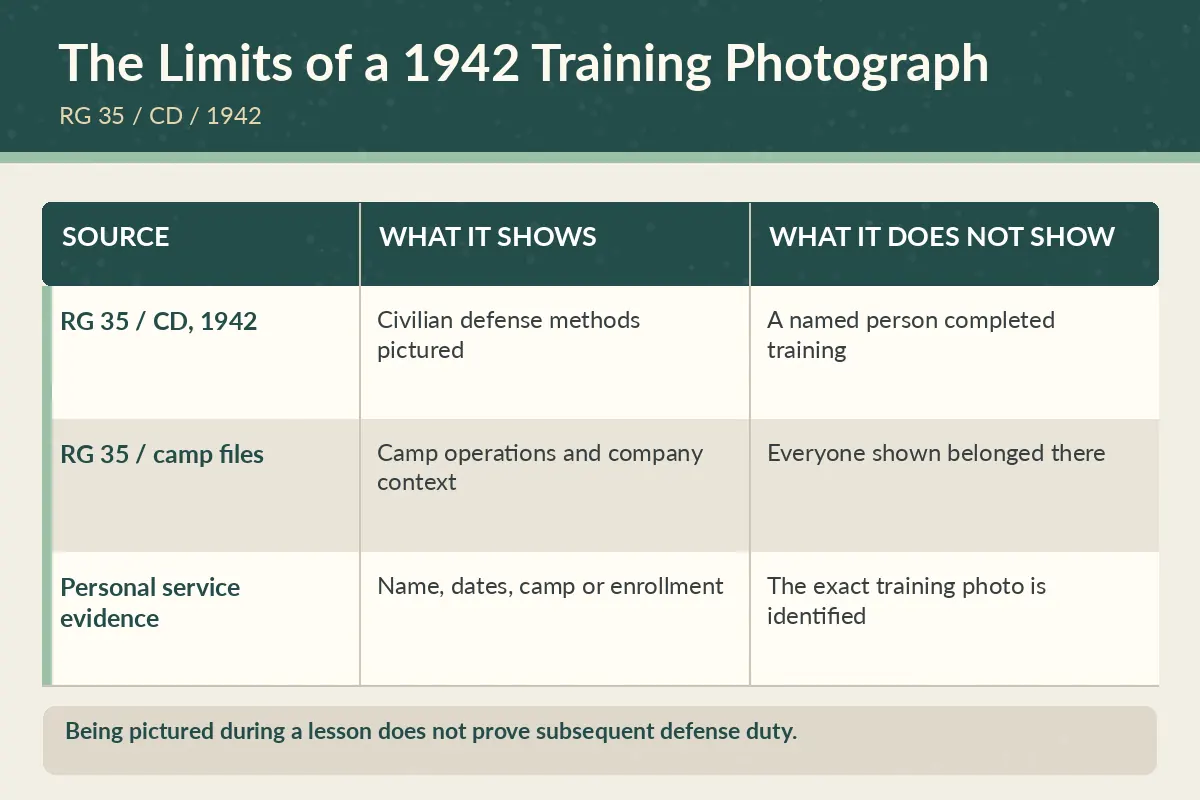
To build an individual biography, gather full name and variants, birthplace or age, likely enrollment window, and any known company or camp number. A photograph with a handwritten name is a lead, not automatically a unique identification. Compare enrollment or personnel material with dated residence, military registration, correspondence, or a family photograph independently identified before asserting the match. Uniforms, hairstyles, and similarity of face are insufficient evidence on their own.
NARA describes organizational and research records in RG 35, including monthly station and strength reports and educational-activity reports. Such documents can verify camp staffing and activities at the group level, but a station total is not a list of every person photographed. Request the actual record arrangement and seek item-level links. If no specific camp can be located, state that the picture documents an agency method while the personal association remains unproved.
Put the Photograph in Its 1942 Administrative Context
Use 1942 as the photographic series date, then research whether the pictured exercise belonged to a particular emergency-preparedness initiative. NARA’s still-picture and textual descriptions do not guarantee that each negative records the same site, lesson, or organizational sponsor. Avoid importing later civil-defense terminology into captions unless it appears in the source. A training demonstration is not a combat operation, and agency participation does not establish a named person’s later service.
Check whether a scene was photographed to document practical instruction, illustrate publicity, or report program activities. A press use might feature a carefully arranged example rather than a typical day at camp. If published in a wartime newsletter, distinguish the date of the underlying negative from the date of reproduction. This is particularly important when a family remembers a 1940 camp experience that was illustrated years later with a different group’s picture.
Write an Evidence-Based Caption and Citation

A reliable caption describes the actual subject, provenance, and uncertainty: for example, “Civilian defense training method, RG 35 CD, 1942; location and identities not verified.” Improve it only when the original item supplies more. For online use, check the item’s access and reproduction information; even federal agency photographs should be reviewed for attribution and any item-specific restrictions. Do not present our modern illustrative diagrams as archival photographs.
Maintain a small evidence matrix. Put the negative number in one column, the exact original caption in another, and a tested claim such as “my relative trained here” in a third. Then list the source needed to close the gap. If the image remains unlinked to an individual, it can still inform a carefully labeled account of 1942 CCC training practices. The absence of a name is a research limit, not proof that the person never served in the CCC.
More Records and Archives Guides
How We Research This Evidence
This guide is anchored in the official archival description: NARA RG 35 section 35.3.2 identifies 41 photographic negatives of civilian defense training methods in 1942 (CD), distinct from CCC general photographs and company series. That supports the existence, arrangement and broad dates of records as described, not the accuracy of claims about an unseen individual item. Check a specific identifier, original caption or register line, date, creator and physical arrangement before using the material in a family or place history. Where archival descriptions conflict with an event timeline, preserve both and explain why they answer different questions. Each schematic image in this article is an original modern educational illustration, not an image of the record itself.
We checked the source information on 2026-11-14; that is an access-check date, not the historic creation date. Follow NARA’s Still Pictures guidance for image requests or research preparation guidance for questions about original holdings and access. Exact availability, digitization, use rights and individual identities must be established at item level. Consult the affiliate disclosure for site transparency; mentioning a repository does not imply a paid relationship. We use this method to separate a 1942 CD training image from a verified CCC enrollee or defense-service history, making explicit what remains uncertain.
It is the still-picture series designation NARA uses for 1942 civilian defense training negatives.
The guide lists 41 photographic negatives, not 41 individual enrollee files.
No. Training and later deployment or service are different events requiring separate records.
No. It establishes a potential organizational lead, not the identity of an unlabeled individual.
No. NARA describes multiple CCC series with different date ranges.