
Start With Nineteen Negatives, Not With an Ancestor’s Name
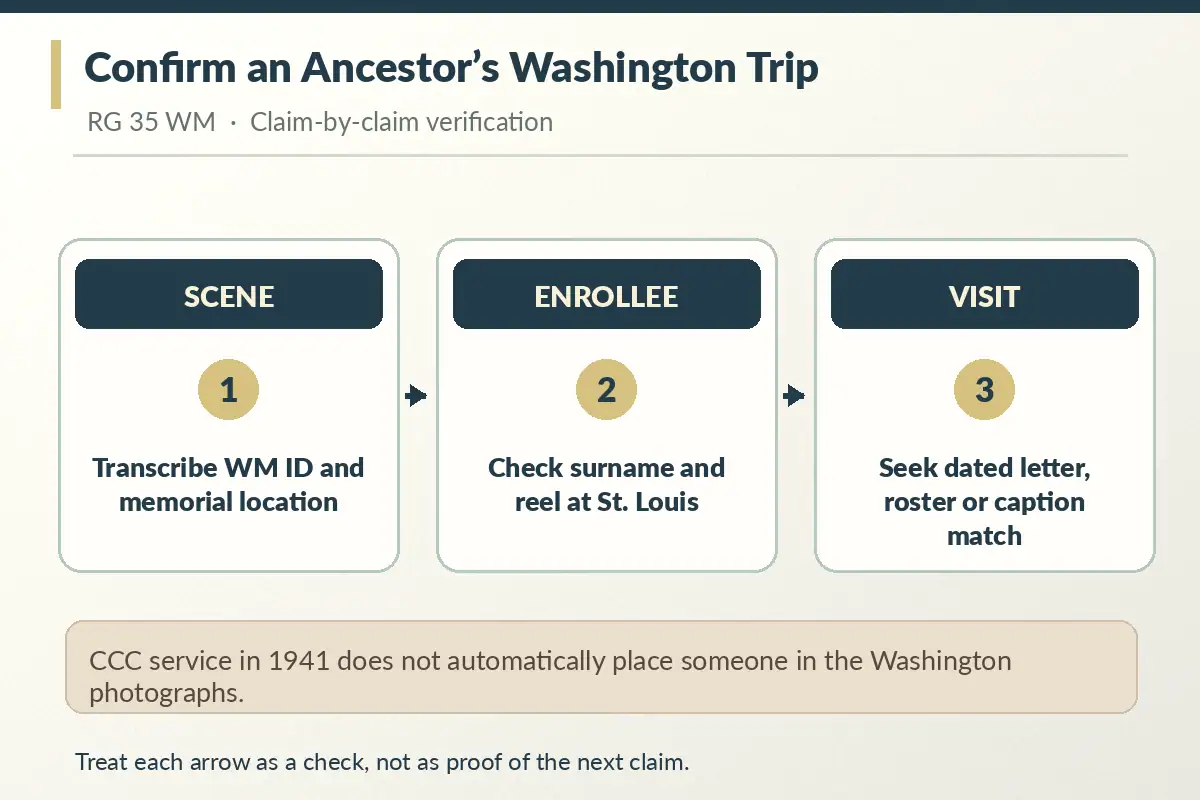
NARA lists 19 photographic negatives of Civilian Conservation Corps enrollees visiting memorials in Washington, DC, during 1941. Their identifier is RG 35 WM, under the agency’s still-picture holdings. This is a narrowly described visit series rather than a complete account of CCC enrollment. A photograph may identify a memorial or a group, but unless the original caption names a person it cannot establish which enrollee is shown. Begin with the memorial itself and save the local image number, caption and composition before bringing a family surname into the analysis.
The series description does not specify the exact day of every negative, the camp that organized a visit or whether all nineteen scenes belong to one excursion. Separate those questions in the research log. Memorials may have been visited by multiple groups across the year, and people with similar uniforms or clothing are not necessarily from the same company. A visible monument can help fix a location, but the year 1941 does not prove that a specific relative traveled there. Never add a name to a group portrait solely because a person was eligible for the program that year.
Identify the Memorial With Location Evidence
Use distinctive architecture and period maps to test a memorial location. Columns, steps, inscriptions, plazas and surroundings may help, but avoid claiming that an unidentified white-stone monument is one particular memorial without a caption or reliable visual match. Washington’s public landscape changed over time. A modern tourist map is helpful for orientation, not proof that every modern path, statue or building existed in 1941. Record any words legible on the original photograph rather than rewriting a difficult inscription from memory.
For each WM frame, list the original description, visible features, candidate locations and one or more independent historic references. If the memorial cannot be determined, retain the catalog’s generic description. A series of photographs might show enrollees arriving, lining up or posing; a sequence reconstructed from image numbers must be treated as provisional because archival arrangement may follow office filing rather than shutter order. A postcard or press clipping can verify a building appearance in 1941, but it cannot identify the uncaptioned visitors in a different photograph.

Use the Separate St. Louis Enrollee File Path
NARA at St. Louis provides instructions for locating Civilian Conservation Corps individual enrollee records using surname finding aids and reel numbers. The digital files are organized by microfilm reel and alphabetically within the surname ranges. This is an important alternative source when a relative’s name is already known. Search the enrollee file under the recorded spelling, note the identifying information and any service dates or camp assignments, and distinguish that personnel evidence from the WM photographs. A person can be a documented CCC participant without having appeared in the 1941 Washington group.
The St. Louis guidance also warns that one enrollee may have multiple files and that some medical and clinical records were maintained separately. Do not assume one retrieved image contains the entire service history. If a surname search fails, consider alternate spellings, different reels or files connected with other agencies. The official instructions describe what is currently digitized and how to pursue additional research; they do not imply that every enrollee file can be found with a single general search. Save the document identifiers so an apparent name match can be evaluated rather than merely accepted.

Connect a Company to Washington Only When Records Permit
RG 35 also includes camp directories, administrative correspondence and organization records. Such documents can establish a company’s location or a camp’s status at a point in 1941. However, a camp being active during the year does not prove it supplied the visiting group depicted in WM. An individual service record listing the company also cannot prove the person left camp for a particular trip. Look for dated letters, programs, contemporary newspaper items, group travel orders or captions that explicitly connect the excursion to a named unit or person.
Be alert to overlapping types of CCC participation, including state selection agencies and other organizational arrangements. The generic term “CCC boy” in a family story may obscure the person’s actual status, age, employer or branch. Verify the historical category before assigning a camp number. Keep military service distinct from CCC enrollment; a uniform appearance does not turn a civilian conservation enrollee into an Army soldier. If a photograph includes visitors or staff, the image alone may not distinguish the two. Name the relationship only when supporting records do so.
Publish a Modest, Auditable Visit Conclusion
A responsible citation should state NARA, RG 35, WM, the local negative identifier, the original caption, the supplied 1941 year and the date you retrieved the item. For a named person, add a separate citation to their enrollee file or a dated trip document. NARA’s still-picture guidance asks for the record group, series and unique image number; those details are more durable than a screenshot with an unsourced caption. If the negative is not digitized, request information using whatever item number survives rather than assuming the entire series is freely downloadable.
You might conclude: “RG 35 WM contains a 1941 photograph of CCC enrollees at a Washington memorial. The family member is independently documented as an enrollee that year, but their participation in this pictured excursion has not been established.” This is an informative, honest result. It tells future researchers exactly what would improve the case: a named contemporary caption, a trip roster or a reliable letter. It also prevents the common leap from national agency history to an unsupported personal biography.
If a family member appears to resemble someone in a small group photograph, write that resemblance down as a hypothesis rather than an identification. Aging, lighting, camera angle and indistinct faces make casual comparison unreliable. Instead, look for a series caption listing a camp or company and a dated enrollee file matching that organization. The WM pictures can still serve as excellent evidence of public educational travel during 1941, provided the discussion does not imply that every CCC camp participated. Preserve the distinction among enrolled members, accompanying staff and bystanders; photograph composition can make them appear to be one group even when they were not recorded as such.
More Records and Archives Guides
How We Research This Evidence
This guide is based on the National Archives record-group description and a second official source, checked November 16, 2026. We checked the exact series labels and collection dates against the custodian rather than guessing from a generic subject search. For item-level inquiries, follow NARA’s still-picture reference guidance: retain the full local identifier, including series and divider information where applicable. The series description does not establish that every item is digitized, that an individual photograph has an exact date, or that any pictured person is identified. There are no paid links or unverified products in this guide; see our affiliate disclosure.
NARA lists 19 negatives dated 1941.
Not by itself. Check the item-level caption and independent person-level records.
NARA at St. Louis provides surname-range finding aids and reel-based access to digitized enrollee files.
Only if the caption or other contemporaneous record connects the person or group to a company or camp.
NARA notes medical and clinical records were stored separately; consult St. Louis guidance for those records.