
Identify Whether the Slide Shows a Building or an Artwork
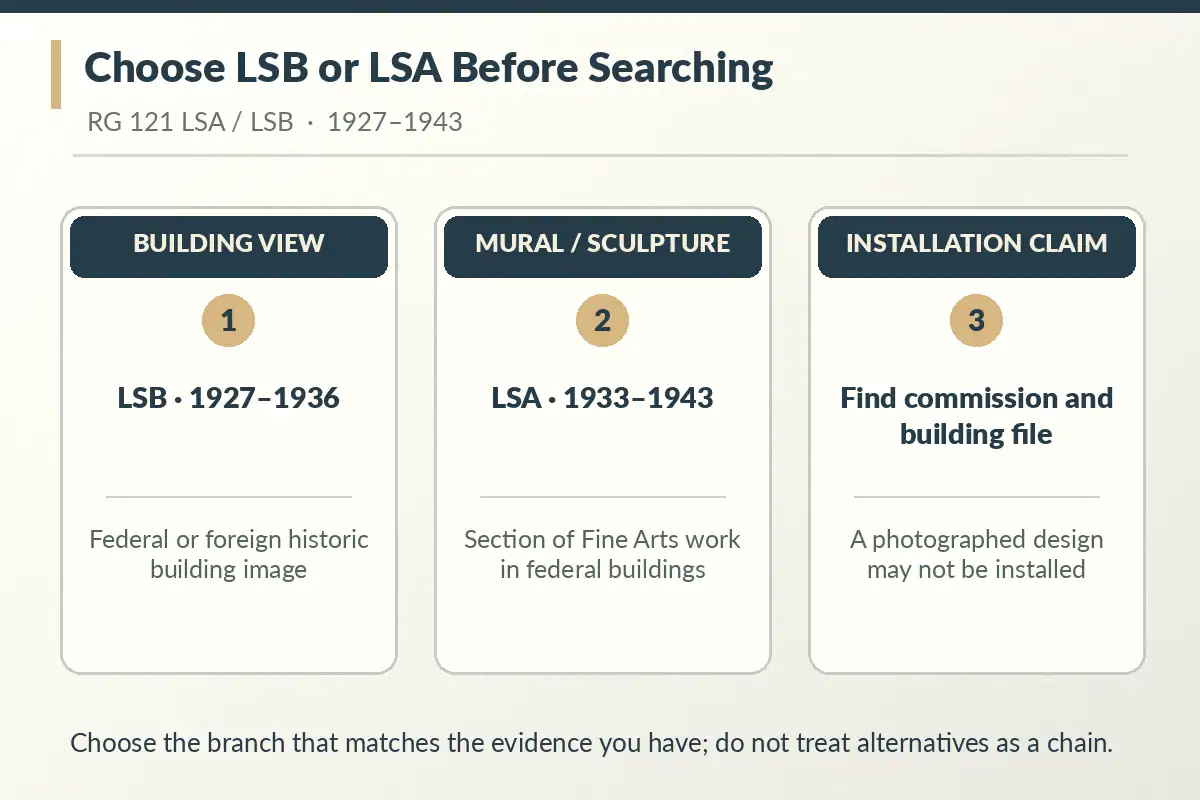
The National Archives lists two different lantern-slide series within RG 121, the records of the Public Buildings Service and its predecessors. LSB contains 261 images dated 1927–1936, while LSA contains 396 images dated 1933–1943. The more detailed still-picture guide identifies LSB with federal buildings and historic buildings abroad and LSA with Section of Fine Arts paintings, murals and sculptures in federal buildings. The first step is to decide which question you are asking: what a particular building looked like, or what a public-art design depicted. Do not search both series as if they were one uninterrupted construction album.
Write down any recognizable façade features, artist signature, inscription, interior wall, or architectural ornament. Where a slide pictures a framed painting or a mural detail rather than the room around it, do not assume that an identical artwork survives at a present-day address. Lantern slides were used to present and reproduce images; a reproduction of a work can be separated from its physical location. An image’s association with a public-building project is evidence of the administrative subject, not necessarily proof of installation.
Use the Dates for the Series, Not as Exposure Dates
LSB’s 1927–1936 and LSA’s 1933–1943 spans describe the collection material. A slide created in that interval may reproduce an older building photograph or an earlier artwork. Conversely, a planned mural image can precede physical installation. Keep separate fields for scene date, slide-making date, project approval, and later completion. When only a decade or an undated label survives, describe the uncertainty instead of selecting the most convenient date from the series range.
For a federal building erected or remodeled across several administrations, a single postcard or slide may show an intermediate phase. Compare a façade photograph with independent plans and contemporary local newspapers, and look for changes in windows, statuary, neighboring structures and street numbers. For a mural, prioritize title, design stages, the proposed commission location, and actual acceptance or dedication. Project descriptions sometimes retain a planned subject even when the executed work differed from the drawing.
Trace Section of Fine Arts Projects Carefully
NARA associates LSA with the Section of Fine Arts, but that label is not a guarantee that each slide depicts a finished original, or that the work was made at the time the slide was created. Read the item-level caption for artist, title and site. If the caption is generic, do not infer authorship from a visually similar painting in an online gallery. Compare multiple verified images and contemporaneous commission records where available. A government-sponsored artist could create more than one design for a project and a later site could receive a different work.
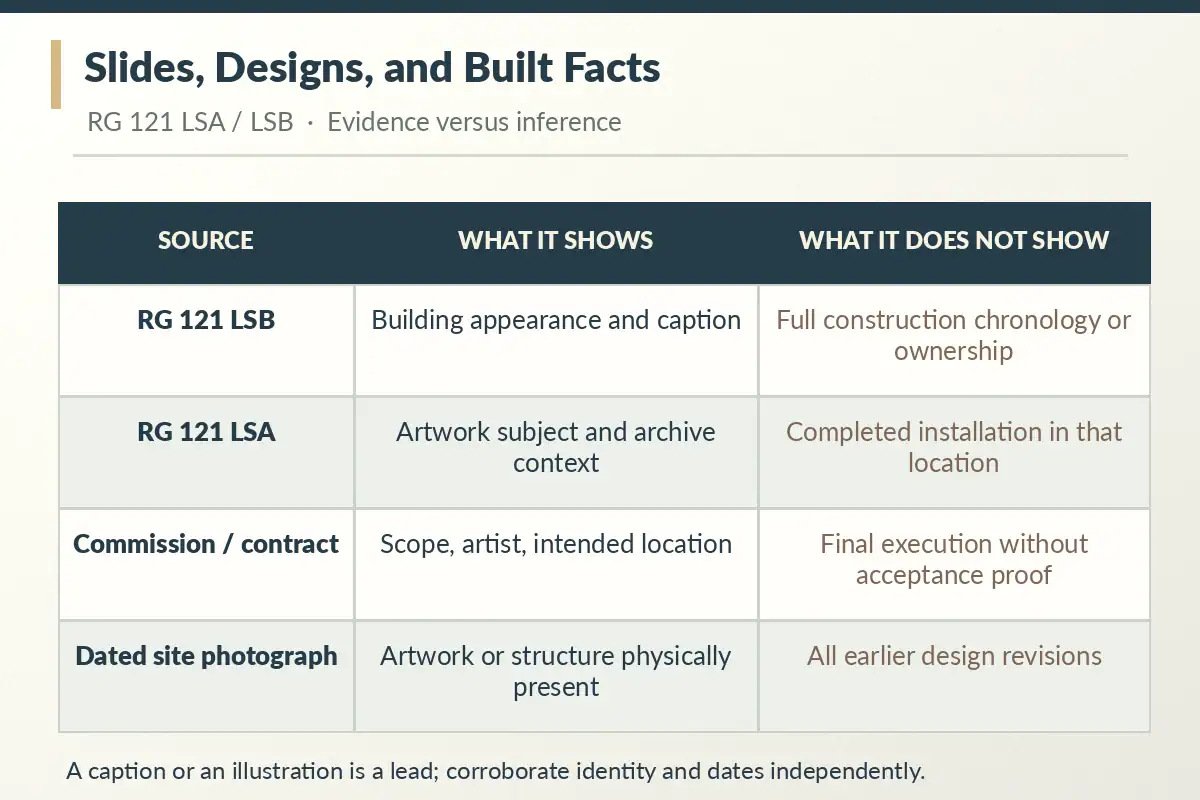
Use an artist-and-building table: recorded title, artist attribution, project address, medium, original design date, installation evidence, and any later moves or losses. A completed contract may prove payment and acceptance by an agency, while an on-site photograph or maintenance file is better for physical placement. Neither an artist’s name in a project inventory nor a design reproduced on a lantern slide automatically proves the artist lived in the town or painted on site. Keep biographical evidence distinct from the art history.
Locate the Building Without Assuming Continuous Use
For LSB, use the building’s historic federal function as one search term but keep the street address and locality as separate identifiers. Some buildings housed post offices, courts or administrative offices at different times. A later federal agency name might not apply to the time depicted. Search maps, contemporary directories, building plans and local preservation inventories to establish whether the structure remained standing, was altered or was replaced. Do not assume that every photograph with a matching architectural style shows the same building.
When researching an ancestor’s workplace, a building picture can provide setting but not employment. A photograph of a post office, for example, does not establish that a relative was a postal employee; a dated appointment, payroll, directory or service file is needed. Similarly, a person standing near a federal mural might be a visitor, contractor, guard or artist. Unless a reliable contemporary caption names them, leave identities open. Use the slides to make the spatial argument stronger, not to manufacture a personal record.

Preserve the Lantern Slide as an Archival Object
Record the slide’s exact RG 121 series and local identifier before circulating a digital copy. If the catalog reproduction is cropped, ask about the original mount, handwritten caption, sequence and neighboring slides. Lettering on a mount may contain a photographer credit or a later classification; distinguish it from the content painted within the artwork. If the same subject appears in a museum catalog, note whether you are comparing an original work, a print or a reproduction. Different physical objects can generate nearly identical images with different research value.
A responsible conclusion is specific: “The LSA slide documents a depiction of this artwork and suggests the associated federal-building project; installation remains to be verified.” For a building, “The LSB slide shows a structure with these features; the matching address is supported by an independently dated map.” Both are more durable than declaring the image definitive proof of an artist’s residence, a contract’s completion or a family member’s employment.
When a slide includes both architecture and art, classify the object that the archivist intended to document rather than automatically filing it under both series. A federal-building interior could appear in an LSB architectural set or as contextual material for an LSA artwork project; its local identifier resolves the custody. If a mural was moved, restored or lost, place those later developments on a timeline outside the slide’s original creation period. A present-day photograph can verify current condition but cannot retroactively prove what was installed in 1935. Maintain separate references for an original design, its photographic reproduction and the work at the site.
More House and Local History Guides
How We Research This Evidence
This guide is based on the National Archives record-group description and a second official source, checked November 16, 2026. We checked the exact series labels and collection dates against the custodian rather than guessing from a generic subject search. For item-level inquiries, follow NARA’s still-picture reference guidance: retain the full local identifier, including series and divider information where applicable. The series description does not establish that every item is digitized, that an individual photograph has an exact date, or that any pictured person is identified. There are no paid links or unverified products in this guide; see our affiliate disclosure.
NARA describes LSA as Section of Fine Arts artwork slides, 1933–1943; LSB shows federal and historic buildings, 1927–1936.
No. Those dates describe the series; a slide might reproduce an older image.
Not necessarily. Verify contracts, acceptance and dated site evidence.
It may depict a workplace building, but a separate employment source is needed to name an individual.
Provide RG 121, LSA or LSB, the full local identifier and any relevant box and slide details.