
A historic slide of a bridge, monument or government building can place a visible structure in an earlier urban landscape, but it is not a deed or directory. The National Archives describes 397 lantern slides, series MS, within Record Group 42, showing historic sites, bridges, federal buildings and parks mainly in Washington, DC, with some views elsewhere, dated 1859–1920. Use that series to identify an image and compare changing city features. Do not assume that seeing a building means knowing its exact owner, occupants, construction date or formal function at the moment of exposure.
The creator context is the Office of Public Buildings and Public Parks of the National Capital and related predecessors, but the group contains several different media. Its guide also describes architectural plans and glass-plate negatives. A lantern slide bearing a reproduced view is not the same object as a construction drawing or original photograph, even if each depicts the same structure. Record the series MS and identify whether an image is itself a camera view, a copy of another visual or a view used for an illustrated lecture. Each has different dating and evidentiary limits.
Choose an Archival Route That Matches the Claim
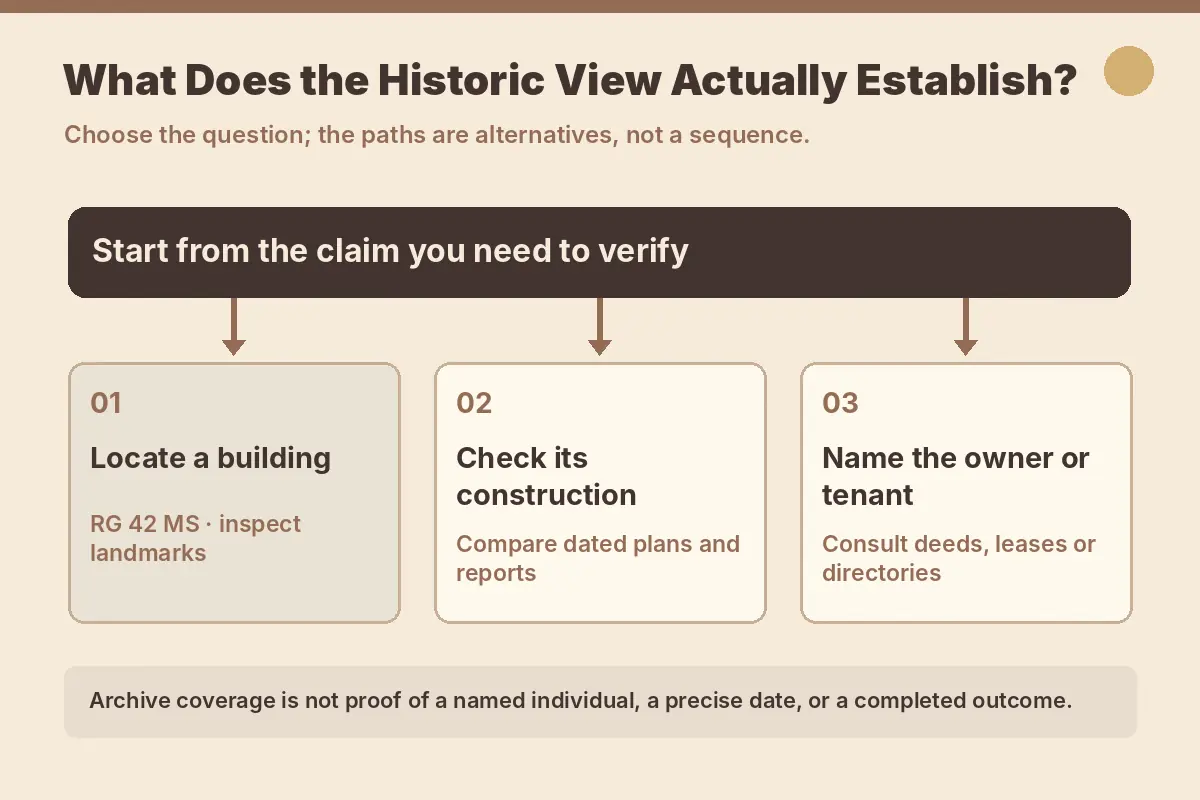
Start by naming what can be recognized independently: a bridge span, a monument base, a street intersection, a characteristic facade or the relation between buildings. Compare those features with historical maps from the same general period. Where a slide’s caption gives a street or park name, record its historical spelling and check whether the site has been renamed. The series is mostly Washington material but includes other places, so do not force an unfamiliar image into the District of Columbia simply because of its record group.
A city landmark may change through stages of construction, landscaping, repair and demolition. Ask first whether the image depicts a proposed design, a worksite or a finished appearance. A bridge plan with ornamental features does not prove those features were built; a dated photograph may show only one stage. Cross-reference the contemporaneous building report, map or plan for the same location before writing a confident chronology. Features outside the frame cannot be assumed absent. An archival slide may also reproduce an image taken before the slide itself was prepared.
The National Archives guide identifies 397 lantern slides in RG 42, series MS, for 1859–1920. That is series-level information. It is not an item-by-item inventory, proof that everything is digitized, or confirmation of a particular person. Record the archival hierarchy before copying a citation: repository, record group, series, actual item identifier and the original descriptive wording. A photograph, lithograph or publicity artifact may have been reproduced or annotated later; those later actions are not identical to the historical event represented.
Date the Source Before Dating the Historical Event
The 1859–1920 range describes the MS material in the guide, not precise exposure dates for every slide. Some views may depict already historic subjects, and slide production or classroom use could occur after a depicted scene. Separate three dates: the event or view represented, any original photographic exposure, and the making or cataloging of the lantern slide. If the source only gives an approximate period, retain that uncertainty. Do not date every visible carriage, streetlight or building solely from a familiar technological timeline.
For house and neighborhood history, link the image to a parcel or address only after checking changes in street numbers and boundaries. Historic maps can help locate a block, but they may themselves represent proposals, generalized information or a later compilation. Directories, tax records, deeds and leases answer different questions. A photograph of a federal building does not necessarily identify its operating office during every year of its existence; a city block used for administrative purposes may have changed hands or functions over the century.
Separate What the Image Shows From What It Suggests
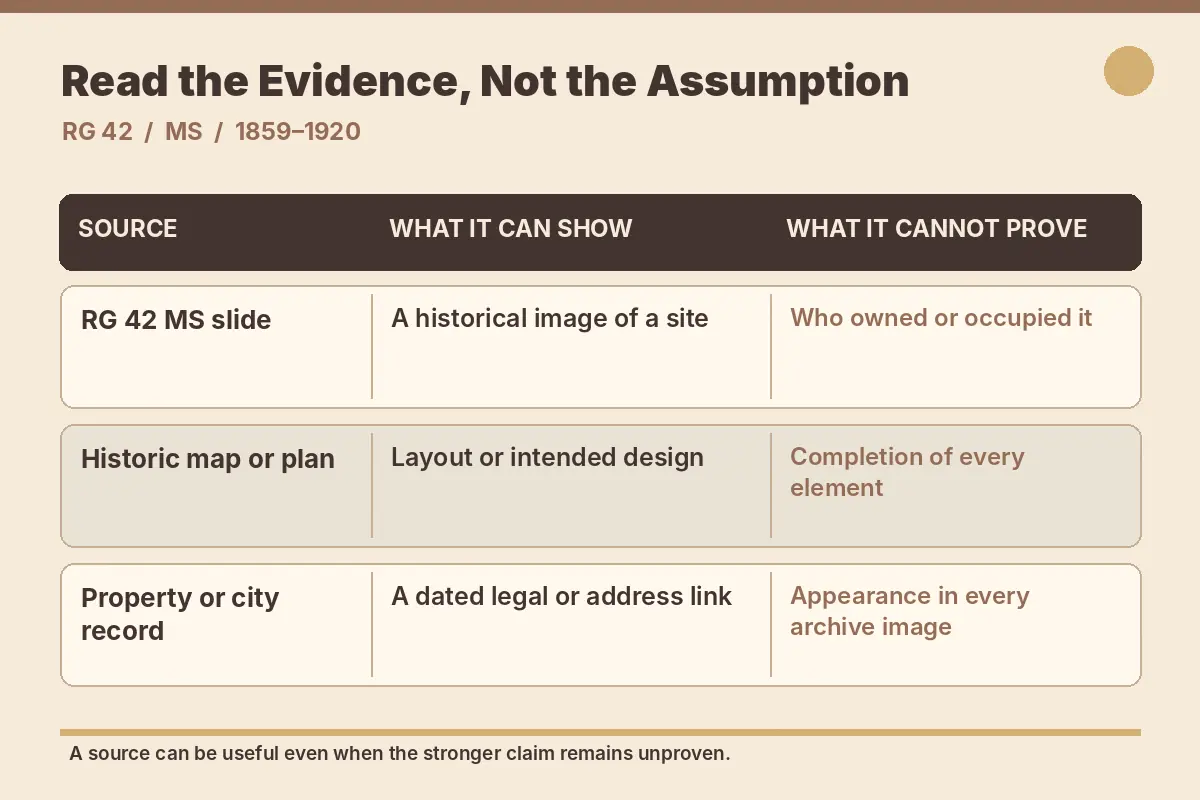
Public monuments introduce a separate question of naming and dedication. A photographed statue may establish that an object stood in a particular setting by a supported date, but the inscription might belong to an earlier commission or a later alteration. Check commemorative reports or official descriptions for installation, relocation and dedication. Avoid assigning the identity of people in a parade or group posed near a monument based only on the location. A visual match to a site is not a match to a resident, visitor or officeholder.
A working evidence table should list the MS item identifier, caption exactly as found, probable original image date, slide preparation evidence, location evidence, and the independent documents used. Mark when a name is supplied by a later cataloger rather than written on an original object. If two slides appear to show the same structure from different angles, compare distinctive architectural elements and street geometry. Resist declaring them the same place merely because their captions contain “Washington.” Keep a record of plausible alternative locations.
Build an Independent Chain of Evidence
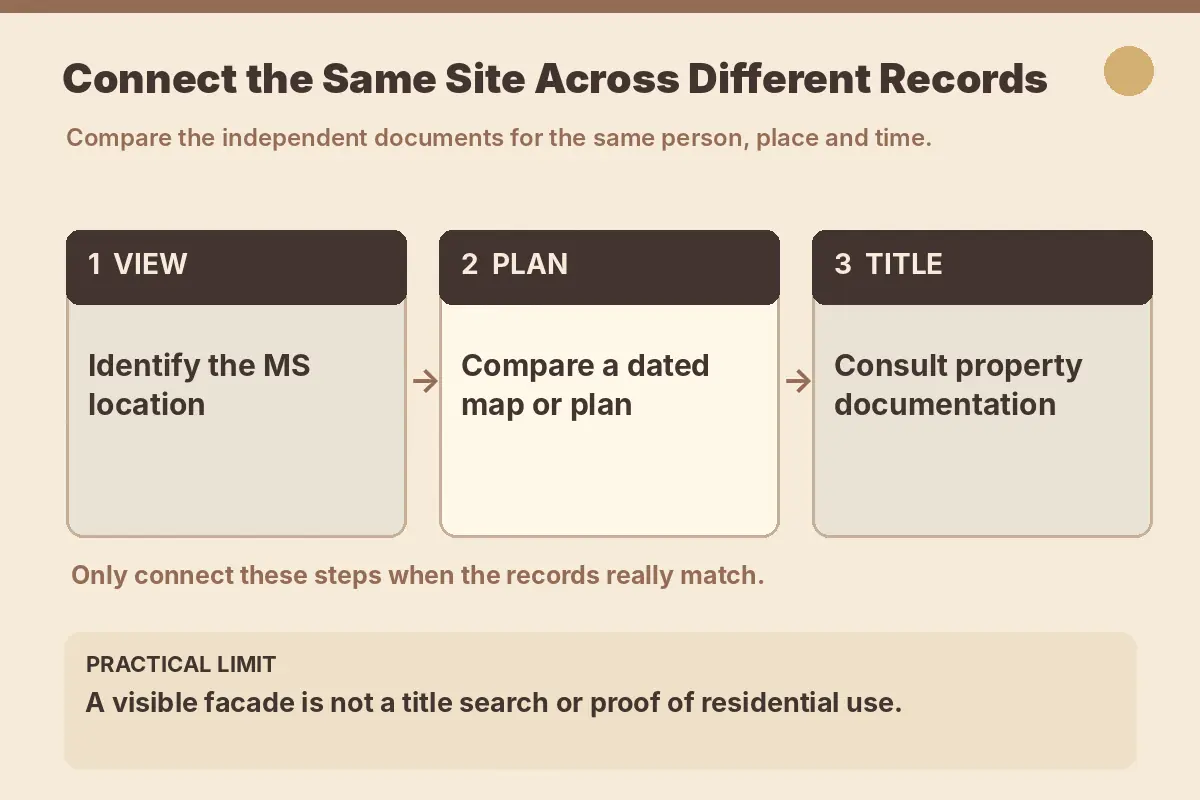
Consider a family story about a shop near a federal building around 1900. An MS view may reveal how the nearby street looked, but it cannot place the family at that address. Find a period city directory, deed, lease or census record that links the family to a specific address, then test whether the building or block in the slide is actually the same location. If the link is uncertain, use the slide as neighborhood context and say explicitly that it is not a portrait of the family home.
A reliable working note has two statements, not one. The first is what the RG 42 MS source directly records or visibly depicts, with all uncertainty retained. The second is a proposed link to a particular family, person, site, transaction, or period; it needs evidence created for that purpose. The same caption repeated in a blog, social post and archive index is still one source. Keep a list of rejected alternatives, and never turn an unsuccessful catalog search into a claim that a historical event did not happen.
Write the Final Caption With Clear Evidence Limits
A useful caption cites RG 42 MS and the exact item where available, then distinguishes the stated location from the independently checked one. Explain what the view shows and what property or construction claims require other records. The pictures made for this article are original diagrams and illustrations, not historical slides. Because lantern slides can be copies, a source chain should point toward the earliest identifiable image or document, not end at a repost. A careful architectural observation remains worthwhile without an invented ownership history.
Check physical context as well as web metadata. A clipped thumbnail can hide a caption, the edge of a building or an original image number. Download or request the fullest lawful reproduction available; transcribe actual inscriptions without silently correcting them. Mark approximate dates as approximate and label any identification supplied by a later cataloger. Keep a copy of the source description used for research because catalog records and access conditions can change. Explain clearly when a newly made illustration accompanies a historical discussion rather than reproducing an object from the named archive.
More House and Local History Guides
How We Research Archival Images and Their Limits
We consulted the National Archives RG 42 record-group description for the creator, media, series designation, number of items and date range. The NARA Still Picture Branch guidance describes research paths for original photographic and visual holdings; the general NARA research guide helps track descriptions to records. The supporting images on this page are original explanatory artwork, not facsimiles of the archival sources. See our affiliate disclosure.
NARA describes 397 lantern slides of historic sites, bridges, federal buildings and parks, mainly around Washington, DC, covering 1859–1920.
No. The guide explicitly notes that the group includes other localities, so verify each item’s place.
Only the depicted feature and a reliable date can be compared; plans, construction records and later evidence are needed for completion claims.
No. Link a person or occupant through a directory, deed, lease or another name-bearing record for the same date and address.
No. A series-level tally is not a guarantee of complete digitization or individual access.