
An archival image about a medical event may have been created long after the event. The National Archives describes 15 undated lantern slides concerning Valentine Seaman, whom its guide associates with bringing cowpox vaccination to New York City in 1799. They appear in Record Group 112, series TSA, among records of the Office of the Surgeon General (Army). The guide gives a subject and a historical reference year but no creation dates for the glass slides. The central research task is to avoid converting that 1799 subject date into an invented date for the visual object.
First identify the medium: a lantern slide is a projected visual artifact, often bearing an image or text intended for presentation. It is not automatically a photograph taken at the depicted time, and it is not a medical case file. NARA describes the series as undated; that uncertainty must remain attached to every summary unless an individual slide or related documentation supplies stronger dating. Do not write “1799 lantern photograph” merely because the slide tells a story about an event in 1799. Separate the depicted subject, preparation of the visual, and later archival custody.
Choose an Archival Route That Matches the Claim
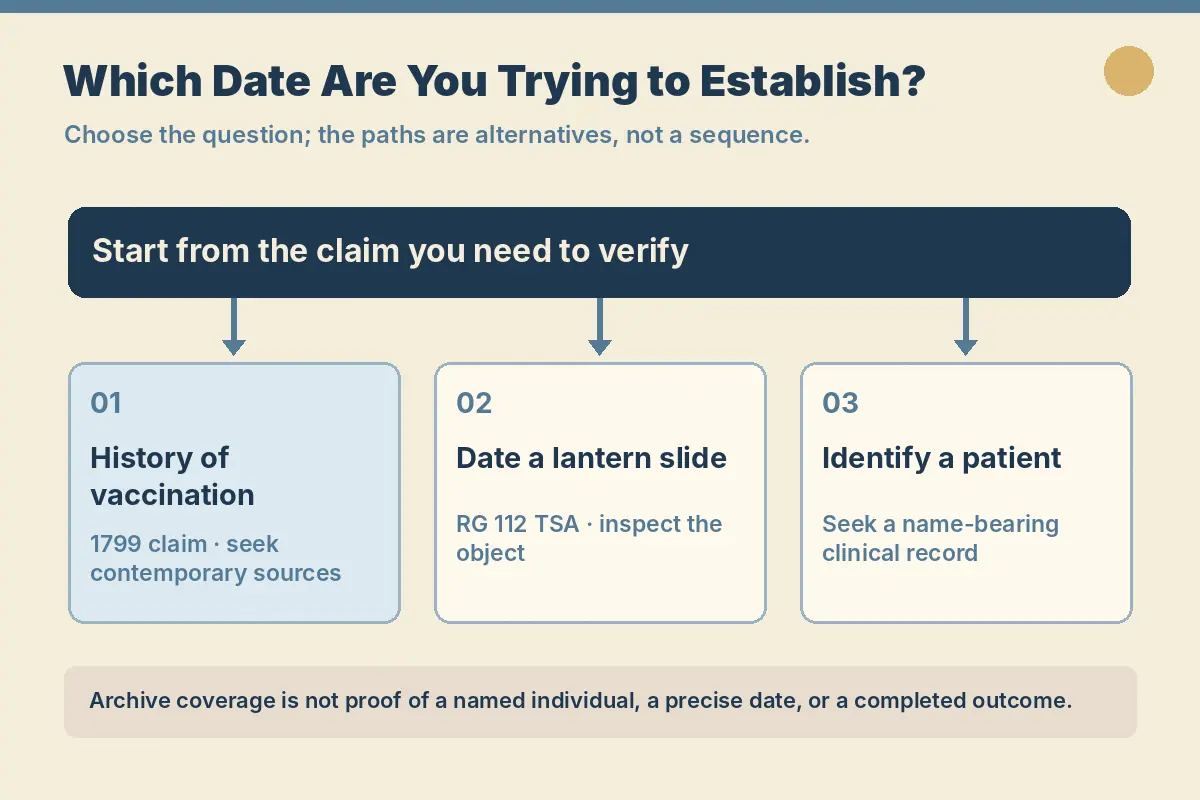
Different research questions need different sources. A slide can help explain how a later instructor represented Seaman and vaccination history. To establish what happened in New York in 1799, consult records created near that date: medical publications, correspondence, institutional proceedings or surviving local documents with clear provenance. To prove that a particular ancestor received vaccination, you need a named clinical entry, correspondence or another personal source. An image showing a doctor and patient, especially an illustration, cannot identify a real recipient without accompanying evidence.
Transcribe the wording on each slide exactly if images are accessible. A title can quote a historical proposition, reproduce a later lecture label or summarize someone else’s scholarship. Note whether labels are original to the glass, added to a mount, or written in a catalog description. The distinction matters: “Valentine Seaman, 1799” on a modern record might be a topical heading rather than a creation-date statement. Record marks, sequence numbers and any publisher attribution before assigning authorship. Where no maker is known, use “maker unknown” rather than guessing.
The National Archives guide identifies 15 lantern slides in RG 112, series TSA, for undated slides; 1799 subject. That is series-level information. It is not an item-by-item inventory, proof that everything is digitized, or confirmation of a particular person. Record the archival hierarchy before copying a citation: repository, record group, series, actual item identifier and the original descriptive wording. A photograph, lithograph or publicity artifact may have been reproduced or annotated later; those later actions are not identical to the historical event represented.
Date the Source Before Dating the Historical Event
The word “cowpox” is important to historical terminology but should not be transformed into a modern diagnosis or patient outcome. The NARA guide’s characterization of Seaman supplies background for why the lantern slides were collected, not proof of how many individuals were vaccinated or whether a medical procedure succeeded. A diagram of the vaccination process could have served instruction decades later. Distinguish representations of technique from surviving clinical observations and the public claims of physicians from independent evidence of outcomes.
RG 112 contains extensive Army medical records from different periods; it is not a single clinical database. Series TSA is a small visual unit, not a shortcut to any possible vaccination register from New York City. Search by the person, city, subject and approximate date only after identifying the relevant institution and record creator. Historical differences in medical terms and spelling can explain failed searches. Lack of a digitized named record proves neither that a person was unvaccinated nor that a vaccine campaign was absent.
Separate What the Image Shows From What It Suggests
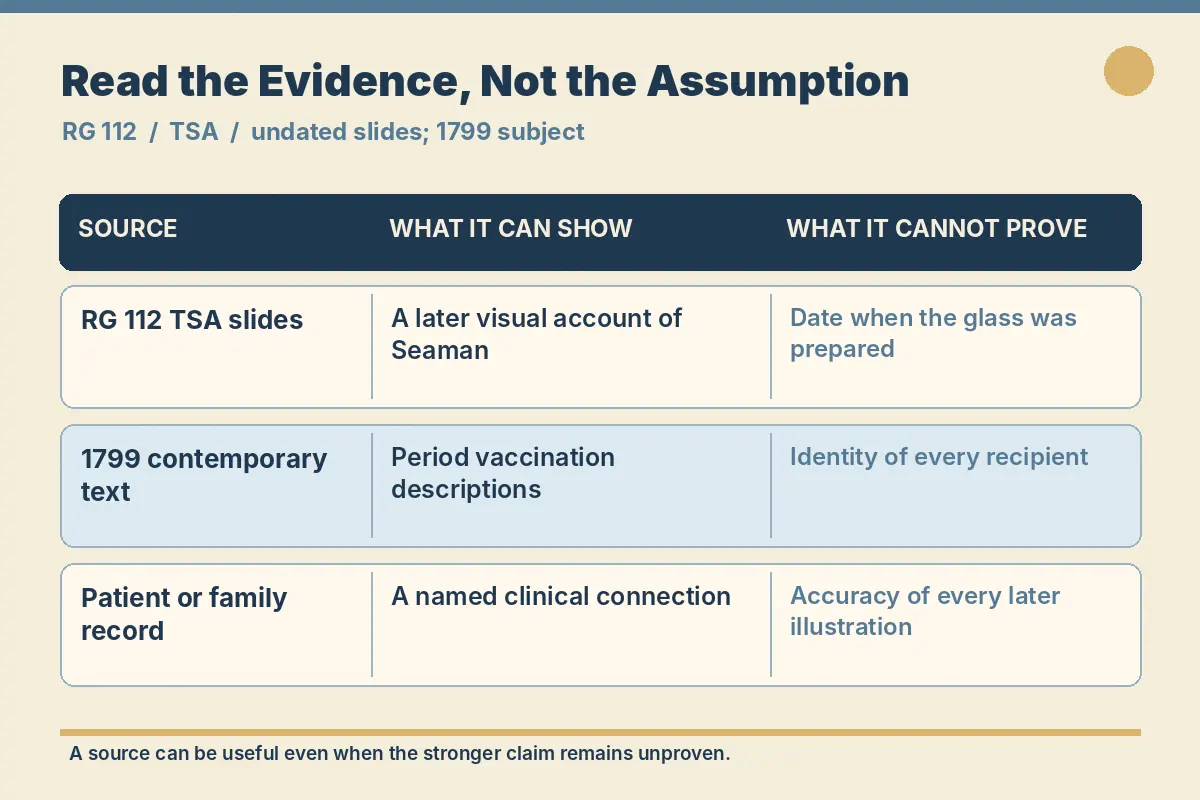
For provenance, note that a later visual lecture could reproduce a drawing, printed plate, document extract or copied illustration. If a slide depicts an eighteenth-century room, the artistic setting need not be an eyewitness view. Compare any recognizable source image with the publication from which it may have been copied. If no source can be demonstrated, label it a historical representation. Resist treating anatomical accuracy, clothes or architectural details in an illustration as independently observed facts about an actual 1799 appointment.
Use a worksheet with columns for slide item, exact text, material features, probable date indicators and the historical assertion made. Next add one column for the contemporary source testing that assertion. For example, a slide saying Seaman introduced vaccination in 1799 supports a claim about how the slide presents him; a contemporaneous medical paper is more suitable evidence for the historical event. A later textbook repeating the same story might derive from the same early publication and therefore add little independent corroboration.
Build an Independent Chain of Evidence

Imagine finding a family account that a New York ancestor helped with vaccination in 1799. The TSA slides may give a useful explanation of the historical setting. They cannot provide the ancestor’s participation unless the specific slides or other evidence name that person. Search period directories, institutional papers, notices or family letters for a matching identity and plausible time. Even then distinguish training, employment, medical care and voluntary participation; the verbs are different historical claims. Publish a cautious connection when the supporting documents are incomplete.
A reliable working note has two statements, not one. The first is what the RG 112 TSA source directly records or visibly depicts, with all uncertainty retained. The second is a proposed link to a particular family, person, site, transaction, or period; it needs evidence created for that purpose. The same caption repeated in a blog, social post and archive index is still one source. Keep a list of rejected alternatives, and never turn an unsuccessful catalog search into a claim that a historical event did not happen.
Write the Final Caption With Clear Evidence Limits
A careful citation identifies National Archives RG 112, TSA, the described undated slides and the exact item if found. Write that the slides concern Valentine Seaman and historical vaccination, not that the glass was produced in 1799. Explain what original sources establish the historical chronology separately. The graphics supplied with this article are newly drawn educational artwork rather than copies or reconstructions of the slide originals. The absence of a production year is a meaningful part of the record, not a flaw to conceal.
Check physical context as well as web metadata. A clipped thumbnail can hide a caption, the edge of a building or an original image number. Download or request the fullest lawful reproduction available; transcribe actual inscriptions without silently correcting them. Mark approximate dates as approximate and label any identification supplied by a later cataloger. Keep a copy of the source description used for research because catalog records and access conditions can change. Explain clearly when a newly made illustration accompanies a historical discussion rather than reproducing an object from the named archive.
More Research Method Guides
How We Research Archival Images and Their Limits
We consulted the National Archives RG 112 record-group description for the creator, media, series designation, number of items and date range. The NARA Still Picture Branch guidance describes research paths for original photographic and visual holdings; the general NARA research guide helps track descriptions to records. The supporting images on this page are original explanatory artwork, not facsimiles of the archival sources. See our affiliate disclosure.
The NARA guide describes 15 undated lantern slides concerning Valentine Seaman in RG 112, series TSA.
The NARA guide does not date them. The year 1799 refers to the vaccination history depicted, not the production of the slides.
The series-level description does not establish a patient list or named clinical register.
Yes. It describes Seaman as introducing cowpox vaccination to New York City in 1799; researchers should distinguish that contextual statement from what any one slide depicts.
No. First identify the slide’s medium, creation context, caption and source before describing what it represents.