
NARA’s RG 77 guide identifies approximately 1,100 lantern slides in the OT series, dated 1917–1925, used by the Operations and Training Section to illustrate civil engineering, military engineering and basic procedures in classes. They offer a visual account of what instructors taught or illustrated. They do not identify every engineer, establish when each skill was taught at a particular post or prove that a named soldier attended a class.
Lantern slides are a teaching medium: a photographed bridge, water-supply method or equipment detail might have been copied, reused or shown years after the original image was made. Begin with the image’s original subject and the OT series reference, then distinguish photo date, slide production and instructional use. For a family history, a soldier’s personnel or unit file must carry the claim of service; the slide can only explain the technology and instructional context.
Locate 77-OT and Its Related Training Images

NARA lists OT lantern slides under records of the Office of the Chief of Engineers and describes their use in engineering classes from 1917 to 1925. A related NARA aerial-photo/still-picture page discusses photograph and slide groups associated with technical instruction and notes the OT lantern sets as a more complete grouping. Search by RG 77, OT and the equipment or procedure, not only by a soldier’s surname. A grouping of training images is typically classified by subject, making a personal name search a weak first step.
Request the individual slide number and any original lecture title, caption or numbering system that survives. A slide mounted in a glass frame might be a copy of a photograph whose separate negative or print is cataloged elsewhere. Save identifiers for both rather than describing two reproductions as independent events. Ask the Still Picture Branch if the finding aid distinguishes lecture sets, original images and later copies. Do not assume every slide survives intact or is available online.
Read the Equipment Before Claiming a Date or Place
A bridging demonstration, camouflage scene, obstacle plan or water-supply photograph may be illustrative of a procedure rather than evidence that the represented work occurred where a relative served. Examine visible unit markings, landscape and caption for clues, but treat an uncited location as unknown. Water supply and bridge construction methods varied by terrain and resources. A slide meant to demonstrate general technique cannot establish the details of a particular wartime project without a separate site-specific report.
The date range 1917–1925 belongs to the instructional series. The image depicted may be older, contemporaneous or copied from another source. Keep a three-date ledger: original photograph, slide preparation and classroom presentation, with blanks where unsupported. If a label uses a broad term such as “field bridge,” do not invent exact model specifications or the training audience. Describe only the features that are visible and the wording the source uses.
Separate Army Engineer Training From Military Service
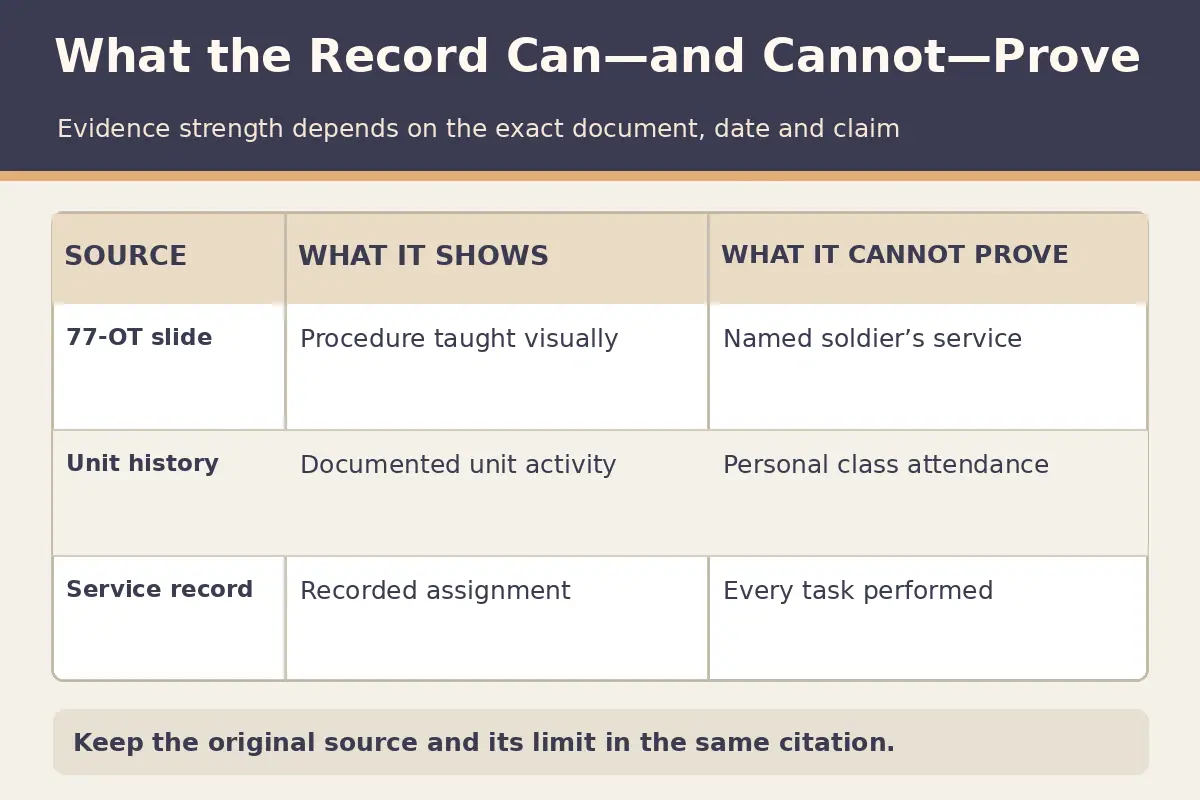
A slide used to teach military engineering demonstrates that the procedure was part of educational material, not that every soldier learned it. A named ancestor’s duty assignment should be checked through personnel documents, muster or unit records, orders, service publications or other contemporary named sources. The Army’s Corps of Engineers and civilian engineering activity may both appear in the record group, so the RG number alone does not establish military status or a particular theater of war.
If a family story claims that someone built a bridge, identify the claimed unit, date, river crossing and location before choosing a slide for comparison. An instructional image may clarify what a method involved, but should be described as a comparable technique unless archival evidence ties it to that unit. Keep equipment depiction, unit operations and personal participation in distinct evidence rows. Never place an individual in an image because their service happened somewhere nearby.
Explain the Difference Between Slides and Original Prints
NARA notes engineer training prints and related image-numbering systems, including film-slide and board negative numbers. Their identifiers are not interchangeable with the OT slide number. When a slide appears to match a published book illustration, ask whether it is a copy and which image bears the original caption. An overlaid arrow, title or measurement may have been added for instruction. Treat those instructional additions as commentary, not as features of the original field photograph.
For a publication, reference the precise source you actually viewed: a lantern slide, a contact print or a scanned reproduction. Do not cite a slide as if you inspected its source negative. Copying can reverse orientation, soften small writing and crop marginal labels. Compare landmarks before drawing conclusions about a location, and inspect a full-frame version where possible. Document the reproduction process when it affects visual interpretation.
Connect the Illustration to a Specific Unit History

To place the training material in a person’s career, begin with a dated source establishing assignment to an engineer unit or school. Add a unit history or training syllabus if it shows the program in a relevant place and period. Only then choose an OT image that genuinely illustrates the subject discussed. This is a chain of comparison, not a claim that the soldier saw the surviving slide or operated the pictured equipment.
Account for changes in military engineering during and after World War I. A 1925 class illustration could reflect a revised teaching practice compared with a 1917 field exercise. Avoid using one undated slide to narrate the entire war. When the unit history and a slide differ, record the difference instead of selecting the image that better fits the story. If no named training record survives, say that the visual source supplies only general context.
Publish a Caption With Precise Source Limits
A sound caption gives RG 77, OT, the unique slide identifier, recorded instructional subject and verified date when the item provides one. Explain that the image was used for engineer instruction rather than making an unverified statement about who appears. For photographs with identifiable people, avoid using speculative family identifications. If a related print has a more informative original caption, quote or paraphrase it with a separate citation so its origin remains transparent.
When requesting the full item, send NARA the record group, OT series, subject, number, and any paired negative or print identifier. Ask about access or preservation restrictions before publication. An accurate visual explanation can reconstruct the range of training practices without claiming that the photographed activity was performed by one particular person. Mark unknown geography or dates explicitly; that honesty also helps future researchers locate better sources.
More Records and Archives Guides
How We Research These Historical Records
We checked NARA’s RG 77 description of the OT instructional slides, the separate Still Picture note linking related engineer photographs to OT and the still-photo identification requirements. The description supports the series, function and 1917–1925 date span, but not the precise exposure date of every scene or the classroom enrollment of any named soldier. We therefore keep lesson illustration, unit duty and individual service separate. Affiliate disclosure.
It is the NARA series label for engineer instructional lantern slides associated with Operations and Training.
The RG 77 guide lists about 1,100 images.
No. They describe the series; source photographs may be earlier or copied later.
No. You need records tying the named person to a unit or class.
RG 77, OT series, subject heading, any slide or related print number and the research question.