
The NARA RG 75 guide identifies a photograph album labeled GS, containing 47 views of vocational training and educational facilities at the Genoa Industrial School for Indian Youth in Nebraska, approximately 1910. The album is evidence of places, programs and an institutional record-making perspective; it is not a verified roster of everyone pictured. A photograph of a classroom or workshop cannot establish that a person with the same age or family background attended the school.
Genoa belonged to the federal Indian boarding-school system, which separated many children from families and communities and used assimilationist policies. Photographs made for institutional documentation can omit coercion, loss and individual experience. Research should therefore place the visual record beside student records, tribal and descendant knowledge, oral histories and the school’s documented policies, without presuming that the official camera supplied the whole story. For respectful context, see the Genoa Indian School Digital Reconciliation Project.
Identify the 47-Image GS Album and Each Item

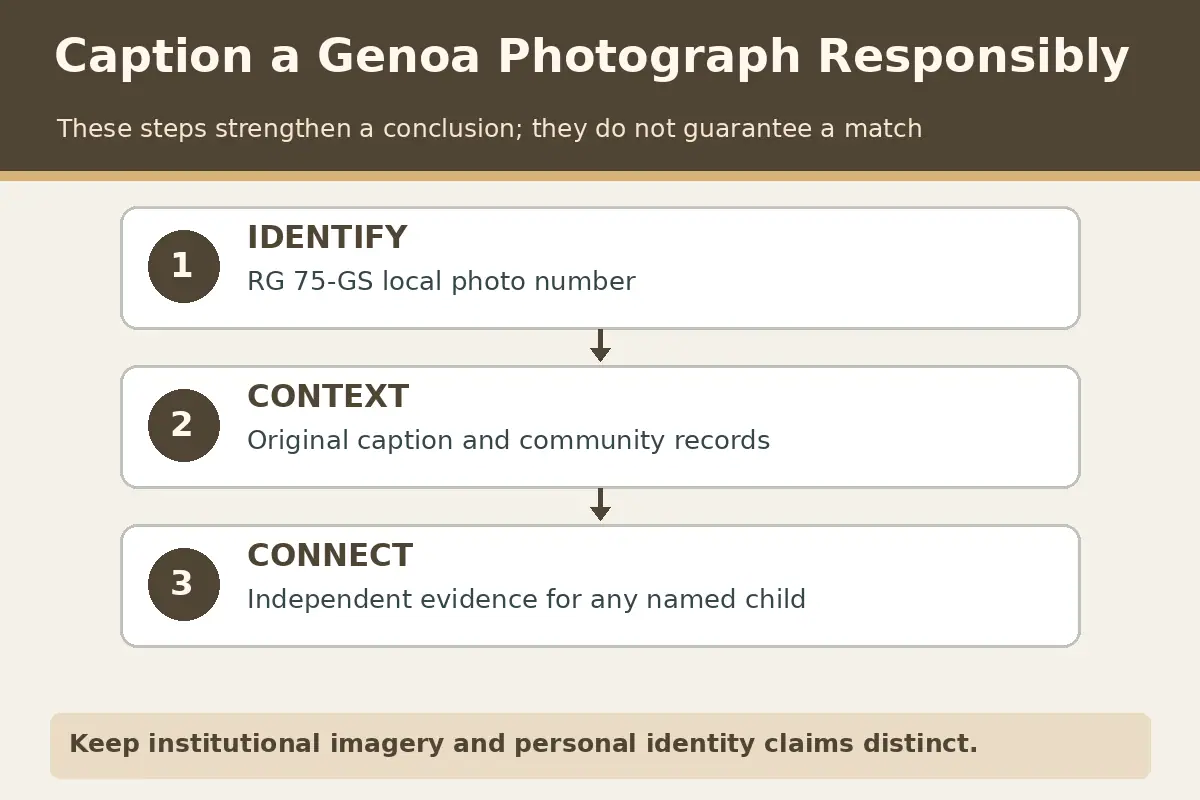
Begin with the exact citation RG 75, Genoa Industrial School album, GS, circa 1910, rather than a generic search for all Indian-school photographs. NARA describes 47 images in this particular album, but the larger record group includes many unrelated schools, agencies and image series. Keep the local identifier for the individual photograph when one is shown. A familiar site name in a modern online caption does not establish the original photographer, date or names of all people visible.
The Still Picture Branch guidance recommends collecting the record group, series, folder or box and unique item number. Ask whether the description is from the original album, an archivist or a later community annotation. Preserve each layer in the research notes. If a modern institution provides a richer caption, cite it alongside the NARA image rather than silently combining their statements into an invented original label. Never use a group-level circa-1910 date as an exact date of exposure.
Read a Classroom, Workshop or Building as a Scene
Images in the GS group depict facilities and vocational education. A blacksmith shop, classroom, agricultural space or printing room may show how the school chose to represent its work, but not the full schedule of an identified student. The surviving selection may have emphasized orderly activities, machinery or completed projects. Look for distinct architectural features, visible tools, desks and contemporary signs before labeling a room. Compare an exterior view with plans or dated photographs if building changes matter.
Avoid assuming a pictured task was voluntary, paid or performed by a particular child. Boarding-school students often labored as part of institutional programs, but a general historical practice is not proof of what an individual did on a photographed day. Note whether the camera captures a staged demonstration or ordinary activity when the item itself supports such a distinction. If it does not, write simply that the image depicts a vocational scene described by its source.
Separate Institutional Captions From Personal Identity

A photograph may have an original label naming a class or group without listing the people in it. Do not apply names from a separate school roster to faces on the basis of apparent age, clothing or physical resemblance. People with similar surnames or English names may be distinct, and some children’s names were changed or recorded inconsistently in institutional files. Where a name is recorded on the photograph, transcribe it accurately and note who supplied the identification.
For a claimed ancestor, build an identity table using name variants, parents, tribal or community affiliation when appropriate, dates of attendance and contemporaneous addresses, with respect for privacy and cultural sensitivities. Place the photographed scene in one column and the named individual’s documents in another. A successful match should be supported by a specific naming source and checked against the original image, not by inherited family speculation.
Search Student Evidence Outside the Album
Depending on survival and access conditions, school-related administrative records can include enrollment and discharge information, correspondence, student files, annual reports and other agency records. The GS picture group alone does not tell you whether such a file exists for a named person or where every record is held. Search by institution, administering agency and relevant years, then ask NARA and appropriate community repositories about surviving material, access conditions and names used in historic records.
An enrollment entry may establish admission but not uninterrupted attendance; a transfer might explain an apparent absence from later records. Compare dates with family correspondence, community accounts and other independently dated material. The absence of a photograph is not evidence that the child was not present, and the existence of a classroom photograph is not a substitute for an enrollment entry. Explain gaps and uncertain identifications, rather than creating a continuous story from selected pictures.
Center Community Knowledge and Ethical Captioning
The Digital Reconciliation Project draws attention to Native perspectives and the broader history of boarding schools. When descendants or tribal institutions provide names, stories or cultural interpretation, seek the appropriate attribution and permission before including sensitive details. An institutional portrait may be emotionally difficult for families. A respectful description can acknowledge that the image represents a federal school system with coercive features while avoiding speculation about a pictured child’s feelings, tribal identity or particular experiences.
Distinguish a community-supplied identification from an archivist’s original catalog description. Neither should be dismissed, but they document different kinds of knowledge. If the individual remains unknown, use “unidentified students” or a more neutral visible description rather than making a guess. Do not use attire, skin tone or facial appearance to classify tribal membership. Where permissions, rights or privacy considerations are unclear, prioritize careful citation and contextual explanation over re-publication of a potentially sensitive face.
Write a Source-Based Family or Local History
A defensible caption might state that RG 75-GS shows a described workshop at Genoa around 1910 and cite its exact local identifier. Follow that with a separately cited sentence about an identified student only if student records or well-sourced community accounts support the connection. Mark a building’s purpose and any personal names as “source caption” or “later identification” when needed. Such labels make the article stronger, not weaker, because they let a reader examine the evidence chain.
For future research, save a photograph of the entire album page if permitted, not merely a cropped face. Note surrounding images, handwritten headings, order and evidence of copying. Compare a school photograph’s date against independently documented construction, student presence and later building reuse. If you cannot secure a reliable link to a person, use the album to explain institutional conditions and leave the individual’s attendance explicitly unconfirmed.
More Family Story and Preservation Guides
How We Research These Historical Records
We confirmed the 47-image GS album and its circa-1910 dating in NARA’s RG 75 guide, compared NARA Still Picture rules for item references, and consulted the Genoa Indian School Digital Reconciliation Project for contextual and community-centered framing. We have not identified any unnamed child from an image or claimed that an album proves a particular enrollment. Descriptions of school programs and personal histories remain separate lines of evidence. Affiliate disclosure.
The RG 75 guide describes 47 album images, dated approximately 1910.
No. It is described as photographs of educational and vocational facilities, not a complete enrollment index.
Only if a reliable source identifies the person and independent evidence supports the attendance claim.
An institutional image alone may omit the coercion and lived experience of the boarding-school system; descendant and tribal sources can add critical context.
Use RG 75, series GS and the exact local item identifier or album page when available, preserving original and later caption sources separately.