
The National Archives inventory of RG 16 identifies 25 lantern slides in series WH showing cultivation, harvesting, and processing of hemp by War Hemp Industries, Inc., during 1942–1946. This is a focused visual group, not a comprehensive file of government hemp policy, every grower, or every employee at a processing plant. Use it to investigate the appearance and sequence of wartime agricultural work, then seek a second record for the people, acreage or industrial output that interest you.
Start by deciding which part of the process a family account describes: a farm growing fiber crops, a crew harvesting plants, or machinery handling material after harvest. Those activities can occur at different places and involve different employers. A photograph of bundled stalks cannot name the landowner; a factory scene cannot identify a relative without a reliable caption or separate records. Preserve the historical name War Hemp Industries as an agency or corporate lead rather than assuming it was the legal employer of every person pictured.
Choose Cultivation, Harvest or Processing Evidence

The RG 16 listing explicitly names three subjects: cultivation, harvesting, and processing. Sort a promising image into the activity actually visible, not the job you hope an ancestor held. Field rows and farm implements may describe a growing operation. Cut or bundled stalks suggest harvest or handling. Factory rollers, fiber machinery, and stacked bales may point to processing, although exact apparatus must be identified from the original image and caption. The grouping is only 25 slides; do not infer that each step is represented equally or that any county had a dedicated slide.
Write the image identifier, its caption wording and the date of the scene separately. USDA compiled or acquired visual material for communication, and the time a slide was projected need not match the exposure date. If a caption gives a state, facility name or farm, confirm that name independently before locating it on a current map. A shared industrial subject is not enough to transfer the place or personnel shown in one image to a different image. Note when the inventory alone cannot establish which physical slide survives in usable form.
Read Company, Farm and Plant Names Literally
War Hemp Industries, Inc., is named in the archival description, but that description does not establish a list of farms operated by the firm. A local farmer could have raised a crop under an arrangement that is not apparent in a government publicity slide. Similarly, the visual presence of a mill, truck or warehouse does not identify who owned the property. Use contemporary land records, agricultural correspondence, directories or contract files to investigate legal roles. Do not convert the archive-level creator label into a deed, employment roster or chain of title.
For family research, build a small table with four columns: person or firm, place, date and source. Put the original caption in one row, a family document in another and any named government or county record in a third. Where the name of a machine operator is missing, leave the identification blank; resemblance or proximity to a familiar farm is not sufficient. A caption may use a company name as a thematic label. Check whether later catalogers added that language before treating it as an eyewitness description.
Separate Wartime Purpose From Measured Production

The 1942–1946 range places this visual series within wartime and immediate postwar agricultural history, but a date range is not a tonnage report. A picture of a large stack of hemp cannot show how much usable fiber resulted from it or how many acres were planted. If an argument depends on yield, look for a dated acreage return, crop estimate or plant production report with an explicit unit of measure. Explain whether the figure refers to a county, a specific facility or a wider program. Never read capacity or output from an artistically framed publicity photograph.
Be precise with the end of the date span. The catalog says that the slides date from 1942 to 1946; it does not say that every pictured operation began in 1942 or continued until 1946. Nor does it prove that machinery visible in a photograph was acquired in the year the slide was copied. Look at writing on the mount and any original reference list for a more exact date. If there is no such information, use the documented series range rather than guessing a single day.
Find a Named Worker Through Independent Evidence
A relative remembered as a wartime hemp mill worker may be traceable through city directories, correspondence, employment records, local newspapers, or payroll material if that material survives and is accessible. Those records provide the person-level lead; the WH slide provides visual context about a process. Compare the documented employer, plant location and dates with any original slide caption. A laborer working at one processing site is not automatically pictured in a national collection. A local plant and a federal publicity image can illustrate the same industry without showing the same event.
For a farm household, separate ownership, tenancy and day labor. A deed addresses title, a farm schedule or agricultural report may describe operations, and a named wage or correspondence record may address employment. None is interchangeable with a slide of a generic field. If the person was a child or otherwise vulnerable at the time, avoid publishing an unsupported identification. Even when a caption supplies a name, examine whether it records an employee, visitor, photographer or informant before assigning a role.
Request the Right Slide and Preserve the Citation
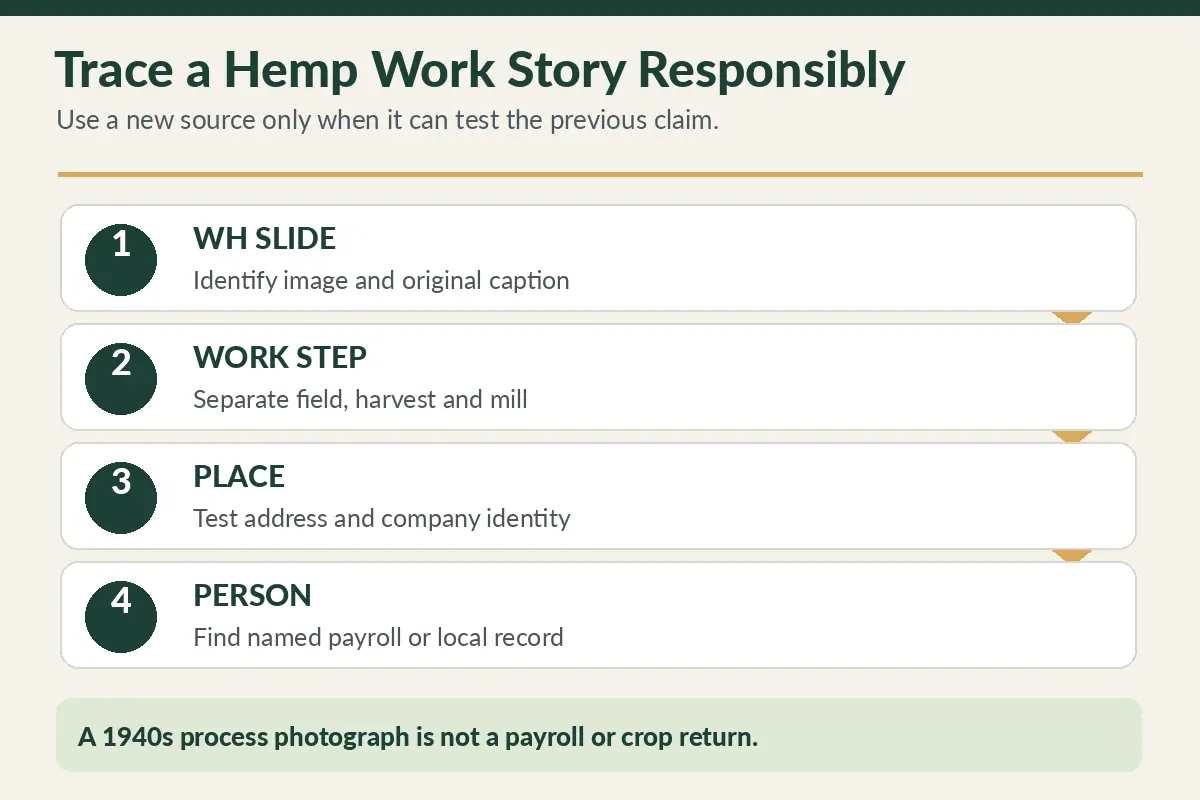
Search the National Archives Catalog using RG 16 together with WH, War Hemp Industries and any place identified in a reliable caption. A record-group description is not the same as a digitized image; check whether the result refers to a series, an individual item, or a reproduction of a lantern slide. When contacting the Still Picture Branch, supply the series designation, inventory wording, date range and any local identifier you can establish. Ask about available references or image copies without assuming all 25 slides are online.
Save the exact wording and source of each caption, alongside any modern descriptive text. Keep research notes away from the image pixels so future readers can tell historical labeling from your interpretation. If you make a schematic or visual reconstruction, identify it separately as an illustration rather than an archival original. Record where your family-related evidence comes from and state plainly when it corroborates the place but not the identity. That produces a trustworthy account of wartime agricultural work.
Worked Example: Testing a Family Hemp-Mill Story
Suppose a family letter dated 1944 says that an uncle helped at a fiber plant in a named town. First transcribe the town, date and the person who wrote the letter. Next search RG 16 WH for a slide with a matching location or a clearly described processing scene. If the slide depicts similar machinery but lacks a place caption, use it only to explain equipment; do not call it a photograph of the uncle’s plant. This example is hypothetical and does not describe a specific NARA item.
Then check a period directory or local document for the plant name and a separate named record connecting the uncle to the employer. Only when independent evidence ties the same worker, site and period together should the narrative state a connection. Write “illustrates wartime hemp processing” for the WH image if direct identification fails. The accurate caption is useful even when the image remains contextual rather than biographical.
More Records and Archives Guides
How We Research These Archival Collections
We verified the 25-slide count, WH designation, company name, activities and 1942–1946 dates against the National Archives RG 16 inventory, then checked NARA guidance on identifying and citing photographic holdings. A published series summary is not evidence that we examined every image. Item captions, copying restrictions and availability must be checked individually.
Our evidence test separates visible agricultural processes, documented business responsibility and a named person. We do not use the archive description as a substitute for contracts, output returns or payroll. For the site’s policy, read the affiliate disclosure; this method does not depend on a paid archive service.
The RG 16 inventory describes 25 WH lantern slides dated 1942–1946.
A specific caption might, but the series-level description does not provide a worker roster; verify any name independently.
No. A processor may handle material from multiple sources; investigate contracts and farm documentation separately.
The inventory does not guarantee digital copies for every item. Check the National Archives Catalog or ask the Still Picture Branch.
Not by appearance alone. Use a dated production report that states quantity, period and unit.