
The RG 18 National Archives guide identifies approximately 1,500 photographs in the SF series, dated 1923–1939. They document the history and activities of Scott Field in Illinois and landscapes of nearby or associated regions. The guide also lists scenes in Illinois, Kentucky, Michigan, Missouri, Indiana, Florida and Wisconsin. This breadth is important: an SF designation does not mean that every photograph was taken on the Scott Field base, nor that everyone visible was stationed there.
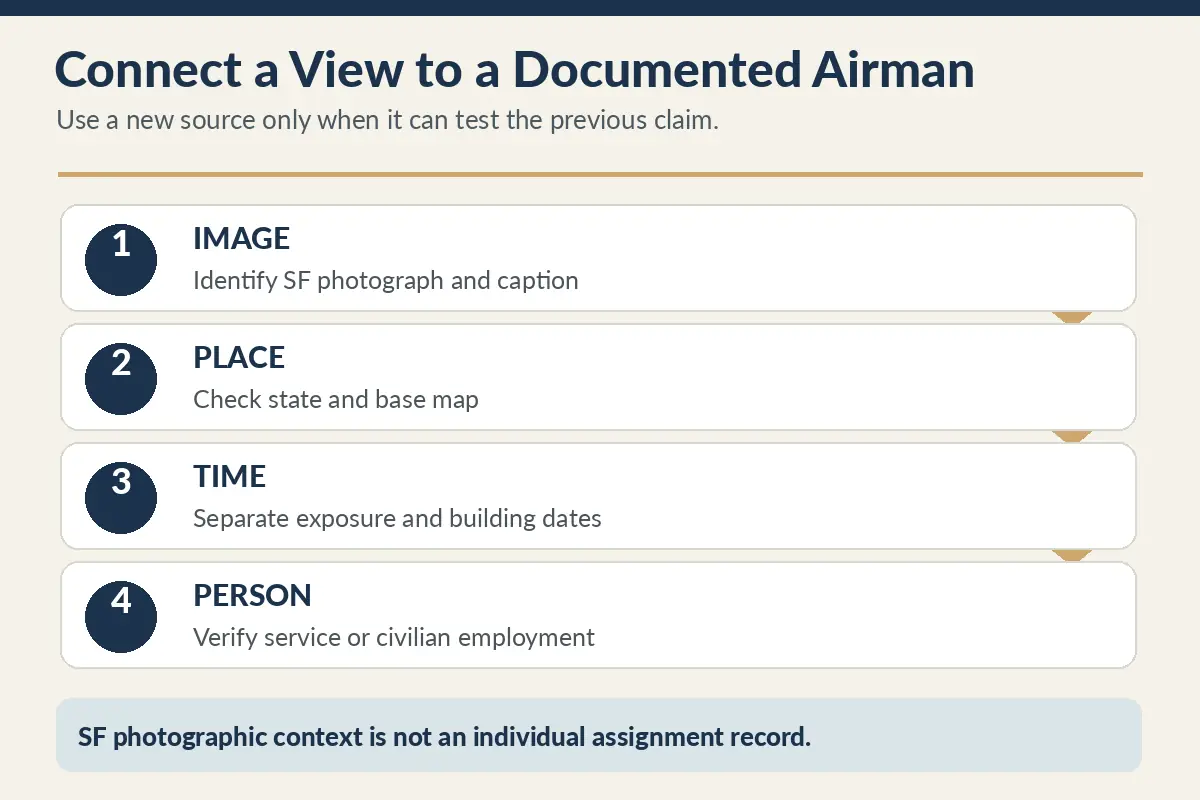
Use this collection when a family story names a building, hangar, airfield neighborhood or training environment. Start with a captioned photograph, then identify the structure and date before adding a person. A photo of a barracks is evidence of a building as represented in that view; it is not a resident register. The strongest method combines the image with a dated installation map, local property or newspaper context, and a separate official service or employment record for the individual in question.
Keep the SF Picture Group Separate From Other RG 18 Series

RG 18 includes several different photographic groups for early aviation. The SF grouping specifically covers Scott Field history and a broader set of landscapes between 1923 and 1939. It is not the same as the HER refueling photographs of 1923, the Air Service E photographs of 1918–1919, or the P and PU identification pictures. Search by series designation in addition to words such as Scott Field and Illinois. If a result is filed under another letter group, use that group’s own provenance rather than silently reclassifying it as SF.
NARA also lists separate textual records of Army airfields and maps. These may offer a useful independent chronology for physical buildings, but their date spans and custodians are not necessarily identical to SF photographs. Before quoting a number such as 1,500, make clear that it is the inventory’s count for the photographic grouping, not a count of individual buildings, aircraft or military personnel. Avoid suggesting there is one photograph per year or installation; the archival series may be unevenly distributed.
Test Whether the View Is Actually at Scott Field
A photograph showing hangars, a road or a runway could belong to many bases. Confirm place through the original caption, signboards, recognizable buildings, road alignments or a map prepared near the exposure date. Because the SF group extends beyond Illinois, a landscape in another state should not be labeled Scott Field merely because its identifier begins SF. Treat place names given by later catalogers as useful leads rather than unquestionable proof. A contemporary plan or a second labeled photograph can help distinguish similar-looking training buildings.
When matching a civilian structure beside the base, remember that roads, field boundaries and neighborhoods can change quickly. Compare dated maps rather than a modern aerial image alone. The presence of a military vehicle in a rural photo is not enough to assign the scene to a particular county. If a family address is known, map that address from independently dated property or directory evidence and ask whether the SF photograph depicts the same location, a nearby landmark or simply a comparable regional setting.
Separate Exposure Date, Caption Date and Building Date

The series span of 1923–1939 is not a date for every photograph. The construction of a hangar may predate an exposure, and a caption could have been copied or updated much later. Read the back of a print, accompanying envelope and any original number list when available. For aircraft, a model type can set a broad context, but it should not replace an authentic caption or a service history. A wartime-looking scene cannot be assigned to 1939 simply because that is the series end date.
For architectural comparisons, list the visible roofline, window pattern, doors and surrounding roads, and explain which are persistent enough to identify a building. Identify whether a drawing shows a proposed structure, a later survey or a completed building. A base map may have amendments, so record its creation and revision dates separately. If a photo shows a structure missing from a particular plan, consider the difference in dates or map scope before claiming the structure was built or demolished.
Find an Airman Without Using a Landscape as a Roster
An SF view can place equipment or buildings in historical context, but it cannot establish that a particular relative trained, lived or worked there. A named soldier should be connected to the installation through service assignments, orders, correspondence, school records or another person-level source. Even if someone appears in an informal group photograph, compare rank, unit, service dates and any named caption before deciding on an identity. Facial resemblance to a later family portrait alone is weak evidence, especially with indistinct early prints.
Civilian workers and nearby residents need different documents. A contractor might have a local directory entry, while a farm household near the airfield may be traceable through deeds and census records. The presence of a road or building does not establish ownership or tenancy. Separate three claims in the final story: what the image depicts, where it was taken, and how the person was linked to that place. If only the first two are demonstrated, do not add a name to the caption.
Request a Reproducible SF Photograph Citation
Search the National Archives Catalog for RG 18 and SF along with a known landmark or date. Record the original identifier, exact caption, any available date and the archive location. If only the aggregate series description appears online, ask the Still Picture Branch about item-level finding aids and reproductions, giving the full series context. Do not assume a series described as 1,500 images has a searchable thumbnail for every image. Where a photograph is a copy, record that relationship and avoid citing a derivative as if it were the original negative.
Create a location ledger: identifier, alleged place, original caption, observed feature, dated map corroboration and uncertainty. For a family album, add a separate citation for the named relative’s assignment or residence. When presenting two similar hangar pictures, state whether they are actually paired by a verified identifier or only by visual similarity. A reliable history is built from explicit links among sources, not from the expectation that all images with the same series letters share one location.
Worked Example: Was a Relative at This Hangar?
Suppose an old letter from 1931 mentions a relative working near Scott Field. An SF photograph shows a hangar and road with no visible people. Verify the photograph’s caption and compare the architecture with a dated installation map. Even if the hangar matches, the photograph establishes setting, not that the letter writer entered the building. This is an illustrative workflow, not a statement about a particular photograph or veteran.
Find an independent service posting or civilian job document for the relative and compare the date interval with the confirmed photograph. If the documents agree only at the installation level, caption the image as a contemporary view of the base rather than a personal workplace portrait. Preserve the limits of each record and do not turn an unlabeled figure in the background into a family identification.
More House and Local History Guides
How We Research These Archival Collections
We checked the SF designation, 1,500-image count, 1923–1939 range and multi-state coverage in NARA’s RG 18 inventory and used its photographic reference guidance for caption and format questions. The collection description cannot validate the date or place of an individual image without consulting that item.
Our method separates image provenance, physical location and personal assignment, with independent sources for each. No archive index or unidentified group view should be used to assign a family member to a military unit. The site’s affiliate disclosure describes our policy; no paid database is required to apply the source test.
No. The NARA RG 18 description includes landscapes and structures in seven states, not just Illinois.
The series-level span is 1923–1939; confirm each photograph’s own date separately.
No. It identifies a picture group, not a named service record.
A securely dated view can show a structure existed by the exposure date; a construction date needs separate documentation.
Provide RG 18, SF, original caption or identifier and the geographic details when contacting NARA.