
Start With the Archival Series and a Specific Question
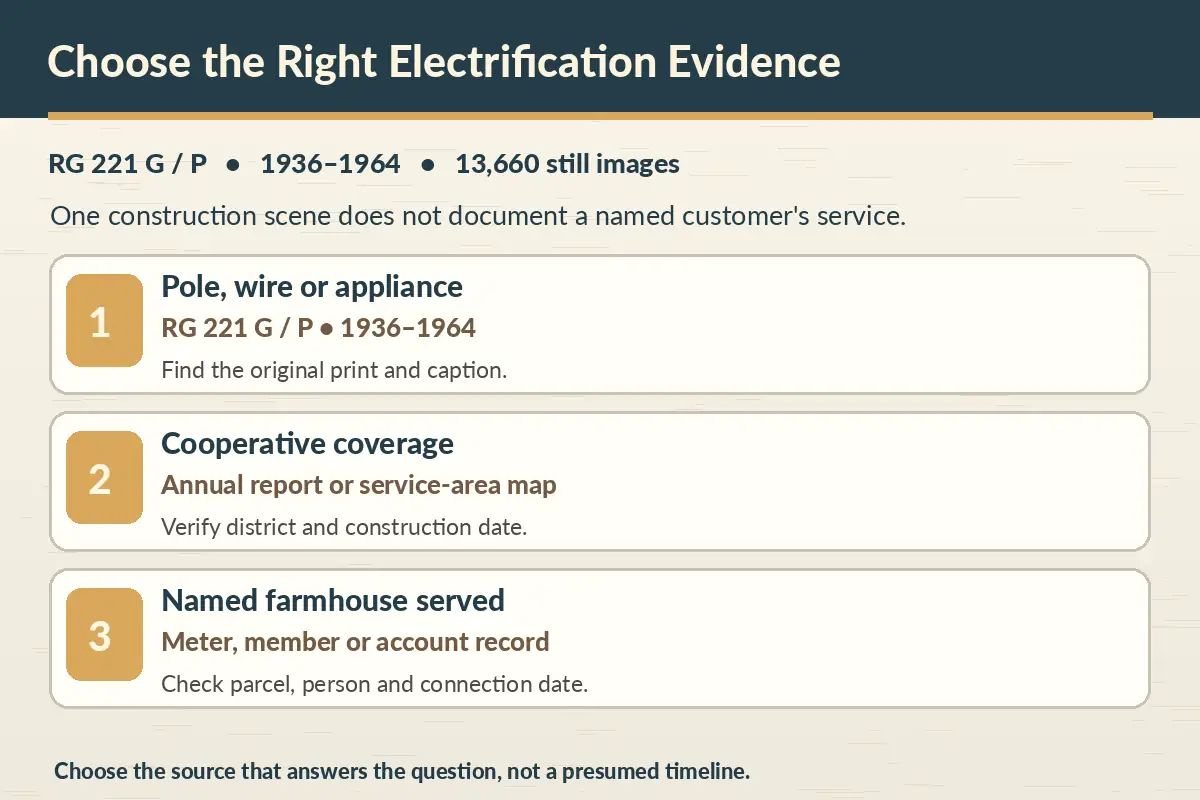
Photographs of rural electrification in National Archives Record Group 221 show how wires, poles, equipment, and appliances entered American farm communities. They do not, by themselves, establish the day a particular family connected to the electric grid. NARA describes 13,660 still pictures from 1936 through 1964, grouped under P, G and several other identifiers. Search for the physical feature first: a cooperative office, a transmission line, a wiring demonstration, or a photographed building. Then establish the specific image and its caption.
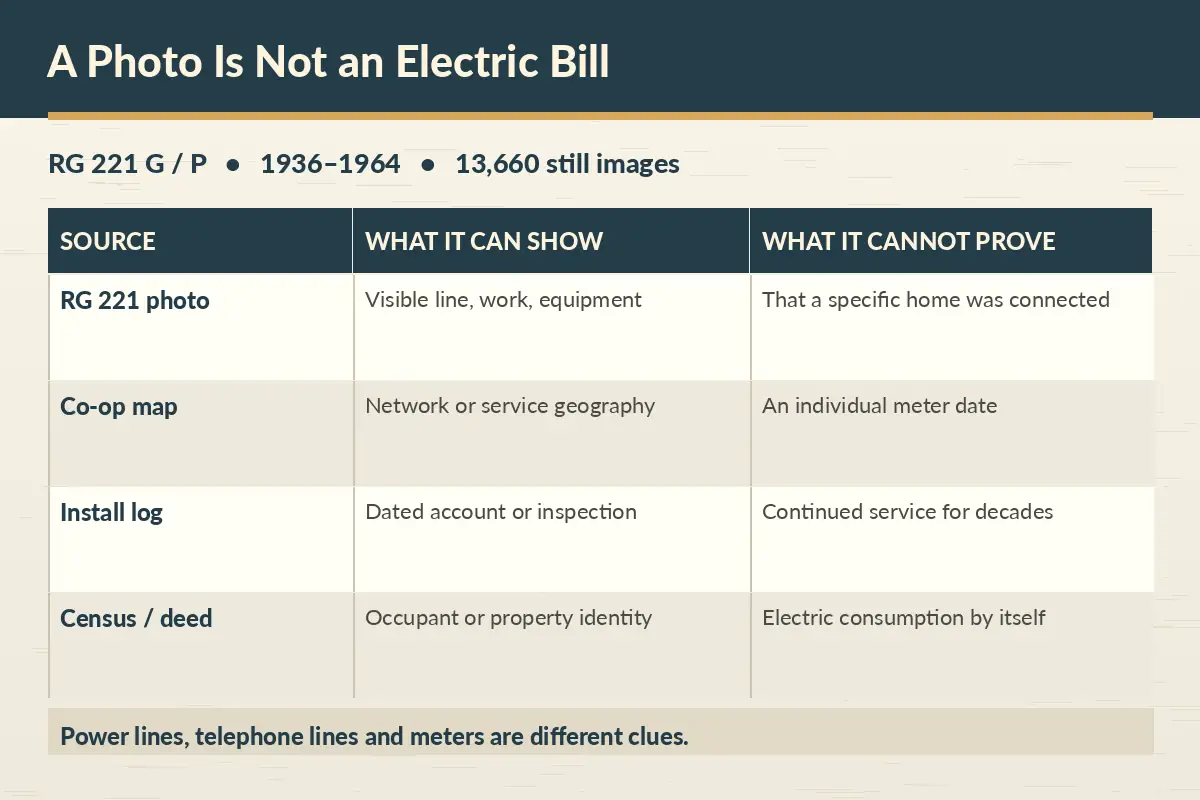
A family-history claim needs a second kind of source. A picture of a lit farmhouse might show a publicity demonstration, an unnamed home, or equipment installed before permanent service began. Even a named cooperative in the caption does not identify every customer. The productive research question is whether a particular parcel or household can be linked to dated connection, inspection, meter, or billing evidence. Keep photo interpretation distinct from proof of electrical service.
Choose G or P and Preserve the Original Caption
NARA identifies several RG 221 photographic designations, including G and P. Its descriptive guide says that the G series has an annotated selective item list, while P has a box-and-folder list and microfiche. These are different finding paths; the letters should not be treated as phases of a single construction project. Start by searching the subject, community and cooperative name. Then note the exact series label, original negative or print number, physical container reference, caption wording and date attribution. A cropped derivative can conceal handwritten identifiers.
The collection includes electric line construction, telephone installations, appliances, agency offices, public ceremonies, and officials. Subject variety matters: an office-opening photograph might say much about publicity but almost nothing about an individual farmhouse. Do not assign a date merely because a tractor, stove, or pole looks like a familiar model. Separate the approximate dating of equipment from the archive’s documented exposure date. If the item is only described at the series level, report the date as a range until the specific print is found.
Determine Whether the Scene Shows Work or Completed Service
An image of a lineman raising a pole shows work at one moment. It cannot alone establish that a line carried power, served every nearby farm, or remained in use. Look for a pole-line endpoint, a visible transformer, a meter base, an indoor fuse box, or the face of a service agreement if it is legible in a separate record. Distinguish construction, electrical inspection, energizing, and household occupancy. Each event may have occurred on a different day and may have been documented by a different institution.
For farm buildings, identify whether the photographed structure is the residence, barn, dairy building, workshop, or demonstration site. Even a meter visible on an outbuilding does not prove that the dwelling had electrical lighting. Compare window shapes, outbuilding location, roads, or a reliable cooperative caption with a dated property map. The existing GenHis guide to RG 221 electrification maps addresses network geography; this photographic guide addresses what was visually recorded and how a particular customer’s service must be independently established.
Follow the Cooperative Rather Than Guessing the Owner
REA history is intertwined with financed electric cooperatives, but a cooperative’s geographic service area is not a household directory. If a photograph names a cooperative, transcribe its historic legal name and county. Compare that name with a contemporary directory, cooperative annual report, service-area map, or meeting minutes. A loan announcement can document financing while leaving the sequence of individual connections unknown. Public-relations photographs may select photogenic examples rather than cover the entire membership. Avoid using a publicity caption as an exhaustive account of who was served.
To identify a family, seek a dated account application, meter installation order, member register, bill, or other document containing a name and address, if such records survive and are accessible. Cross-check the person against a deed, farm schedule, directory, or census in the appropriate year. Farmers and tenants may have different legal relationships to cooperative membership; service at one structure does not necessarily prove that a named renter paid for it. Record uncertain street, rural-route and parcel descriptions in a comparison table instead of silently modernizing them.
Keep Telephone and Electricity Evidence Separate
The series description expressly includes installation of telephone lines as well as electricity. A line running beside a farm road may be a telephone facility rather than an electric distribution line, and a photo caption may not resolve the distinction. Examine any original description, pole hardware and accompanying documentation before calling the line electrical. A switchboard photograph is evidence of communication infrastructure, not house lighting. This distinction is especially important when reconstructing a family’s access to two technologies on different schedules.
Agricultural appliances also require care. A photographed refrigerator, pump, iron or milking device may be a demonstration displayed for the camera rather than the family’s purchased equipment. Identify whether the scene was an exhibition, an installation, or ordinary use, and cite any contemporary advertisement or purchase document separately. The presence of a device is not a statement about long-term affordability, reliability, or use across an entire township. Describe the narrow visual observation first, and only then add independently supported claims about wider changes in rural life.
Build a Dated Service Timeline Without Inventing Connections
Write four distinct columns for the locality: application or financing, line construction, meter or wiring inspection, and documented first service. Enter only dates carried by sources that actually address each event. A photograph may be valuable for the construction column and silent on the rest. Sometimes a cooperative annual report provides a count of connected members without a list of names. That aggregate number cannot be allocated to a particular family. Missing records can reflect retention limits, not evidence that a connection never occurred.
If a later photograph appears to show an electrified farm, compare it against the same land parcel in tax, agricultural or insurance records. Avoid inferring a dramatic before-and-after transformation from two unrelated images. List major uncertainties: a surname that repeats in the county, an original caption with no township, or equipment from a neighboring property. This approach permits a cautious statement such as ‘a cooperative photographed wiring work in this county’ without asserting that a particular ancestor had service on the day shown.
Make an Item-Level Image Citation and Research Request
NARA’s general record-group guide is an entry point, not a substitute for a print-level citation. Record RG 221, the exact letter series, local image number, box or folder where known, historic caption, image date as stated, and the repository or catalog link. Preserve the difference between an original negative and a later photographic copy. If a digital display omits the reverse of the print, ask whether the reverse contains captions or stamps. Do not represent a catalog description as an inspected original if only a summary has been viewed.
A useful request to NARA states whether the goal is a named cooperative, line construction in a specific county, or equipment inside a particular building. Provide alternate place spellings, a narrow year range and any negative number already found. Photograph and utility records may be held by different repositories, so record each citation independently. An honest finished history describes what the image shows, what a dated cooperative document confirms, and where the record trail stops. It does not make a power-line photograph stand in for a household ledger.

More House and Local History Guides
How We Research This Collection and Its Limits
The series description, dates, and record designation were checked against the official National Archives research guide on November 16, 2026. Independent context was compared with a second official research source, while NARA still-picture citation guidance establishes the information needed to locate an exact image. The site topic list and earlier production titles were compared for duplication. A series description does not identify every subject, date, or object in every frame, and access to a fully digitized item cannot be assumed. The figures in this guide are newly drawn explanatory editorial illustrations, not historical negatives or genuine reproductions. We make no unverified claims of commercial endorsements. See the affiliate disclosure for site policy.
NARA describes the main still-picture group as 1936–1964; date an individual photograph using its caption or negative record.
No. Both appear under RG 221, but NARA describes an annotated selective list for G and a box-and-folder list for P.
No. Link the exact property to separate dated meter, membership or service evidence.
Yes. NARA identifies rural telephone installations, so the type of line must be established before interpreting the scene.
No. The series description is not an availability guarantee; request item details and reproduction options from NARA.