
NARA’s RG 126 guide describes photographs and lantern slides covering the Copper River Railroad, the survey, construction and operation of the Alaska Railroad, and related scenes of settlements, workers, officials, wildlife and Native people, 1908–1933. The inventory identifies AR (2,500 images), ARS (122) and ARA (500). These series provide place-first clues for family historians, but the aggregate description is not a list of every person who built or rode the railways.
Begin with the specific railway, route section, settlement or construction stage rather than with a common surname. A photograph of a bridge or rail camp can establish that a place was represented in an archival scene. It cannot prove the employment of an ancestor, the date they arrived in Alaska, or which workers erected that structure. Use the image to guide a search for named payroll, correspondence and contemporary local records.
Identify AR, ARS and ARA Before Selecting a Scene
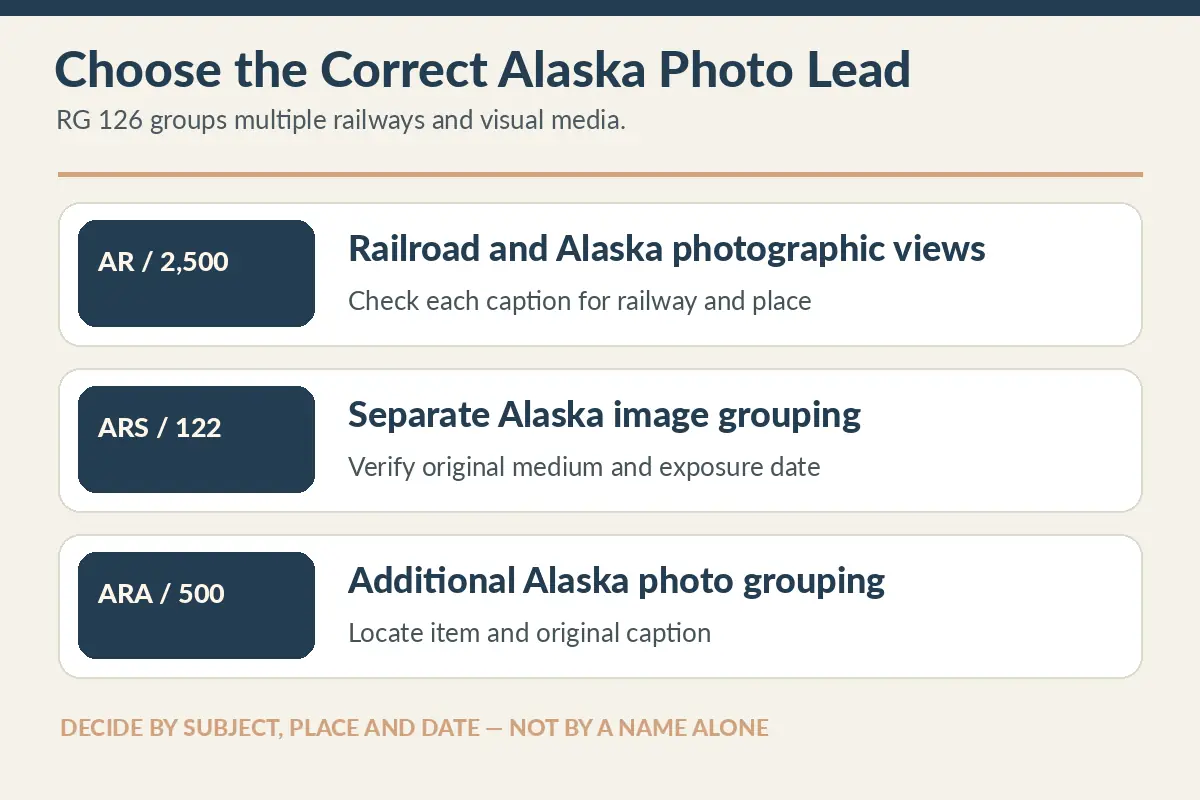
The RG 126 section 126.9 entry gives three photographic designations and approximate image counts. Record them separately instead of totaling them into a single unnumbered album. The guide groups together views of the Copper River Railroad and Alaska Railroad and other subjects, so the presence of a photograph in these collections does not automatically mean it shows the same line. Search image captions by railway, geographic feature, worksite and year and preserve the original series or item number.
An AR or ARA photograph may have been copied or captioned long after exposure, while a lantern slide can be mounted for presentations. Verify the physical format of each item before using the mounting date as a photograph date. The full 1908–1933 series range is not the chronology of one bridge or settlement. If NARA only provides a collection-level description, request the underlying caption lists or item finding aids rather than assigning a location from a generic image thumbnail.
Place a Railroad Photograph on a Historical Route
Railroads changed landscapes through new cuts, bridges, stations, sidings and temporary camps. To locate a scene, compare labeled topographic features, river crossings, track curves and visible buildings with a map close to the exposure date. A modern railroad map may omit construction spurs or earlier names. Verify whether the historical source refers to the Copper River line or the Alaska Railroad before tracing it on a present map; they are not interchangeable projects.
Note the uncertainty of matching a distant mountain or valley from a single camera angle. If a caption gives a milepost, record the precise railway and the date of the milepost system. Other clues include bridge numbering, station signs, rolling-stock markings and worksite equipment, but do not build a precise coordinate solely from an unverified number. Keep a map overlay and the unaltered source image together so that the reasoning can later be reviewed.
Date Construction and Operation as Different Events

A photograph showing graded track, a bridge framework or a camp may document a construction stage. It does not necessarily establish the opening of regular passenger service or the completion of the entire railway. Search dated engineering progress reports, company correspondence, operating schedules or local newspapers if the historical claim concerns when a segment opened or how it was used. A scene with a moving train can establish visible use at the photographed moment without proving a timetable.
Separate the date of exposure from the date that an album was compiled or a lantern slide was prepared. Some views may be reused to tell a later institutional story. When a family letter identifies a worksite during a single season, compare its date to the exact bridge or grading stage rather than the general series range. A document about a nearby settlement might confirm context, but it does not identify everyone visible at a railway camp.
Research Workers, Settlers and Native Communities Respectfully
The guide’s general words “workers,” “settlers” and “natives” are categories in an old archival description, not personal identifications. Do not convert anonymous portraits into employee lists or assume that every person near the tracks worked for the railroad. People in a photographed settlement may include nearby community members, travelers, traders or contractors. Preserve an original caption, explain outdated terminology when necessary, and seek locally grounded evidence about the individuals depicted.
For a claimed railway worker, look for a named payroll, employment letter, crew list, census, local directory, or family correspondence linking a specific person to a place and date. A shared surname or physical resemblance is inadequate. For Indigenous community histories, distinguish the government photographer’s viewpoint from the community’s own records and names. Avoid treating a passing institutional photograph as proof of land ownership, residence or a person’s role without independent support.
Build a Site-Based Archive Request and Proof Table

Use the Still Picture Branch guidance together with the RG 126 inventory. Ask for AR, ARS or ARA materials relevant to a named railroad, station, route segment, geographic feature and approximate date. Include an item identifier if the Catalog supplies one. A request for “all Alaska Railroad workers” is unlikely to locate a single image or a useful textual file; begin with the most specific known worksite.
Maintain a ledger with source caption, series, probable place, confirmed date, visible construction stage, suggested personal connection and independent corroboration. Label the last field “not established” until a named record exists. If a photograph is not digitized, NARA’s ordering instructions call for as exact an archival citation as possible; seek the finding aid and preservation advice before expecting a reproduction. The collection counts do not guarantee complete online availability.
Worked Example: A Bridge Camp in a Family Letter
Suppose a family letter dated 1916 mentions work near an Alaska river crossing, and the researcher finds a photograph of a bridge camp in an AR-series search. First confirm which railway the letter names, then identify the bridge, map position and photograph date. If the picture shows an unidentified crew, it remains a scene of that worksite rather than a portrait of the letter writer. This is a hypothetical method, not an identification of a real RG 126 image.
The next evidence might be a dated employer document, local newspaper, crew roster or another letter with a confirmed work assignment. If none is available, write “the photograph shows the kind of setting described in the letter” rather than “the ancestor worked on the pictured bridge.” Keep construction chronology and employment evidence on different lines of a research timeline. That protects both the historical place and the individual from invented details.
More House and Local History Guides
How We Research These Archival Records
We checked RG 126’s 1908–1933 photographic grouping and separately recorded the AR, ARS and ARA counts. The description covers different railways and a wide range of Alaska subjects; it should not be mistaken for a single continuous project album or a searchable roster. NARA’s still-picture guide supplies retrieval context, not identity verification.
Our approach requires an independently matched railway, location and date before using a scene as family context; name-level conclusions require a separate document. The affiliate disclosure describes site policy. We do not promise that a specific photograph is online or available for immediate download.
The guide describes AR (2,500 images), ARS (122) and ARA (500) for various railroad and Alaska views, 1908–1933.
No. The general entry includes both and other Alaska subjects. Identify each image by its actual caption and series.
Not by itself. It may show a stage of construction; operating records are needed to confirm service dates.
Not without a named contemporary caption or other independent record tying the person to that scene.
Provide RG 126, AR/ARS/ARA as appropriate, place, railway, date and any exact Catalog or item identifier.