
A surprisingly specific WWI research source appears in NARA’s RG 95 guide: an album of 275 photographic prints of military-related work on the properties of wood, dated 1917–1918, designated WR. These images may document apparatus, samples, workshops and laboratory practices. The collection is not an inventory of equipment accepted by the Army, a roster of researchers, or proof that a depicted experimental material reached a battlefield.
The Forest Service guide also lists correspondence and later research reports covering such subjects as kiln drying, adhesives, wood fireproofing, shrinkage control and wood chemistry. Those textual records can help explain why an experiment was conducted, but their dates are not interchangeable with those of the WR album. The correct research sequence goes from photographed setup to a dated test report, then—if the question warrants it—to procurement or deployment evidence and a named personal record.
Start With the 275-Image WR Album, Not General War Photos
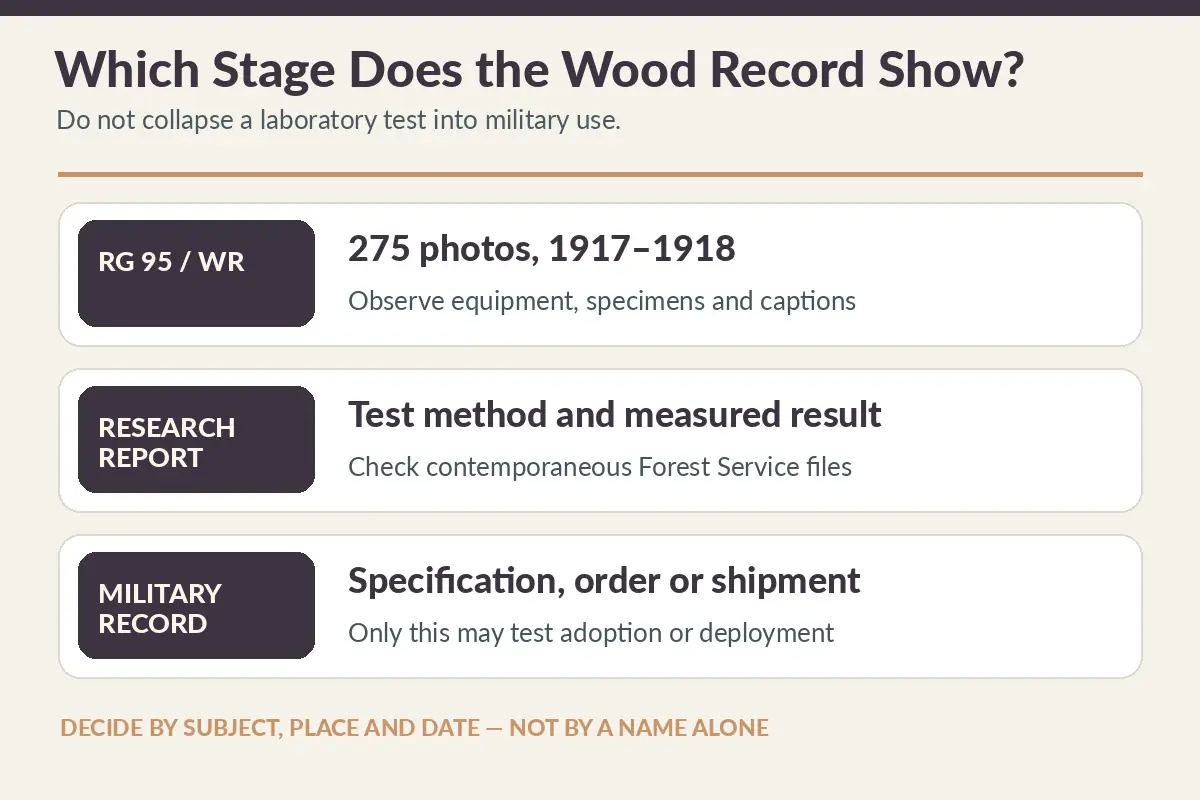
Use the RG 95 Forest Products Laboratory and research-unit description to locate the album. Record “WR,” 275 photographic images and 1917–1918 as inventory information. A search for “wood tests WWI” might return much later product photographs, unrelated government patents or publicity stills. Keep the archival series and original caption in view while reading individual images. Ask whether the album contains negatives, separate captions, numbered pages or references to laboratory notebooks.
An archival guide may summarize the whole album in a few words. Do not assume that all 275 photographs show the same device or even the same kind of test. If a copy is available, preserve the page sequence; paired photographs may show before-and-after conditions while a cropped image may remove the identifying apparatus. Photographic dates should be copied from individual mounts or accompanying records, not assigned automatically from the album’s overall date span.
Interpret What a Wood Test Visibly Demonstrates
First transcribe what the image actually shows: dimensions of a test piece if labeled, clamps, load-bearing devices, treatment containers, boards, joints or comparative samples. If a caption says “fireproofing,” that is a lead to a particular experiment, not proof that the treated wood passed any military requirement. Record the test setup and any scale markers, and distinguish visible damage from an investigator’s measurement or technical conclusion.
Look for the original protocol: species and condition of the sample, moisture content, applied forces or treatment, test duration, and criteria for success. These attributes may be in textual reports rather than a photograph. Without them, claims about strength or durability are speculative. Even a dramatic shattered beam can show an outcome under specific conditions but cannot establish how a material performed in service. Present captions as descriptions, not engineering certifications.
Separate Research Report, Recommendation and Military Adoption
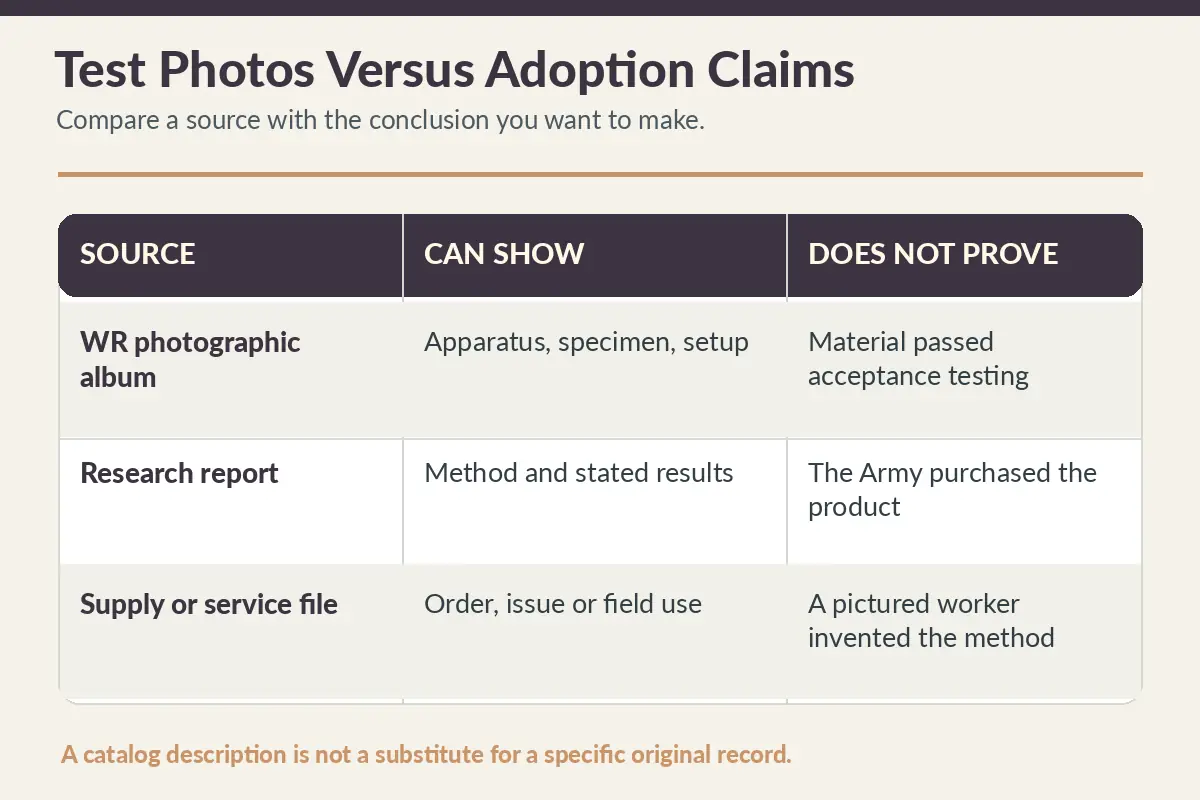
The RG 95 guide identifies research reports and studies extending beyond the war, including material on drying, glues, fireproofing and shrinkage. Search by experiment, report title and date, not simply by the photograph’s generic subject. A report proposing a method is different from a purchasing specification; a military order is different from widespread deployment. An illustrated demonstration cannot bridge those stages by itself.
If the question is whether an adhesive or treated timber was used by a particular military unit, search for dated specifications, supply orders, shipment records and the unit’s records. Avoid attaching that conclusion to a photograph from 1918 when no procurement evidence has been located. A failure to find one order is not proof of nonuse everywhere. State precisely what documents were checked, what claims they support and where the evidentiary chain stops.
Research Laboratory Workers Without Inventing a Roster
A technician’s hand, coat or figure in a laboratory image does not establish name, rank, qualifications or civilian versus military status. The Forest Service research organization included scientific and administrative functions, and not every person photographed must have been an employee. Seek captioned portraits, contemporary staff directories, personnel files, published technical reports with authors, or correspondence naming participants before assigning a role.
A family letter stating that an ancestor worked at a forest-products laboratory can be compared with a confirmed employment record and the relevant project dates. If the person’s name appears on a report, that may establish authorship or contribution but still not presence in a specific photograph. Keep separate claims for employment, project participation and visual identification. Avoid copying a common surname from an unrelated research report into a scenic album caption.
Build an Audit Trail From Image to Technical Decision
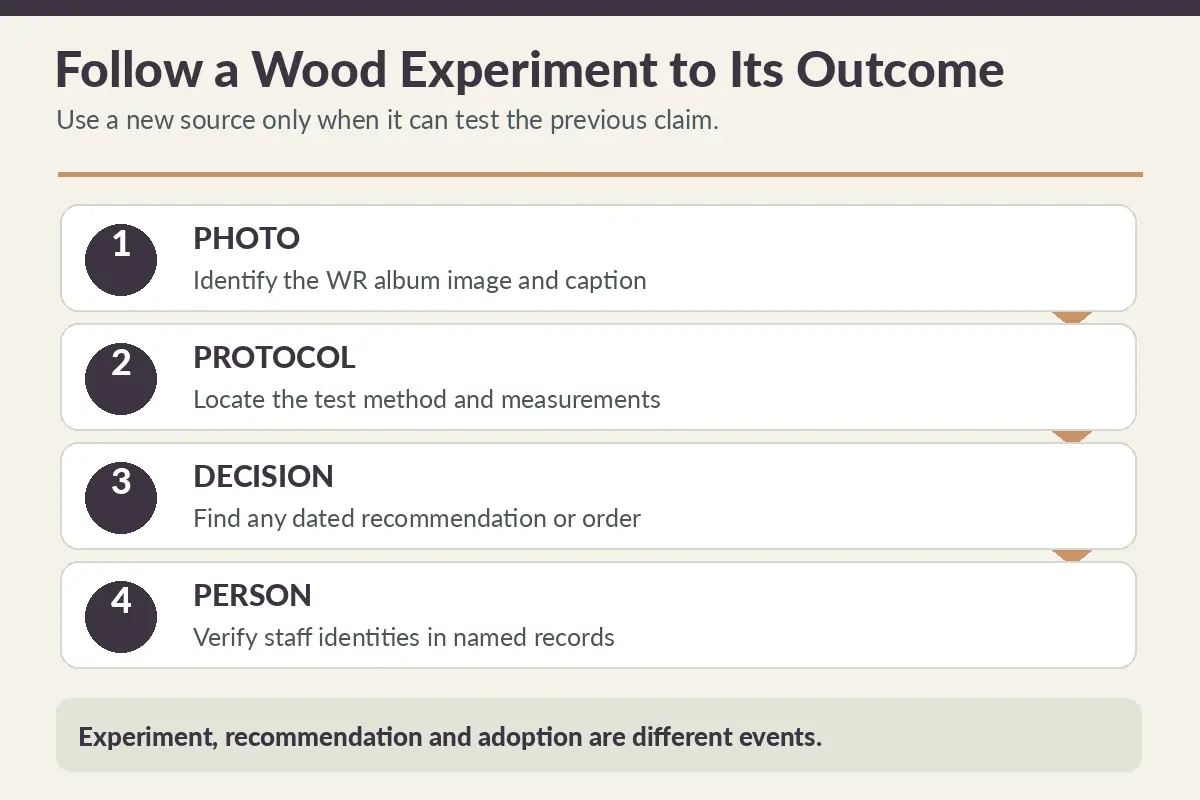
The NARA Still Picture Branch guide and the record-group inventory help locate photographs, but the original image and associated report establish the usable evidence. For each item record RG 95, WR, any image or album-page number, caption, date and the location of the full-resolution reproduction. Maintain separate entries for experiments or reports whose titles are only inferred from labels.
Use a stage-by-stage ledger with columns for setup, tested property, observation, reported result, recommendation and procurement evidence. Mark unsupported stages rather than filling them with assumptions. If a report describes a later experiment on the same subject, identify it as a later source instead of treating it as the caption of the 1918 image. This is how to write a defensible history of a wartime research project rather than an appealing but unverified invention story.
Worked Example: A Fire-Treated Board Photograph
Imagine a WR album page depicts two boards beside a laboratory furnace and bears a brief reference to fireproofing. The image may document the presentation of a comparison test, but without the full report you cannot know the treatment composition, test duration or acceptance criterion. Search the related dated research reports and transcribe their stated findings. This is a hypothetical example, not a claim about a particular WR image.
If a family account alleges that a relative devised the process, search for contemporary correspondence, authorship records and dated employment evidence. Even a report bearing a matching surname requires identity checking. If the invention was recommended but no procurement record appears, report the recommendation and the unverified adoption separately. A useful visual narrative can describe the testing environment while leaving the technical and personal questions open.
More Research Method Guides
How We Research These Archival Records
We checked the WR album description in RG 95, including its date range and count, and compared it with the separate textual research categories. The archive lists an album and reports; it does not say that each photo represents a successful or deployed military product. The Still Picture Branch guide supplies a method for locating originals, not a technical verdict.
Our workflow tests claims in sequence: image, procedure, measured result, recommendation, procurement and individual role. The affiliate disclosure explains policy; no paid technology or research service is implied. Technical details must come from the actual contemporaneous report, not from an artist’s recreation of laboratory equipment.
NARA lists 275 photographic prints in an album of military-related wood-properties research dated 1917–1918.
No. A valid performance conclusion requires a documented method, measurements and an original report.
No. Procurement and operational evidence are separate from laboratory experiments or recommendations.
Only with a documented caption or other independent named record connecting the person to the image.
Begin with RG 95 research correspondence and reports, then request specific item and file references through NARA.