
The National Archives guide to RG 97 describes thousands of photographs relating to dust explosions, fires, fire prevention, tests and exhibits, including G and M series material from 1878–1941. A dramatic cloud in a laboratory image might depict a controlled experiment rather than an accident at a factory. Before connecting any photograph to a family member, local mill or disaster date, establish the kind of activity shown and the caption’s documented provenance.
Industrial safety images are valuable precisely because they record equipment, demonstrations, teaching methods and institutional concerns. Yet one picture cannot disclose the complete sequence of a workplace accident or the names of people outside the frame. Treat the descriptive title and visible content as separate forms of evidence. If your research begins with a local newspaper account, search for matching site and date information before claiming that an RG 97 image illustrates that incident.
Find the G and M Series Descriptions
RG 97 includes photographic material on dust explosions and fire prevention. Record the series designator, any image number, caption, source date and image format. The broad guide entry is not an item-by-item index, and its date range should not be mistaken for the dates of each test. Search with distinctive equipment names, institutional names and subjects as well as the term dust explosion. A photograph called “test apparatus” may be more relevant than an image titled with a sensational description.
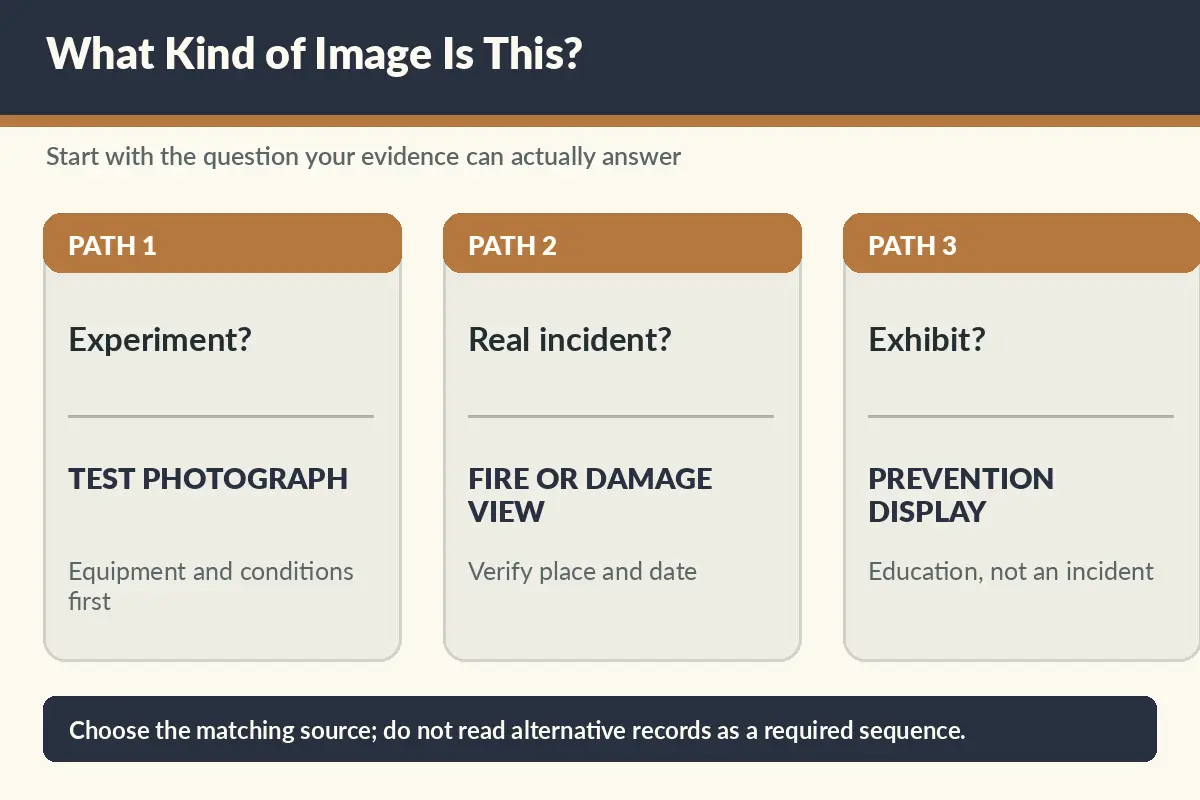
The series description includes tests and exhibits as well as fires. These are different historical objects. A display may show a model building or a demonstration poster. A laboratory test may use conditions unlike those in a working grain elevator or mill. Examine the surroundings: instruments, barriers, controlled apparatus and spectator positioning can be clues, but such visual clues alone do not establish the purpose without the written record.
Distinguish Demonstrations From Industrial Losses

For each image create a classification field: verified experiment, described prevention exhibit, identified real event, or uncertain. Require supporting caption language for the first three. If a date and location are absent, do not supply them from a visually similar disaster photograph online. A fire or explosion may have been recreated for training. Likewise, a sequence of staged images may show different phases of one experiment rather than multiple catastrophes.
Avoid using a general photograph to quantify casualties, determine an ignition source or prove blame. Those claims call for incident investigations, official reports and, where available, coroner or workplace records. Modern safety terminology should not be imposed uncritically on an old caption. When the underlying activity is uncertain, describe the photograph’s visible apparatus and the words printed by the archive, then explain what remains unknown.
Read the Machinery Without Naming Workers

A photograph can depict hoppers, ducts, enclosed equipment, mills, grain handling or test chambers, but these observations need careful terminology. Do not identify a workplace from a single shape or assume the clothing of people in the frame reveals their occupation. A person operating equipment in a demonstration could be a researcher, technician or employee. Their identity must be established from a caption or separate record, not posture or appearance.
If a relative worked at a flour mill, separate three questions: Did that person work at the mill? Did the mill suffer an incident? Does this photograph represent that incident? Payroll, directories and union or company records may answer the first; local reports the second; a securely identified photograph the third. All three links are required before writing an image caption that names your relative or places them at an event.
Make a Source-and-Image Comparison Table
Record exact dates, locations, series references, visible features and claimed event type for each candidate photograph. Beside that place any local newspaper, fire department report or company record. A mismatch in building architecture, year or agency should be documented rather than excused as an archival mistake. Consider whether the original image was cropped, retouched, copied or printed after the event.
When several photographs have similar scenes, preserve the separate identifiers. An exhibit may contain a picture of a historical accident; the exhibit photograph is still a different object from the original incident image. The same scene can circulate in publications without its first caption. An evidence table keeps those layers from collapsing and helps future researchers revisit your interpretation without starting the search again.
Request Reproductions and Write Safe Captions
Use the NARA still-picture reproduction guidance to prepare a request with RG 97, series, box or folder if known, and a unique item identifier. Search the Catalog for both the local identifier and the descriptive title. Guide-level mention of photographic holdings does not certify that every print has an available digital copy or a complete caption.
Caption only the evidence you have. “Dust explosion demonstration, source identified as RG 97” is different from “Explosion at the Miller family factory in 1910.” If the second attribution cannot be supported, omit it. Record any enhancement, crop or colorization separately from the original. This protects both the accuracy of the family history and the integrity of an image that might later be reused in a local exhibit.
For an exhibit or a family website, retain the original caption text in your research file even when you write a simpler public caption. A modern title such as “factory explosion” may have been added by a republisher and can mislead readers about the underlying photograph. If an image contains a teaching model, distinguish the scale model from the industrial plant it illustrates. If a photograph is part of a numbered test sequence, do not omit the sequence number when discussing its order. A separate source note should give the archive, series, item identifier and your reasons for treating the view as a demonstration, an incident or an uncertain subject. That transparent method makes later corrections straightforward.
More Research Method Guides
How We Research This Record Series
Our method begins with the official NARA record-group guide, checks the Catalog search instructions for description levels and uses reproduction guidance where item citations are needed. The years and categories here describe the holdings documented in the guide; they do not promise complete online digitization, named people, or uniform local coverage. We distinguish what a document states, a testable inference, and an unverified claim. Our affiliate disclosure explains site policy; these public archive links do not represent a paid partnership.
Some material concerns fires, but the same series description explicitly includes tests and prevention exhibits; classify each image individually.
The general RG 97 still-picture entry covers 1878–1941, while individual photographs have their own dates.
Only when an archival caption or independent person-level evidence supports the identification.
Begin with item-level caption and context, then compare apparatus, date and site with independent incident evidence.
Provide RG 97, G or M series if applicable, the local identifier, and any known caption or box information.