
Start With the Negative Identifier, Not a Family Guess
The National Archives describes a discrete set of 750 photographs relating to Thailand in 1951–1953 within Record Group 166, records of the Foreign Agricultural Service. The guide calls the photographic group series T and says it includes agricultural practices and products alongside urban and rural life, culture, industry, trade and transport. These are not a register of every farm or family in Thailand. A photograph might depict a rice-field operation, a market stall or transport equipment while providing no verified personal names at all. Begin by finding the image’s series and identifier instead of identifying a relative from resemblance or regional dress.
If a family holds a printed image believed to derive from a government album, examine its reverse, edge markings, credit lines and any retained caption. Record those details separately from oral attribution. The printed year may reflect publication, copying or caption preparation rather than the instant of exposure. Do not infer that everyone visible is a farmer or that a scene was recorded for an ethnographic purpose merely because it appears in an agricultural archive. The creating agency’s documentary purpose is part of the evidence and must be stated accurately.
Separate Thailand Series T from Other Geographic Coverage
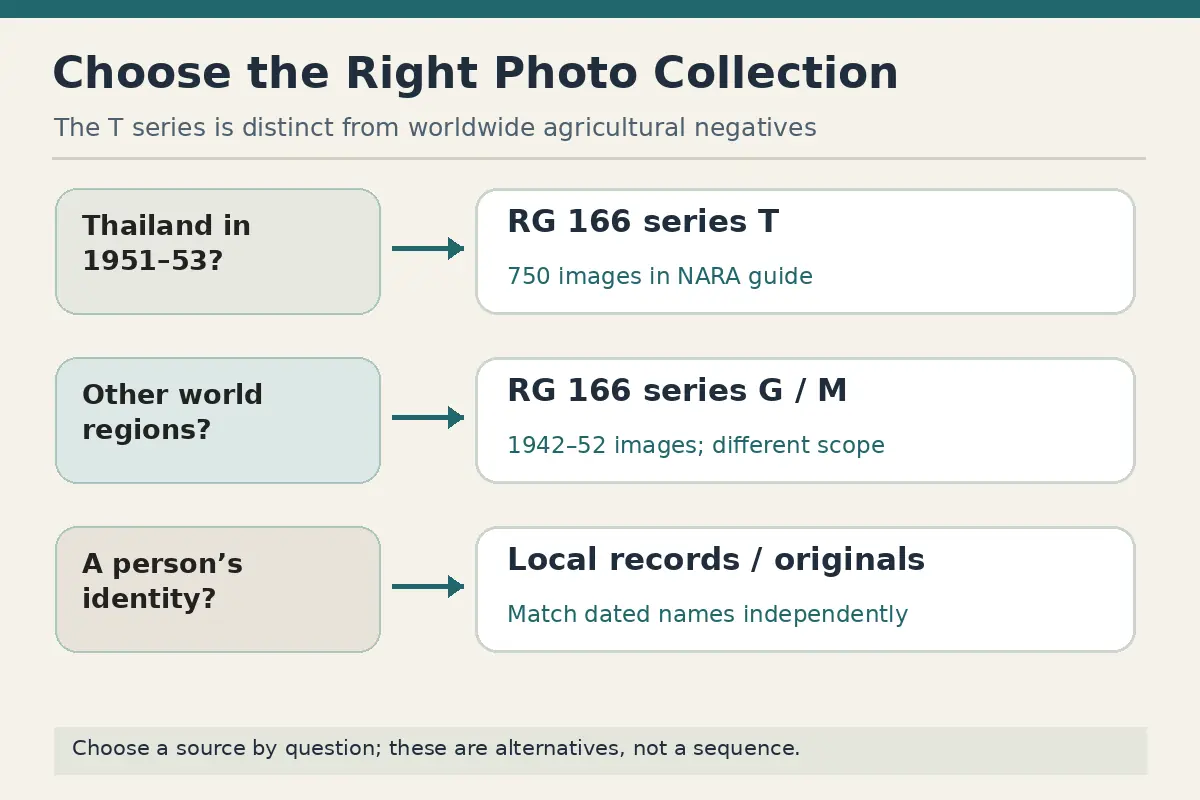
RG 166 has more than one photographic path. Section 166.7 identifies series T images of Thailand, 1951–1953, and distinct series G and M negatives of agricultural practices in Central and South America, the Caribbean, west and east Asia and Africa, 1942–1952. Those global descriptions do not authorize placing an unidentified G/M image in Thailand. Choose the series on the basis of the archival label and original citation, not on the appearance of a crop or landscape. Keep a record of where the reference was obtained and what geographic certainty the description provides.
The date spans are holdings descriptions, not proof that the Thailand sequence contains a photograph for each month, province or village. A 1953 negative may depict a subject whose physical setting was older or whose caption was prepared later. Ask for an item-level caption or finding aid before drawing a precise date. If only a broad folder title survives, say “attributed to” rather than “photographed at” when making local-history claims. Compare local place-name spellings without assuming transliterations from different periods are identical.
Read the Photograph as a Layered Primary Source
A useful image log records exactly what is visible, what an original annotation says and what the modern researcher thinks it may mean. For example, “two people beside a plow” is an observation; “the photographer described a demonstration farm” is an attributed caption; “this is my grandfather in Chiang Mai” is a hypothesis needing a separate identity chain. These belong in different fields. Physical equipment can be altered, reused or posed. Clothing and body appearance do not establish nationality, ethnicity, religion or family relationship, and should never serve as the sole basis of such labels.
Look for landmarks, building outlines, agricultural implements, transportation, vegetation and camera orientation that may be compared with dated local records. But beware overinterpretation: similar paddies and workshops exist across many provinces, and a government photographer might have selected an unusual demonstration setting. A photo of a person using equipment proves that the action was represented in the frame; it does not establish their employment contract, daily life or usual occupation. When original labeling uses outdated names or descriptions, preserve a literal transcription and clearly attribute the language to its creator.
Request a Precise Still-Picture Citation

NARA’s still-picture request guidance asks researchers to provide record group, series, applicable box or folder and a unique item number. In the National Archives Catalog, both a National Archives Identifier and a Local Identifier may be important. Do not send a reference request that says only “Thailand 1952” if a more precise image code is available. Note whether the digital file is a photograph of a print, a scan of the original negative or a derivative copy. Different versions may have cropped out identifying marks or a caption.
If a website shows an image without citation metadata, trace it to the archival collection before assigning provenance. A watermark or institutional logo on a modern copy does not prove that the visible caption was part of the original. Check reproduction permissions and any description of restrictions separately from research access; public availability of a thumbnail does not resolve every use question. Keep a copy of the item-level description, your retrieval date and the exact words of any archive-supplied identification.
Correlate Place Claims With Independent Local Evidence
A plausible location can be tested using contemporary road maps, local government publications, dated market or industrial reports and credible community histories. Choose sources that belong to the same time window, and state whether they actually show the named site. A modern place of the same name might occupy a changed district boundary. If an image shows an institution sign, record its visible letters and confirm the institution in a period directory. Avoid interpreting an English administrative label as the name used by the local community without checking local-language evidence.
If someone is named in the original caption, that name still needs an identity test. Compare available dates, workplace or affiliation, documented residence and family details; verify whether the photographer’s informant knew the subject or whether the caption was copied from another source. An unknown person may remain unknown, even if the place is established with high confidence. Recording that difference protects individuals and gives readers a clear explanation of the archival evidence rather than a visually compelling but unsupported attribution.
Publish a Responsible Finding Without Fabricated Details

A defensible result might state that an image in RG 166 series T depicts an agricultural scene identified by the archival caption as being in Thailand during the 1951–1953 series span. A narrower claim, such as a precise province, named worker or exact crop variety, requires the original item and supporting evidence. Where item metadata has not been inspected, state that limitation plainly. Do not imply the entire series is searchable by every person’s name, and do not promise that all 750 images are available as web previews.
For family history, keep a final table with the historical image identifier, documented caption, visible features, independent comparisons, unresolved alternatives and the next archival question. If nothing corroborates a remembered face, the careful conclusion is “identity unconfirmed,” not a guessed name. A caption may also reflect the viewpoint of a foreign government agency rather than the subjects themselves. Including that provenance and, where possible, local voices produces a more faithful account of an agricultural photograph and its limits.
More Research Method Guides
How We Research This Archival Question
We checked the archival description for RG 166 and its relevant series, then distinguished what the official source explicitly documents from what a researcher might infer. The date spans on this page describe the listed holdings or survey, not a claim of complete digitization or coverage for every locality. We assessed each map, report, directory or inventory at the level of the individual item needed for the research question, rather than treating a series heading as a personal record.
We also compared this route with the relevant repository access guidance and use the National Archives Catalog guidance when a particular file unit or digitized image remains to be located. Evidence limits, alternative explanations and missing dates are named rather than silently filled. Our informational articles contain no confirmed affiliate offer; our affiliate disclosure explains the site policy.
The RG 166 guide identifies 750 photographic images in series T, dated 1951–1953.
No. G and M cover several world regions in 1942–1952 and require a separate item-level geographic check.
No. Visible attributes alone cannot reliably establish a person’s identity, ethnicity or employment.
Provide record group, series, item identifier and, where shown, the Catalog Local Identifier and NAID.
No. Inspect the original caption and item-level metadata before claiming a specific day or place.