
The National Archives guide to RG 208, section 208.3.5, describes 1,350 photographic prints of Black Americans in government, industry and the armed forces during 1941–1945. The collection code is NP, and the records sit within the Office of War Information’s News Bureau materials. These photographs can document how wartime public information depicted particular people or occupations. They do not form a complete national roster, and neither an image nor a caption automatically establishes a person’s entire employment or military history.
The archive’s historical description uses dated terminology; this guide uses “Black Americans” in reader-facing prose while preserving archival series titles when citing them. Researchers should be alert to selection and representation: a publicity photograph may have been chosen to illustrate a message rather than provide an unbiased statistical sample. The right approach is to identify the original item, check how it was captioned and distributed, and verify person-level claims with independent records.
Find NP Prints Instead of Artwork or Poster Proofs

In the same RG 208 area, NARA lists COM drawings and cartoon mockups, a separate collection including work associated with Charles Alston, as well as PM poster proofs. NP is the group of 1,350 wartime prints of Black Americans, not a code for every wartime image or every Black American art object. Search by RG 208, NP, the historical News Bureau heading, and place or subject terms. Keep the photographic medium distinct from a drawn image or a printed advertisement even when they address similar subjects.
The listed years 1941–1945 are the collection’s descriptive span; they do not necessarily give an exact day of exposure to each photograph. Item captions or negative identifiers may supply more precise dating. If an image appears on a third-party site without its original identifier, establish whether it belongs to the NP group before repeating that attribution. A title derived from a later photograph agency may not match what wartime staff wrote on the original print.
Read the Caption and the Image as Different Claims

Examine the original print and any caption card, backstamp or linked release notes when available. Separate what is visible from what the caption asserts. A photograph might show a person operating machinery, but a caption’s name, job role or factory location should be treated as a documented attribution only after its provenance is checked. A posed demonstration may not represent normal duties. Clothing or equipment alone may be insufficient to identify a specific military branch or skilled occupation.
Transcribe names and titles as written, including initials and uncertain handwriting. Then note possible inconsistencies with a contemporary directory, muster roll or labor record. Do not discard a conflicting source merely because the photograph is compelling. A photo of several workers at a plant does not establish that all were permanent employees; some could be visitors or trainees. Similarly, a uniformed sitter need not have served in a theater suggested by a wartime publicity caption.
Understand the Office of War Information Context
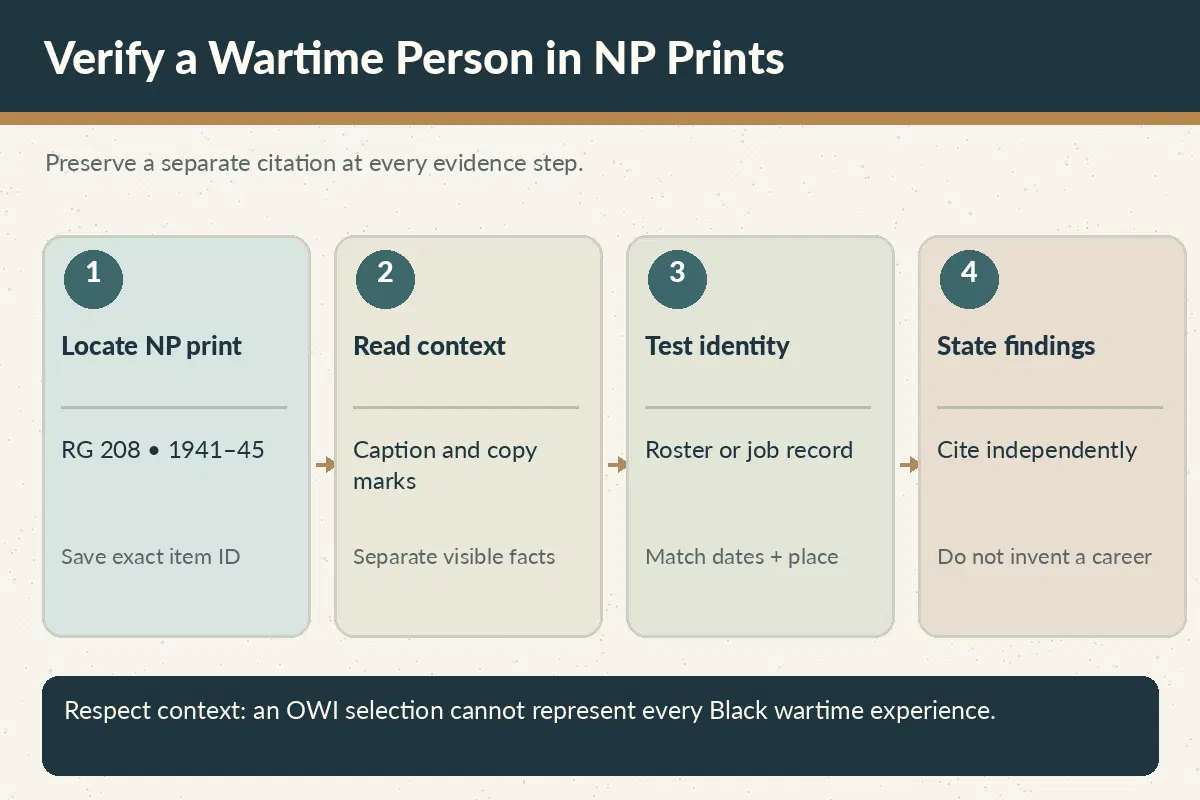
The Office of War Information was involved in wartime communication and publicity. A News Bureau photograph may reflect that mission, but the existence of a photograph does not prove a particular newspaper printed it, that an audience saw it or that its framing was representative of all Black wartime experiences. The selection of subjects, angles and titles can emphasize certain achievements or institutions. Distinguish the photograph’s documentary value from the claims of a government publicity narrative.
If you want to establish distribution, seek dated press releases, newspaper issues, magazine pages or records of the photo’s use. Match image crop, caption text and publication date rather than assuming all printed versions were identical. If the government caption uses language now considered outdated, preserve exact words only when necessary to analyze the source and explain that wording in context. Treat the people represented as historical individuals, not anonymous illustrations for sweeping social claims.
Corroborate a Named Worker or Service Member
For a civilian, check city directories, personnel files if available, union records, company reports, census schedules and contemporary community newspapers. For military subjects, seek service or assignment evidence appropriate to the period and branch, taking privacy and archival access limits into account. A name common in a particular community may match multiple people. Compare age, location, unit or employer and date before declaring that a person shown is a family ancestor.
A photographed role is not a full employment timeline. A factory image dated 1943 might depict training rather than a long-term job; an aircraft or ship in the background does not prove service on that vehicle. A caption giving a rank at a particular date does not establish promotions before or afterward. Keep the identity conclusion and the work or service conclusion in separate lines, each citing the strongest direct evidence. Avoid inferring family relationships from two people pictured together.
Search by Workplace, Unit, Place and Caption Text
The National Archives Catalog may be searched with NP, RG 208, a known wartime employer, military unit, city or original caption phrase. Use collection-level searches if no name results appear. The RG guide does not guarantee all 1,350 images are digitally available or transcribed for surname searching. A lack of hits therefore says little about whether an individual was photographed or employed. Keep exact item titles and identifiers for promising results.
For an undigitized image, use NARA’s reproduction guidance and provide the record group, News Bureau NP set, dates, location and item number if known. Inspect the full print rather than reposting an uncited crop. If a family collection contains a similar photograph, compare the physical print, photographer marks and annotation dates before claiming it is an official OWI image. Similar themes or poses do not establish common provenance.
Publish Responsible Identifications and Citations
A reliable write-up distinguishes five things: the source image, the visible action, the original caption, independent confirmation of a person’s identity, and the limits of any claim about work or service. Cite National Archives RG 208 and the NP item identifier where possible; add precise citations for corroborating service, employment or publication sources. The image may be historically powerful even if the depicted person remains unidentified. Do not invent a biography to make a caption more emotionally complete.
Keep an unaltered archival reproduction and separately labeled enhancements or cropped versions. If colorization or contrast adjustment changes small details, retain access to the original pixels. Note when an identification comes from a later researcher rather than a contemporary caption. This evidence chain respects both the archival record and the people whose wartime labor and service it may depict, while allowing readers to verify what has actually been established.
More Research Method Guides
How We Research These Federal Holdings
Our starting authority is the National Archives RG guide, especially section 208.3.5, which supports the specific dates and record categories described above. We then use NARA’s Catalog instructions to distinguish record-group, series, file-unit and item descriptions, and consult its reproduction guidance if an item is not available online. The guide is an inventory, not a complete transcript, digitization guarantee, individual name index or certification of a family connection. Each statement about a named person needs independent support and a traceable document citation. The site’s affiliate disclosure explains our editorial and relationship policy; the public archive links here are not claimed as paid partnerships.
NARA lists 1,350 images of Black Americans in wartime government, industry and armed forces, 1941–1945.
No. NP photographs, COM drawings and PM poster proofs are separately described material in RG 208.
No. Locate a specific dated issue or publication record to establish distribution.
No. Verify the identified person and the relevant assignments in name-bearing independent documents.
Preserve the original terminology only when needed for accurate citation or source analysis, and explain it in its historical context.