
The National Archives guide for Record Group 33, section 33.4.1, describes 37 Extension Service photographs of school lunch programs dated 1939–1944, marked SL. That small, targeted group can illuminate wartime-era food service, school facilities, and public education work. It is not a complete photographic census of schools, a list of 37 lunchrooms, or an enrollment record naming the children who ate there. Begin by locating an item and reading its original caption rather than assuming the series title identifies a town or pupil.
A family historian may recognize a school building or remember an ancestor receiving a meal in the 1940s. A general federal program photograph is a valuable historical illustration, but an exact match needs more. Keep separate questions for the school’s identity, the date of the scene, the program described, the people pictured, and actual pupil attendance. A photograph of a child at a table does not establish that the child attended the pictured school every day or came from a particular household.
Use the SL Code Instead of Broad Extension Service Photography
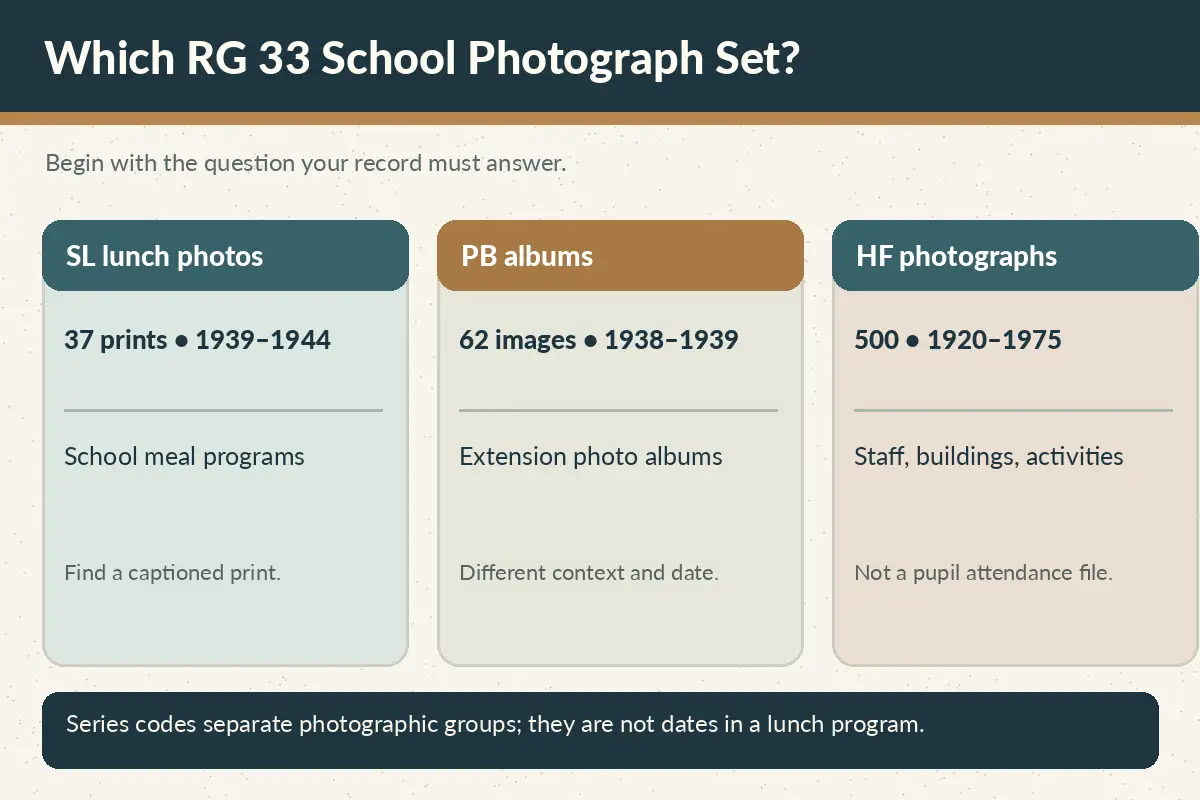
The RG 33 guide groups still pictures under several labels. SL contains 37 school-lunch-program prints, 1939–1944. PB identifies 62 photographs in Extension Service albums titled “Pix” and “A Look at Extension Work,” dated 1938–1939. HF covers about 500 photographs of staff, activities, early agriculture buildings, and miscellaneous subjects over the much broader period 1920–1975. If the question is a wartime school meal, begin with SL, then search the other sets only if their subject and date plausibly fit.
Do not treat the three designations as a chronological program history. They are described photographic groups with different subjects and sizes. A 1939 album print does not automatically show a precursor of a 1944 lunch photograph, nor does the group title prove direct federal operation of every photographed lunchroom. Capture each item’s code, original title, date statement, and creator as provided. If two agencies share similar images, trace which reproduction or original negative the repository actually holds.
Read the Lunch Scene Without Inventing a Menu
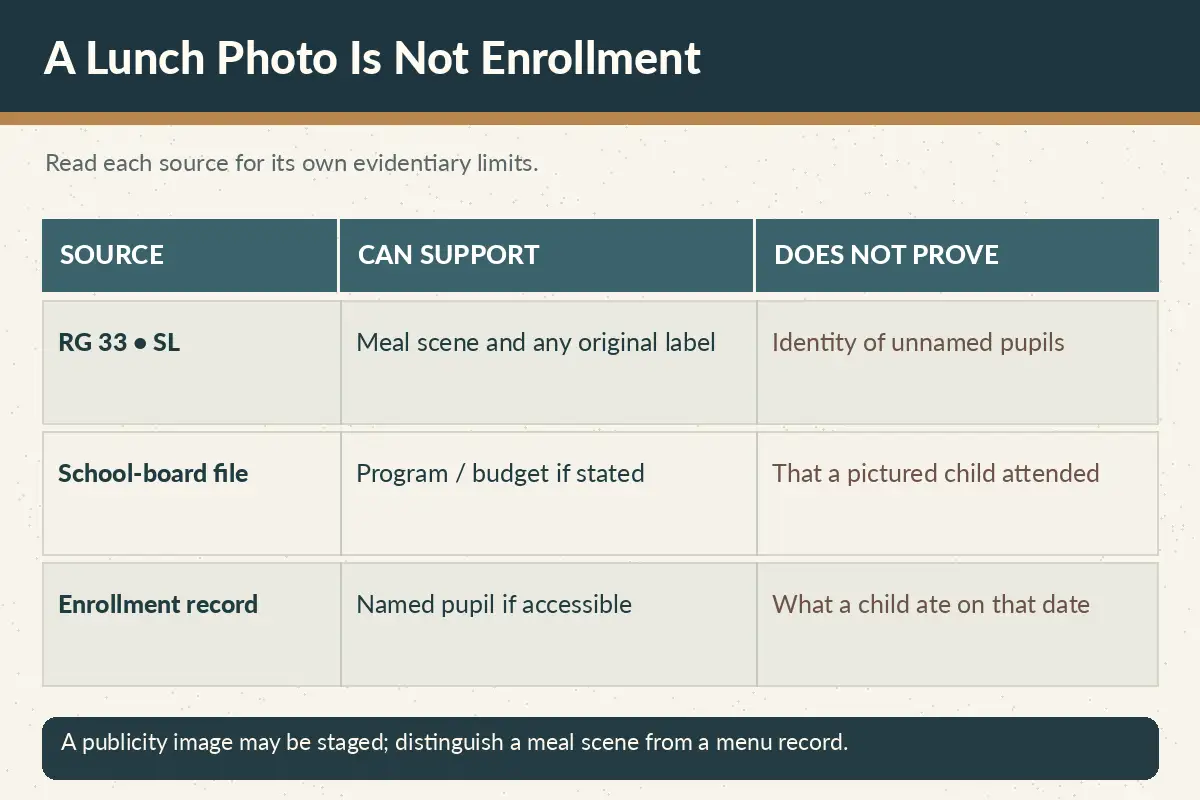
First describe visible evidence: tables, dishes, serving lines, kitchen equipment, a dining room, staff uniforms, posted signs, and the number of visible people, without converting uncertain details into precise statistics. A plate that appears to contain vegetables may not allow a reliable identification of the full menu or portion size. The archival caption may state a demonstration, training exercise, or program objective. Keep its claim separate from what the image alone proves, and date the caption when possible.
A staged photograph can still document equipment, messaging, and social expectations, but it may not represent a typical meal. A publicity claim about nutrition does not establish individual health outcomes, food consumption, or attendance. When students or staff are shown, do not assign names based on visual resemblance or age. Copy the full frame and any reverse annotations; later photo crops or retouches might hide signage that identifies a particular school, as well as contextual information about how the image was used.
Find the School and Check the Date Independently

If the caption identifies a county or school, test it against contemporary school board minutes, district maps, directories, yearbooks, and locally held school photographs. School names and boundaries change, and a 1940 caption may refer to a rural school later consolidated into a different district. Compare architecture and road landmarks, but do not make the match solely from a similar facade. A federal series covering 1939–1944 does not establish the exposure date of an individually undated print.
To establish whether a lunch program operated at a named school during a particular semester, seek the school board’s budget, dining records, extension reports, newspapers, or other relevant contemporary evidence. Program existence and one photograph of a meal are not the same claim. If a photo was taken during a demonstration or visit, it may show a service not routinely provided. Note which source documents the institution, which describes the program, and which establishes the particular date.
Separate Photographed Children From Enrollment Records
A school lunch photograph is not an attendance list. Some visible children may be visiting, attending a special event, or acting in a demonstration; the archive guide gives no blanket promise of name captions. For a named ancestor, use an accessible enrollment register, school census, yearbook, family letter, or report card, then compare the individual’s age and location with the photograph’s verified date. The person-level record must be cited separately from the visual impression.
Remember that information about children and families can be sensitive even in historical collections, and modern restrictions can apply to later student files. Follow the repository’s access rules rather than treating a public federal print as authorization to disclose unrelated school records. A face that resembles a family member may suggest where to investigate, but it is not an identification. If the person cannot be documented, label the pupils unknown and focus the caption on the institution or program that is actually supported.
Compare Program Reports With Publicity Imagery
RG 33 also contains Extension Service general correspondence, circulars, and field reports for overlapping years. The inventory does not state that every SL photograph has a matching local report, but those categories suggest search paths when investigating what the Extension Service was doing. Distinguish a photograph prepared to illustrate program activity from the school system’s own records of purchases, operations, or pupil participation. A publicity image can display a preferred practice without proving that every district adopted it.
If a relative described receiving lunches during wartime scarcity, explore dated local newspapers, school accounts, family food records, and relevant county extension materials. Do not use a national 1944 picture to prove a particular 1940 event at another school. Place program evidence and household memory on a timeline, checking whether changes in prices, staffing, or schedules are documented. Where sources disagree, attribute the difference rather than forcing the family account to match a federal photograph.
Cite the Print Without Overclaiming Its Subjects
Search the National Archives Catalog for RG 33, SL, “school lunch,” the possible community name, and 1939–1944. Search by subject and series if surname results are empty. The Catalog describes holdings at several levels and does not guarantee that all 37 SL prints are digitized or fully captioned. Preserve an item ID and ask the repository about the original when needed. Consult NARA copy guidance for reproduction requests.
A responsible final caption might state that an RG 33 SL print depicts a school-lunch-program scene within the described period, with school and date further specified only if supported by the individual item. Add separately cited board minutes or enrollment records for an identified institution or pupil. If the image cannot be tied to the family, use it as explicitly labeled context, not as an ancestral photograph. The strongest family history makes that distinction easy for later readers to verify.
More Family Story and Preservation Guides
How We Research These Federal Holdings
Our starting authority is the National Archives RG guide, especially section 33.4.1, which supports the specific dates and record categories described above. We then use NARA’s Catalog instructions to distinguish record-group, series, file-unit and item descriptions, and consult its reproduction guidance if an item is not available online. The guide is an inventory, not a complete transcript, digitization guarantee, individual name index or certification of a family connection. Each statement about a named person needs independent support and a traceable document citation. The site’s affiliate disclosure explains our editorial and relationship policy; the public archive links here are not claimed as paid partnerships.
NARA lists 37 Extension Service school-lunch-program photographic prints dated 1939–1944.
No such equivalence is stated. PB is separately described as 62 album images dated 1938–1939.
No. Use accessible, dated pupil enrollment, school census, yearbook, or family records.
Not reliably. Visual objects and captions may be incomplete or staged; check contemporaneous meal or program records.
The inventory does not guarantee online copies or student-name indexing. Search the Catalog by series, location, and subject.